12/31/2025
Growing Dahlias
Sean Tarr & Roberto Lopez
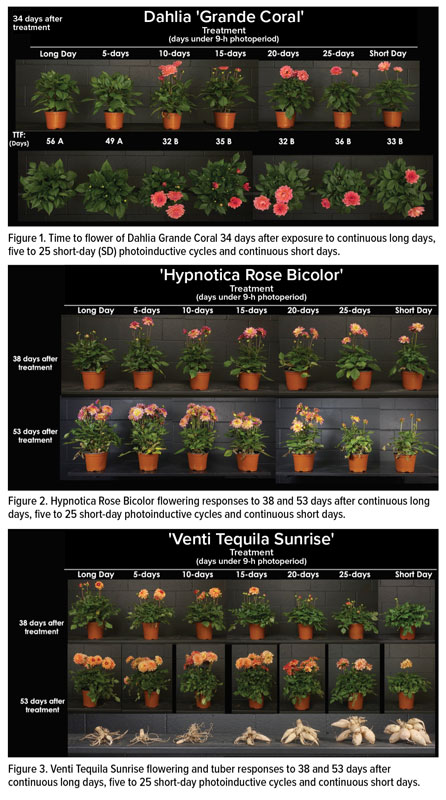
Most dahlia (Dahlia × hybrida) cultivars are facultative short-day (SD) plants, meaning they’ll flower under any daylength, but will flower faster if under short days (daylength less than 12 hours). However, SDs can also induce tuber formation, signaling the approaching cold season and prompting the plant to prioritize tubers for overwintering while reducing foliage and floral growth.
In a previous study, we observed that providing a few SDs to hasten flowering may be effective without the detrimental impacts of tuber formation. In the current study, we assessed how 10 dahlia cultivars from major breeders responded to increasing durations of SDs. We measured the impact on bud number, time to flower, flower number and tuber development.
Study design
In Week 11, rooted cuttings of 10 dahlia cultivars listed in Table 1 were transplanted into 6-in. or trade-gallon pots filled with a commercial soilless substrate composed of 86% peat and 14% perlite. The greenhouses maintained an average daily temperature (ADT) of 70F (21C), a DLI of 15 mol∙m–2∙d–1 and a 20-hour photoperiod. In Week 14, treatments began and plants were placed under photoinductive nine-hour SDs for five, 10, 15, 20 or 25 days or continuous long days (LD) or continuous SDs. The SD photoperiods were created by opening and closing black cloth at 8 a.m. and 5 p.m., respectively. Plants were then returned to a 16-hour LD after their respective SD treatments. The time to first open flower (TTF) was assessed and plants were grown for an additional four to six weeks after the first open flower, at which point we counted the total number of spent, open or flower buds showing color. Additionally, four cultivars were assessed for tuber mass by removing stems and roots from five plants per treatment.
Results
Dahlia TTF: For Grandalia Lavender Ice, Hypnotica Lavender, Hypnotica Rose Bicolor, Labella Grande Coral, Labella Maggiore Deep Rose, Labella Grande White, Darlin’ Abstract Fuchsia, Darlin’ Perfect Red, XXL Cozumel, Starsister Red & White and Venti Tequila Sunrise, exposure to SDs reduced TTF compared to continuous LDs. Of those, providing 10 short days was enough to reduce TTF by three to 24 days (Table 1; Figure 1).
For Dahlietta Rachel, exposure to SDs did not hasten TTF, except for under continuous SDs. Daylength did not affect TTF of Dalaya Yellow+Red Eye, XXL Juarez and Venti Pink+White Eye. Labella Grande Purple did not show a clear response to SDs, but flowered slightly faster under continuous LDs. Similarly, TTF of Labella Medio Raspberry and Dalaya Purple+White occurred first under continuous LDs, with inconsistent increases in TTF with exposure to SDs.
Dahlia flower number: The number of flowers across all cultivars was affected by SD exposure, with the lowest number observed under continuous SDs. This reduction in flower number was significant, with some plants having 12 flowers under continuous LDs down to just two under continuous SDs. Fortunately, this flower reduction was primarily observed in the continuous SD treatment, while some cultivars also exhibited moderate decreases in the 20- and 25-day SD treatments (Figures 2 and 3). For all cultivars, there was no detrimental effect on flower number when provided with five to 15 SDs when compared to continuous LDs, while most cultivars showed an increase in flower number.
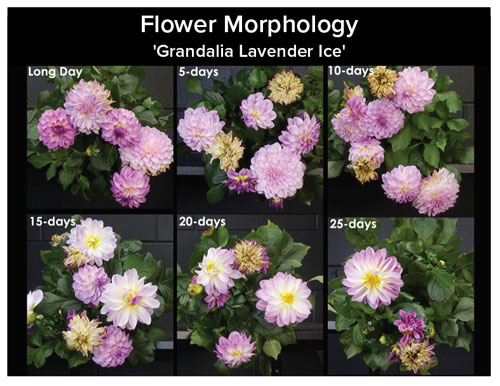 Left: Grandalia Lavender Ice flower morphology after continuous long days or five to 25 short-day photoinductive cycles.
Tuber size: Tubers were present across treatments, but increased with SD exposure (Table 2 and Figure 3). Continuous SD exposure produced the largest tubers, followed by the 25 SD treatments. However, tubers under the 25 SD treatment were 30% to 50% smaller than those under continuous SDs.
Flower morphology: An additional pattern we noticed between treatments was an impact on flower size and morphology. For some cultivars, as the number of SDs increased, flowers were smaller and had fewer petals. Although we didn’t measure this directly, the photos we took clearly show that the same cultivars exhibit vastly different flower morphologies (Figure 4).
Key takeaways
From this study, it appears that we can reduce production time by providing dahlias with a brief exposure to SDs. While the exact response to SDs is cultivar-dependent, we recommend providing 10 SD to an established plant (three to four weeks after transplant) to reduce TTF by approximately three to 24 days. By delivering just 10 SDs, you’ll also avoid the detrimental impacts on flower number, while also potentially increasing flower number as observed in Hypnotica Rose Bicolor, Labella Grande Coral, and Starsister Red & White. GT
Sean Tarr is a Research Technician and Roberto Lopez is an Associate Professor and Controlled Environment/Floriculture Extension Specialist at Michigan State University.
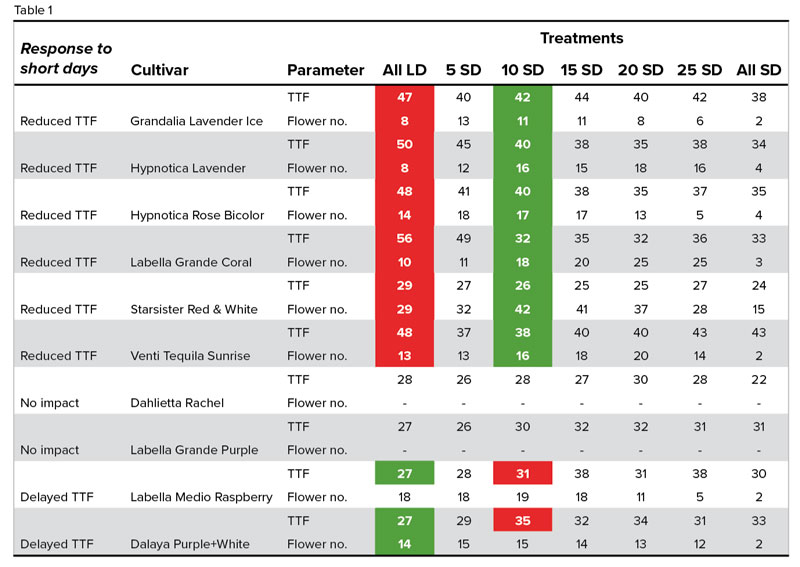
Table 1. Average time to first open flower (TTF) and number of flowers after four to six weeks from TTF after continuous long days (LD), five to 25 photoinductive short days (SD) or continuous SDs for 10 dahlia cultivars. Green highlighted section = reduction in TTF or increase in flower number to plants grown under the red highlighted section.
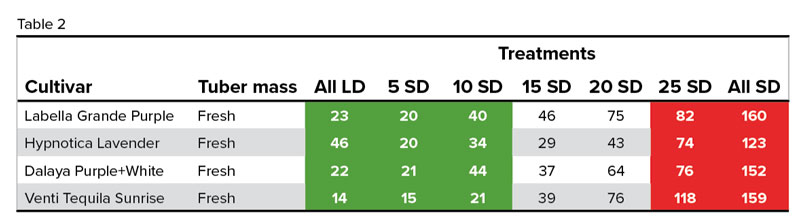
Table 2. Average mass of tubers after continuous long days (LD), five to 25 photoinductive short days (SD) or continuous SDs of four dahlia cultivars. Green highlighted section = a reduction in tuber mass compared to the red highlighted section.