11/28/2025
Growing I’Conia Begonias
Michelle McElhannon
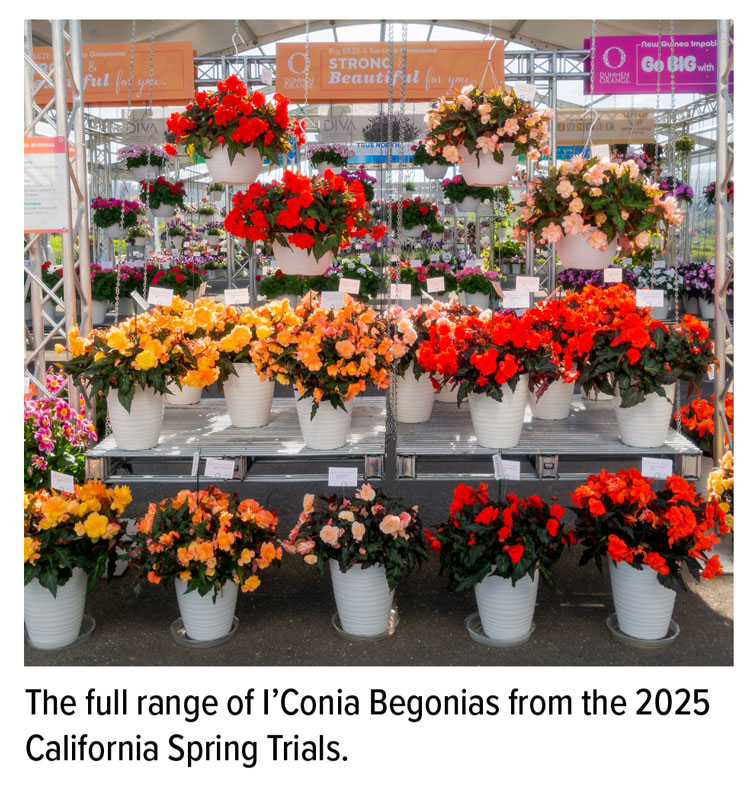
I’Conia Begonias are the most luxurious series of hybrid begonias available for both sun and shade. Bred equally for foliage and flower, these beautiful plants make a dramatic statement in the garden, combination container gardens and hanging baskets. Dümmen Orange offers I’Conia in five distinct families to simplify programming and sizing. A new highlight for 2026 is Bacio Lemon, featuring large, double blooms that promise to impress.
Propagation: Creating a “Goldilocks” environment
Successful I’Conia propagation depends on maintaining a low-stress, “just-right” environment from start to finish. Consistent, steady growth minimizes stress and reduces non-branching (blind) cuttings.
I’Conia cuttings should be treated as priority stick one—unboxed, sorted and stuck immediately. If sticking is delayed, store in a cooler at 54F (12C) for no longer than 24 hours with bags open. Mist in the cooler if cuttings appear dry or wilted. Stick cuttings in 72-cell trays using a well-drained propagation mix (pH 5.6 to 6.2). Water thoroughly before and after sticking, arranging leaves in one direction to avoid covering the growing point.
Avoid mixing I’Conia with elatior begonias, as they require different conditions. Maintain high humidity around the cuttings while avoiding overly saturated media. Fog systems or remay covers are best, but many growers are successful with mist if managed properly. After day one, mist only enough to keep cuttings turgid. Moisture should fluctuate between level 2.5 to 4. Tempered mist is best; cold mist can stress cuttings. Begin reducing mist after three to five days and aim to be off mist by days seven to 10. Removing cuttings from mist will encourage root initiation. Extended misting leads to prolonged callusing rather than root growth. Once liners are weaned off mist and roots form, feed moderately (150 ppm N) with a balanced fertilizer containing micronutrients.
Maintain consistent air and root-zone temperatures of 70 to 75F (21 to 24C). Provide high-quality light and a 16- to 18-hour photoperiod for optimal growth and branching. Lighting that rides on a boom is not adequate for I’Conia daylength extension. Higher light and/or better light penetration will reduce non-branching shoots. Liners that are too tight in the tray receive insufficient light and may become blind.
Pinching is optional. If performed, pinch softly between the 3rd and 5th node—pinching too high or low increases blindness risk. Once roots are established, Configure (Benzyladenine 2%) at 100 to 150 ppm encourages branching. Florel (Ethephon 3.9%) at 150 to 200 ppm can also encourage branching and remove buds, but must be used cautiously due to I’Conia’s ethylene sensitivity. To tone liners and control stretch, apply Cycocel (Chlormequat 11.8%) at 250 to 350 ppm once or twice, or at lower rates more frequently.
Implement a preventative fungicide rotation for Botrytis within one to two days after sticking, repeating every seven to 10 days. A preventative insecticide or biological control program is also advised, particularly against broad mites. Visible damage often appears too late for correction.
Growing on
Rooted liners are typically ready for transplant within three to four weeks and should be transplanted on time to prevent blindness from stress. When transplanting, orient the largest leaves outward for a balanced habit. Use a well-drained media (pH 5.6 to 6.2). Maintain 68 to 75F (20 to 24C) days and 65 to 73F (18 to 23C) nights, gradually lowering to 65 to 75F (18 to 24C) days and 55 to 60F (13 to 16C) nights as plants establish. Day temperature can be lowered to match night temperatures in the final weeks to tone plants and enhance color saturation.
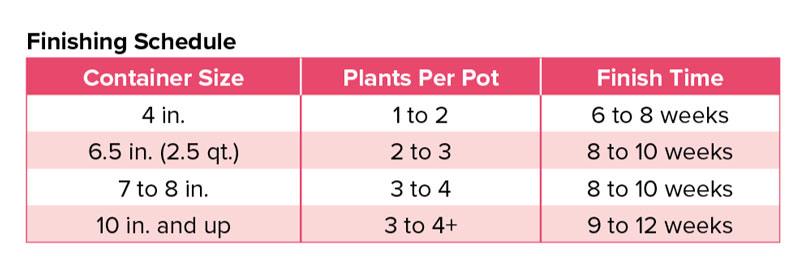 Provide moderate light (300 to 500 f.c./32,000 to 54,000 Lux) and a 14-plus hour photoperiod throughout production, ideally 16 to 18 hours. Acclimate plants slowly to new environments to avoid stress.
Keep plants moderately moist for best results. Fertilize with 150 to 250 ppm N and maintain an EC of 0.5 to 1.5 mmhos/cm (SME). Proper water management is your best growth control tool—moisture cycling promotes compact growth, but avoid excessive drying. For additional growth control, apply Cycocel (Chlormequat 11.8%) at 300 ppm or a tank mix of Cycocel 250 ppm plus B-Nine (Daminozide 85%) at 1,000 ppm.
For further technical guidance on growing I’Conia Begonias, contact Dümmen Orange Technical Services at Tech.NA@DummenOrange.com. GT
Michelle McElhannon is a Technical Specialist for Dümmen Orange.