7/28/2016
Pallin’ Around with Paul
Jennifer Zurko
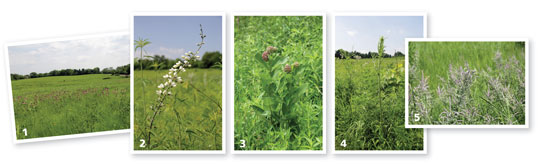 Schulenberg Prairie, Morton Arboretum
Lisle, Illinois
Schulenberg Prairie, Morton Arboretum
Lisle, Illinois
Named after Morton staff member Ray Schulenberg, the idea to restore 8 acres of prairie on the arboretum’s grounds started over 50 years ago. At the time, it was only the fourth attempt in the whole country to try and save the native eastern tailgrass that was disappearing across the Midwest.
The first seedlings were grown in the arboretum’s greenhouses and planted directly into the ground, while the wind helped spread more seeds in surrounding areas. To help the prairie grow and keep the nutrients in the soil, staff sets controlled fires, which they’ve been doing regularly since it was first planted.
Although it’s carefully monitored for invasive species and is well-cared for, the arboretum admits that the Schulenberg Prairie isn’t as diverse as a normal natural prairie would be. It has a lower proportion of grasses with more summer-blooming plants than spring ones. This may be because of how and when the different parts of the prairie is burned. Regardless, it’s quite a sight, with 100 acres of grasses, wildflowers, native perennials and oak trees you can literally get lost in.
1 Among the expanse of green, you can see dots of color, including tons of echinacea.
2 Baptisia alba was starting to sprout all over the prairie. Paul said he’d never seen so much of this type of baptisia in one place.
3 One thing Paul was very excited about seeing was the different species of asclepias, a staple for any prairie that welcomes pollinators.
4 Silphium lacinatum, which looks like a really tall weed to me, but probably because the large yellow, daisy-like flowers hadn’t bloomed yet.
5 Veronicastrum (one of my favorites in the prairie).
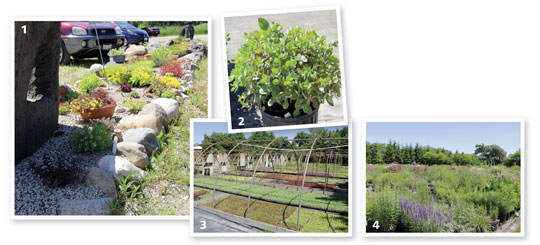
Intrinsic Perennial Gardens
Hebron, Illinois
Renowned perennial plant breeder and author Brent Horvath comes from an entrepreneurial family—in the 1980s, his father owned a garden center (which also was called Intrinsic) and his mother had a florist shop. In 1991, Brent bought 23 acres of land in Hebron where they grew the perennials they sold in the garden center. Now, Intrinsic produces mostly wholesale container perennial plants for local landscapers and IGCs.
As far as breeding goes, a lot of Brent’s handiwork is offered by large suppliers, including Proven Winners, Emerald Coast Growers and Walters Gardens. He trials much of his own genetics with more than 50 companies and licenses to businesses like Ball, North Creek Nurseries and Skagit Gardens. The first perennial he ever bred was Penstemon Pink Dawn in 1996. His most popular are Pennisetum Red Head and Leucanthemum Daisy May.
When you walk with Brent through his property, you can see how passionate he is about his plants and his knowledge is boundless. He also takes great pride that he uses very few herbicides and other chemicals when growing liners and finished containers. All of this is probably why he’s earned the well-deserved honor of receiving this year’s Grower Award from the Perennial Plant Association.
1 Brent recently built a sedum garden in the parking lot with varieties based on his book, “The Plant Lover’s Guide to Sedums.” It also serves as a trial garden for some of his own proprietary plants.
2 Brent’s newest sedum, Pillow Talk, has suppliers very excited to start selling it—especially because it’s rhizoctonia resistant.
3 Brent and his team grow a lot of young plants for their customers, including 7,000 plugs of Thunder Cloud Sedum pictured here.
4 Brent’s “workshop” is a large field of experimentals and breeding trials in containers. It was an interesting sneak peek into what we may be seeing in the next few years.
 Lurie Garden at Millennium Park
Downtown Chicago
Lurie Garden at Millennium Park
Downtown Chicago
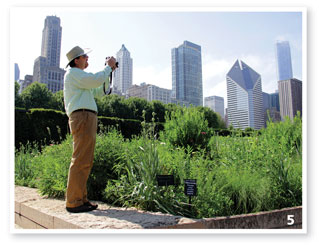
Created in 2004 in conjunction with the development of Millennium Park (which includes “the bean”), the Lurie Garden is a four-season display of different plants that flower all year round. Color and texture were the primary goals for the garden’s 5 acres. Even in the bitterly cold, windy Chicago winters, seed heads and ornamental grasses maintain their interest.
A 15-ft. high “shoulder” hedge wall cordons off the garden from the Millennium Park bandshell in order to prevent concert-goers from trampling through, but it still allows visitors to enjoy the music. (The day we visited, we got to hear jazz and funk saxophonist Maceo Parker practicing for his concert later that night.) It’s also home to a few families of red-winged blackbirds that were dive-bombing some people who got too close for comfort—which is why staff members have had to gate off parts of the garden.
5 Country boy in the big city.
 Chicago Botanic Garden
Glencoe, Illinois
Chicago Botanic Garden
Glencoe, Illinois
On our way into the city, we stopped at the CBG to chat with Richard Hawke, who manages the plant evaluation program there and, like Paul, was one of the speakers at this year’s Darwin Perennials Day at Ball. The Bernice E. Lavin Plant Evaluation Garden sits across the way from the Plant Conservation Science Center at the CBG. Richard said it’s the only garden built without donor money. “That’s how much the CBG believed in it,” he said.
When the garden was built in 1989, it only had five genera at the time; now there’s over 900. Richard’s focus is to keep it as a comparative trial, with at least three plants, some donated and some he buys in, that they plant in the ground and evaluate for at least three years. And he keeps it as real as possible, making sure the breeders and suppliers know what did and didn’t pass muster.
“Anything that grows here, but doesn’t thrive here, isn’t a good plant,” stated Richard. “And in this climate, you can’t do a short trial because it’s different every year.”
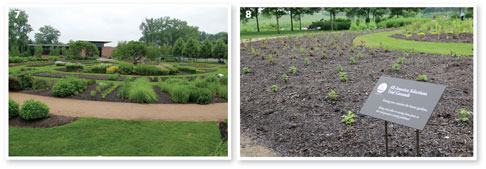
7 A bridge-eye view of the Plant Evaluation Garden.
8 This is the first year that the Chicago Botanic Garden is trialing perennials for All-America Selections. There are five different entries (echinacea, dianthus, rudbeckia, salvia and Korean chrysanthemum) in a 100-ft. bed.
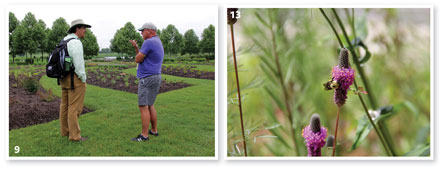
9 Paul Westervelt (left) and Richard Hawke (right) discussing the intricacies of trialing perennials.
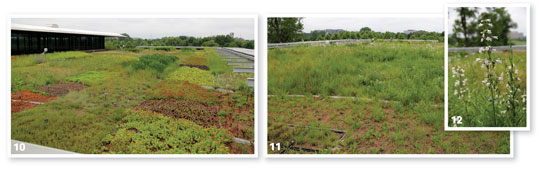
10 The Plant Conservation Science Center has two different green roofs with solar panels that produce 5% of the building’s power. This one is filled with succulents planted in 4, 6 and 8 in. of soil. The poles sticking up are monitors that gauge air temperature, light and soil moisture.
11 The other green roof features North American native plants that were just planted and allowed to grow as Mother Nature intended.
12 & 13 There were similar plants that we saw in the Schulenberg Prairie, including penstemon and Dalea purpurea, which the bees love.