9/30/2015
Join the Conga Calibrachoa Line
Ryan Hall
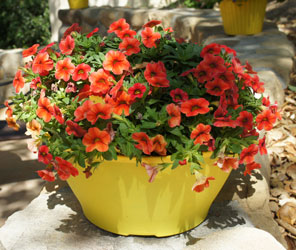
Small-space gardening isn’t a new concept, but seems to be more relevant than ever in today’s marketplace. The larger lots and yards of our parents’ era are no more and new homeowners often compromise with a greatly diminished gardening footprint.
However, small-space gardens don’t need to be as limited in color as they are in square footage. Whether an urban dweller with a tiny balcony or a row house with a very long and narrow lot, small spaces can have just as vibrant and productive gardens as the house in the suburb with its quarter-acre lawn. One trend that’s evident in breeding is to develop products at both extremes of the size spectrum to fit gardens of all shapes and sizes.
More and more you’re seeing “compact versions” of what historically are big plants: verbena, petunia, you name it. Most of the core classes have been tamed and are available in a smaller package. Calibrachoa is the most recent member of this group to be miniaturized. This genus has come a long way since its gangly trailing habits that were essentially only suitable for big hanging baskets. Calibrachoa is now available in small, medium and large, and in every color of the rainbow. It’s no wonder the calibrachoa market continues to grow and breeders are eager to develop new forms to feed the insatiable consumer appetite for this class of flowers.
So what does one do with a compact calibrachoa? It’s a basket plant right? Ball FloraPlant was posed with this very question when they developed the Conga line of compact calibrachoa. This early flowering and extremely uniform series is perfect for small pots and looks completely at home in color bowls and window boxes.
Congas are the perfect table topper to decorate outdoor spaces. They also provide a great package for growers. Their extreme series uniformity and wide range of bright and novelty colors work great in small containers, such as pints and quarts. Conga’s controlled habit requires little to no PGR, making them a very efficient crop to produce. Conga is also part of Ball FloraPlant’s Real Series group of plants. This Real Series message gives growers the confidence to produce all Congas exactly the same and have all colors ready for market at the same time, with matched habits and a ton of color.
Growing Congas is very straightforward and follows many of the same protocols as standard calibrachoa. However, their compact size does require a different approach when it comes to things like PGRs.
Crop time: Roote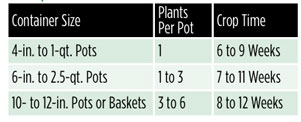 d liner to finish
Conga Calibrachoa are moderately fast growers. The key in producing Conga is to start with a liner that’s fully rooted. Adding an additional 1 to 2 weeks to the rooting time can help ensure Conga gets off to a great start after transplanting.
Media & pH
Like most calibrachoa, Conga prefers a well-drained media that doesn’t stay overly saturated. Conga should be finished on an acid pH range of 5.4 to 5.8.
Temperatures
Calibrachoa, and Conga in particular, prefer moderate temperatures and can tolerate cooler night temperatures. Cooler temps combined with high light can almost eliminate the need for any growth regulators. Recommended temperature should range from 71 to 76F (21 to 24C) days to 50 to 58F (10 to 14C) nights.
Light levels
Conga prefers high light levels. Lower-than-optimal light will encourage stretch and reduce flowering. Ideal light levels for Conga should range between 5,000 to 8,000 f.c.
Fertilizer
Calibrachoa are heavy feeders and benefit from a constant feed between 225 to 300 ppm N. Avoid fertilizers high in ammoniacal nitrogen, as this can encourage soft and leggy growth. Nitrate-based feeds should provide the best balance of habit and flowering. Calibrachoa benefit from the full complement of micronutrients, as well as the addition of extra iron.
PGRs
Conga requires little to no PGRs due to its naturally compact size. Growers should apply PGRs sparingly and only if needed. If it’s determined that extra control is needed, one should start with lower rates of B-Nine between 1,500 to 3,000 ppm 2 weeks after transplant.
Pest & diseases
Growers should scout for pests on a regular basis. Thrips can be especially problematic on calibrachoa and can damage leaves, making plants unsaleable. Be on the lookout for aphids and leafminer. Proper sanitation is the best defense against most common calibrachoa diseases. Growers should be especially diligent in avoiding root and stem rots with proper management of the growing environment and irrigation techniques.
Once only available as a vigorous basket plant, calibrachoa have come a long way. Conga Calibrachoa paves the way in a new product form that gives both small- and large-space gardeners a new way to enjoy calibrachoa.
GT
Ryan Hall is Product Manager for Ball FloraPlant, stationed in Arroyo Grande, California.