8/27/2015
Growing With Griffin: Preventing Common Seed/Plug Problems
Tami Van Gaal
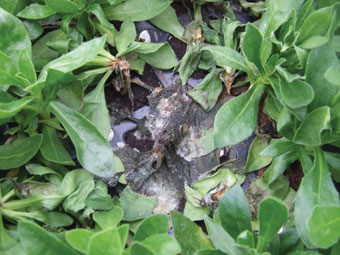
Plug producers running thousands of trays through production each week and growers starting a few trays on the bench face the same issues with respect to achieving strong stands of usable plugs. While most germination and plug challenges can be avoided with proper culture, some problems need intervention. When these problems appear, the scale of production has little impact on control methods chosen. Instead, both large and small growers simply need to use their best option first for the quickest and most effective results.
Pictured: Osteospermum with Rhizoctonia. Moisture management and drying foliage before night become critical for avoiding the disease.
Early in production, attention is focused on maximizing germination. To increase both percent of germination and uniformity, provide a controlled environment for initial germination, i.e., a germination chamber. Remove trays from the chamber when seed coats crack to allow hypocotyl emergence to occur in the greenhouse and avoid excessive stretch in the low-light environment of the chamber.
Once on the bench, media should be kept saturated-to-wet for most crops, but moisture levels must be reduced soon after radicles emerge. For some crops, such as begonia, media must stay wet for a longer time, which encourages fungus gnats and algae growth. Best control options for fungus gnats target the larvae. Once the larvae are controlled, adult populations will decline five to seven days later. While a number of chemicals are effective against fungus gnat larvae, the use of the beneficial nematode
Steinernema feltiae is both effective and safe for all crops. Applied as a drench,
S. feltiae controls fungus gnat larvae for two to three weeks.
Algae in irrigation lines and on media can be controlled with sanitation products. If starting with clean lines, constant injection of EcoClean will limit biofilm growth. Limiting the biofilm will, in turn, limit the algae. Other injection options include SaniDate 12.0, ZeroTol 2.0 or KleenGrow.
As true leaves develop, moisture management and drying foliage before night become critical for avoiding disease. Collapse of young seedlings is most often due to Rhizoctonia and/or Botrytis attacking the young, tender stems. Botrytis produces fuzzy sporulation, while Rhizoctonia produces a web-like mycelium. The two pathogens are often present together. Effective options for control of this disease complex include Affirm, Chipco 26019, Emblem, Medallion, Pageant Intrinsic and Palladium.
Thielaviopsis can also be problematic in plugs, most often in pansies and vinca. Thielaviopsis cannot be cured and spores are long-lived, so prevention is critically important. Never sow susceptible crops in previously used trays. Keep media pH in the preferred range of 5.3 to 5.8 and treat early with Affirm, Cleary’s 3336, Emblem or Medallion for protection. If active disease is diagnosed, immediately bag and remove symptomatic plants from production (including pots and media), dispose of the material offsite and thoroughly sanitize the production space.
Phytophthora may also attack seedlings, more often in the later stages of the crop cycle. This is a fast-moving disease requiring swift, effective control. Look for wilting and/or necrosis moving from the petiole into the leaf, especially in petunias. Segway, Alude, Fosphite and Subdue MAXX are strong choices for control. If growing on a recirculating system, be sure to treat the tank with SaniDate 12.0 or ZeroTol 2.0 to eliminate swimming zoospores.
Empress Intrinsic is a nice option for broad-spectrum protection against fungal diseases in plugs. Not only does Empress Intrinsic promote root development, but both Empress Intrinsic and Pageant Intrinsic stimulate natural defenses on a systemic level for improved growth and stress tolerance.
Height control in plugs starts with proper fertilization with a low-phosphorus, nitrate-based feed and proper moisture management. DIF and DIP are both effective on many crops. In addition to cultural controls, most growers use PGRs. Early stretch is often controlled with A-Rest as the cotyledons develop. Some crops are best managed with Cycocel (e.g., geranium, begonia), while others may benefit from Bonzi (e.g., dianthus, impatiens). The only PGR labeled for use on fruiting vegetable plugs is Sumagic. Rely on cultural tools for height control of leafy edibles. Finally, remember that transplanting on time is one of the most important practices to prevent a stretched plug.
Throughout the entire crop, perform regular media and tissue tests. Unlike potted crops, the fertility of plug cells can change rapidly due to small media volume. Therefore, consistency in testing is very important. In-house monitoring of pH and EC is required to enable rapid grower action to prevent fertility problems. Several reliable, affordable and easy-to-use meters are available from companies serving the greenhouse market, such as Hanna Instruments and Bluelab.
Always read and follow all label directions. Not all products are registered for use in all states or for all crops. Products other than those mentioned here may also be safe and effective.
GT
Tami Van Gaal is a GGSPro Technical Support Representative for Griffin Greenhouse Supplies. She can be reached at ggsprotech@griffinmail.com.