1/31/2015
Be a Water Miser
Jeremy Crook, Allison Justice and Jim Faust
Environmental concerns are driving new and innovative ways of conserving water. Regulations and tighter control on runoff from horticulture production facilities are making it ever more important to conserve water for the future health of our industry. Besides being wasteful, excessive water application in propagation greenhouses can cause crop problems such as nutrient leaching, root rot and algal growth, which increases the production costs associated with fertilizers, fungicides and water treatment.
Additionally, excess water applied during propagation can inhibit rooting by reducing the available oxygen necessary for adventitious root formation. With these facts in mind, a research project at Clemson University was initiated with the support of the USDA-ARS Floriculture and Nursery Research Initiative to quantify the water requirements of unrooted cuttings in propagation. The goals of this ongoing project are to provide the greenhouse industry with benchmarks for water use in propagation, as well as recommendations for how to best achieve those benchmarks.
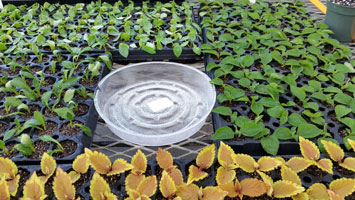
Top, Figure 1. Use a saucer placed among the cuttings to collect mist throughout the day. A
system that is fine-tuned to the environment should have little water accumulation in the saucer.
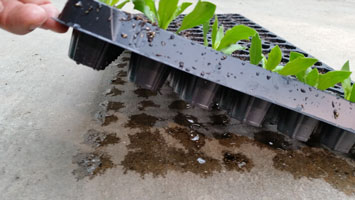
Bottom, Figure 2. Lift up liner trays to visually evaluate leachate. Water from individual cells shouldn’t be connected.
The first objective of our project was to assess the range of water use at commercial propagators during the peak late winter propagation of vegetative annuals and zonal geraniums. Water use measurements were made at 17 commercial propagators at locations ranging from Ontario to Georgia. Those measurements revealed a difference of 10.3 L/sq. ft. between the highest and lowest amount of water used over a 10-day propagation cycle. These differences were not primarily affected by the local climate, but rather by the growers’ decision-making processes. This wide range of water use among propagators also suggests that floriculture crops are quite forgiving and that many growers can reduce their water use without observing negative consequences.
The measurements recorded at the commercial greenhouses suggest that a useful benchmark for water use during the peak late winter propagation season is 2 L of water per square foot over a 10-day propagation cycle for vegetative annuals, while only 1 L per square foot is necessary for zonal geranium propagation over the same time period.
Here are five practical tips to help growers achieve these benchmarks:
Water Conservation Tip #1: Monitor mist volume with empty saucers.
Ideally, the amount of water that’s applied as mist should be approximately the same as the amount of water that’s evaporating from the trays of unrooted cuttings. In a perfectly balanced system, the mist wouldn’t add to the volume of water in the medium or accumulate on the floor or bench beneath the crop.
Mist volume can be monitored by simply placing a solid saucer or tray among the cuttings (Figure 1). If your mist system is fine-tuned to the environment, there should be relatively little water accumulation in the trays. If you’re applying considerably more water than is evaporating, then water will quickly accumulate in the saucers and start to flow over the edge of the trays. The saucers are a very simple tool for evaluating whether or not excess water is being applied during propagation.
Water Conservation Tip #2: Monitor leaching.
Ideally, very little leaching should occur from a tray of liners during propagation. Look under the trays of cuttings for signs of excess water. If you pick up a tray there should only be a little bit of water below each individual cell (Figure 2). If you have a porous bench, then a solid surface will need to be placed under the propagation trays. Leaching can be measured by placing a solid tray beneath the cuttings to capture the water. Leaching not only wastes water and fertilizer, but also is a sign that the propagation medium is remaining saturated, which will have a negative effect on rooting. A good rule of thumb is to apply no more than 0.2 L/sq. ft. of water per day.
Water Conservation Tip #3: Record the amount of water applied during a mist event.
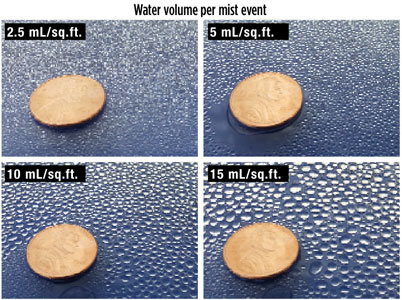
Knowing the amount of water that’s currently being used in your propagation system is the first step toward conserving water. This knowledge will help you decide the degree to what changes may need to be made. An empty tray can be used to measure the water volume applied per mist event. Use a kitchen scale to weigh the tray, then place the tray under the mist for one mist event. Once the mist finishes its cycle, weigh the tray again, and the difference is the amount of water applied per mist event. This should be done in several locations on the bench. If a kitchen scale isn’t available, the images in Figure 3 can be used to estimate the amount of water applied per mist event. An acceptable range for mist volume is between 3 and 10 mL/sq. ft. while a target range from 3 to 6 mL/sq. ft. is optimal.
Water Conservation Tip #4: Use lower volume mist nozzles.
The mist nozzle type will have an effect on the amount of mist applied. The most common low-volume mist nozzles used in propagation are: TeeJet 8001 and 11001 that supply 0.1 gal. per minute, TeeJet 8002 and 11002 that supply 0.2 gal. per minute and the Netafim 4-way Cool Fog nozzle that supplies 0.03 gal. per minute. Higher-volume nozzles should only be used for irrigation, not propagation mist. Low-volume mist nozzles not only apply less water, but the water droplets are also smaller so they stick to the cuttings better. This means that more water remains on the
cuttings and doesn’t run off into the growing medium. The one
disadvantage of low-volume mist nozzles is that booms may need to run more frequently which, in turn, may have maintenance ramifications.
 Water Conservation Tip #5: Fine-tune the mist frequency.
Mist should be applied in a step-down fashion, gradually reducing the frequency of mist events throughout the propagation cycle. Unrooted cuttings of most floriculture species gradually adapt to prevent water loss while in propagation. Osteospermum cuttings in propagation will transpire half as much water on day 3 as on day 1, even if they’re in the same environment. This means that the amount of mist required to maintain a turgid cutting is also reduced over time on the propagation bench.
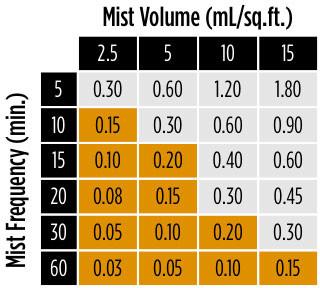
Making simple mist frequency changes can have a dramatic effect on the total water volume used over the propagation cycle. Table 1 shows how the total volume of water applied per day changes with mist volume and mist frequency. Numbers in the orange are in the ranges that result in very little, if any, leaching occurring from the propagation trays.
Pictured above: Figure 3. Water droplet size on a plastic tray can be used as a visual indicator of the water volume applied during a
single mist event. A penny is used for a visual comparison.
Pictured left: Table 1. The effect of mist volume and mist frequency on the total volume of water applied in a 10-hour day. Orange highlights are water volume application levels where leaching shouldn’t occur.
Based on our measurements made at commercial propagation facilities, the amount of water that could be saved by utilizing the water conservation tips described above may be as much as 4 L/sq. ft. for vegetative annuals and 10 L/sq. ft. for geraniums over a 10-day propagation cycle. These tips show there are many different approaches that can be taken to save water. Some of these tips require minimum time, effort and money. Implementing just a few of them can reduce the total amount of water used without reducing plant quality.
GT
The authors wish to thank the USDA-ARS Floriculture and Nursery Research Initiative for their ongoing support of this project and to the growers that allowed us to record data at their facilities.
Jeremy Crook is the Ecke and Oglevee Brand Manager, Allison Justice is the president of Hope Greenhouses and Jim Faust is an Associate Professor at Clemson University.