12/30/2013
Desert Air in the Cold North
Chris Beytes
Photography by Chris Beytes
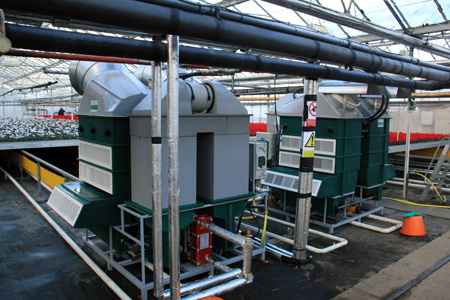
At Bordon Hill Nursery in Stratford-upon-Avon, they’re using machines developed in the Middle East to reduce the humidity in their cool, moist English greenhouses.
Cyclamen finish stronger and more colorful when grown cool, explains Bordon Hill General Manager Peter Byrne. But cool greenhouses are humid greenhouses, and humidity leads to botrytis on foliage and flowers. You can heat to reduce humidity, but that increases production costs and negatively impacts the quality of the finished crop.
The solution seems to be these machines, called Ventilated Latent Heat Converts (VLHC). Built by Agam Greenhouse Energy Systems of Israel (
www.agam-greenhouses.com), the devices use fans to take in greenhouse air and run it past lithium chloride, a desiccant, to dehumidify it. In the process, there’s an “exothermic” reaction (the release of heat). What comes out of the machine is warm, dry air (plus the moisture that was removed from it).
The VLHCs were installed and tested this fall, and as of late November after just a couple of weeks in full operation, they were creating ideal conditions, says Peter—75% humidity and a night temperature of 13 to 14C (55 to 57F). A quick cost comparison from a cold night earlier in the week revealed a cost of 230 GBP ($375) to heat one greenhouse versus just 30 GBP ($50) to operate the VLHCs—a significant savings and with better growing conditions.
“So far the results are very good,” says Peter. “We’ve got no issues at all in here with botrytis, we’re maintaining the temperatures we want [and] we’re getting the humidity levels we want.
GT