5/24/2013
Grow Newer, Better Garden Orchids
Gary Hennen
Spathoglottis × hybridum, sometimes known as garden orchids, are tropical orchids that offer spectacular color for the garden or patio. They provide year-round color in warm climates, as well as an interesting seasonal flowering patio plant for cooler climates. Plants feature palmlike foliage and long-lasting flower spikes that produce an impressive series of colorful blooms.
Oglesby Plants International has bred a new collection of spathoglottis selected for compact growth, consistent flowering (despite the season), good flower count and early flowering 16 to 20 weeks after planting liners. A great departure from orchids currently in the trade and a great improvement over older varieties.
Cabaret showcases large, 2-in. flowers with purple petals highlighted by white brush strokes and a dark-purple lip with a yellow center. Fast growing and well-branched, it reaches 24 in. in 6-in. pots. Ideal for 6 to 8-in. pots.
Groovy Grape features clusters of dark purple flowers 1.5 in. across with a contrasting lip—yellow in the center, deep purple at the end. It reaches up to 17 in. tall with a great natural branching habit. Ideal for 4 to 6-in. pots.
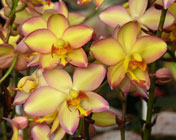
Mello Yellow (pictured left) features broad yellow petals with a dash of purple on the edges. Fast growing and well-branched, it produces multiple flower spikes, each with numerous large (2+ in. in diameter) flowers. Once the flower show starts (approximately 20 weeks after planting), it continues on and on. Mello Yellow grows 24 to 30 in. tall. Good for 6 to 8-in. pots.
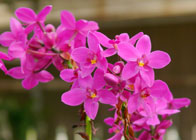
Purple Passion (pictured right) is a vigorous, early-flowering garden orchid with solid purple flowers featuring a bicolor yellow and purple lip. With maturity, this variety produces flower spikes with large clusters of flowers too numerous to count. Each flower spike continuously produces flowers for months. Up to 24 to 36 in. tall. Ideal for 4 to 8-in. containers.
Snow Angel offers clusters of large, 2-in. pure white flowers. Excellent for 6 to 10-in. pots, it reaches 24 to 26 in. tall.
Planting Expect flowering 4 to 7 months after planting a single tissue-cultured young plant in a 5 to 6-in. pot. Allow 7 to 9 months for a full 8-in. pot. Spathoglottis can be grown with very close spacing without compromising quality. Upon maturity, plants will bloom relatively non-stop with warmth, bright light and good nutrition. Flowers open a few at a time at the top of the spike. Each can have multiple flower spikes and each spike can last for months, producing numerous individual flowers.
Medium Use a well-drained, fibrous peat-based soil mix incorporating at least 20% perlite or airlite. A mix of 60% peat, 20% perlite or airlite, and 20% bark should work well. Spathoglottis have a vigorous root system and require standard or extra-deep containers. Azalea pots or bulb pans are not recommended. Maintain a pH level of 5.8 to 6.5 and an electrical conductivity level of 1.0, not to exceed 1.5.
Light Spathoglottis grow well under light shade to full sun conditions. Foliage color and appearance are best when grown under 30% to 73% saran cloth. Under glasshouse conditions, plants will flower well at 1,500 to 2,500 foot candles.
Water Keep plants evenly moist. Overwatering may cause fungal problems, especially in young plants. Don’t allow plants to dry out.
Nutrition Spathoglottis are fast growing and require a higher-than-average orchid nutrient supply. Requirements will vary with light and temperature conditions.
Constant liquid fertilization at 150 ppm nitrogen (1:1:1) works well. If incorporating a slow-release fertilizer, use up to 15 lbs. per cubic yard. Be cautious with trace elements. Avoid repeated sprays with trace element mixes, as manganese and iron can accumulate and cause phytotoxicity. Don’t allow pH to go lower than 5.5.
Temperature Spathoglottis require daytime temperatures above 75F (23C) and nights above 60F (15C) for vigorous growth and flowering. Plants may drop leaves and go dormant with extended temperatures below 40F (4C) and they won’t tolerate freezing.
Pests and diseases While spathoglottis are susceptible to most common pests, no particular pest seems to pose serious problems. Watch for spider mites, thrips and aphids.
Monitor carefully for botrytis, flower mold and anthracnose. Spathoglottis are prone to crown rot if over-watered or grown in poorly drained media.
GT
Gary Hennen is president of Oglesby Plants International, an Altha, Florida-based breeder and young plant producer.