1/28/2013
The Water Soluble vs. Controlled Release Dilemma
Daniel Jacques
Controlled-release fertilizers are hardly new to the greenhouse industry. They’ve been used for many years in greenhouse production. For the most part, when a controlled-release fertilizer (CRF) has been used, it’s been as a supplement to a water-soluble fertilizer (WSF) program. Conversely, the majority of crops are grown using only controlled-release fertilizers. For many years now, suppliers of controlled-release fertilizers have been saying that it’s possible to grow a crop using only controlled-release fertilizers. They claim that there can be a substantial savings in fertilizer costs by switching from a water-soluble program. However, growers haven’t really embraced the idea of completely eliminating their WSF programs for a 100% CRF program.
There are many questions that come to mind when thinking about the CRF versus WSF dilemma:
• What are the pros and cons for use of each of the two methods of fertilizing your greenhouse crop?
• What incentive is there for growers to use CRF?
• Which of the many CRF formulations and brands will work in the greenhouse?
• Can mix manufacturers offer growing media containing all the fertilizer that a crop will need for its entire production cycle?
It’s interesting that these questions have been asked for well over 20 years now and we still don’t seem to have complete answers!
Weighing the pros and cons
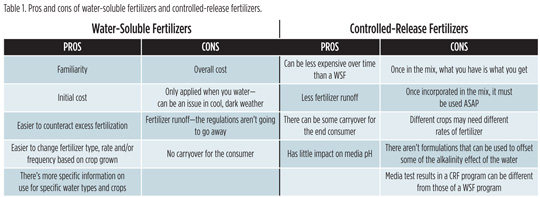
Let’s think about some of the above questions. First of all, let’s consider the pros and cons of both CRF and WSF programs. Some of these comparisons are shown in Table 1. This table is by no means a complete comparison of the WSF/CRF pros and cons, but does touch on the major points that growers usually discuss when comparing the two. These pros and cons also can be used to provide some possible answers to some of the other questions.
Probably the biggest concern most growers have when using a CRF is the first “con” shown in the table. There’s usually a fear that if too much CRF is added to a mix, there’s nothing that can be done to change it after the fact. This is especially true for CRF blended into a mix as opposed to being top-dressed. Growers are more comfortable with the feeling that they’re “in control” with their conventional system. The most common response you get from a grower is they’ve “heard too many horror stories” and will stay with what they know. It’s a fear of the unknown. When there’s little margin for error, they prefer to go with what they’ve been doing all these years—a program that has a lot of information backing it. CRF manufacturers have made great strides in coming up with products that are very viable for the greenhouse, but it will take time for growers to get past the issue of the old “horror stories.”
The other con that we often hear growers bring up with CRF is there are no CRF products available that can offset some of the alkalinity in the water. In other words, potential acidity or basicity isn’t a factor with CRF. The impact on media pH will be minimal. Growers need to make sure that they have their water alkalinity under control.
So if growers look at the pros and cons, and for the most part, stick to programs that are mainly WSF-based, what incentive could there be for them to reconsider and switch? One possible answer to that may also be found in Table 1—fertilizer runoff. Regulations on fertilizer runoff are getting tighter as time goes on and they’re not going to go away. Many growers are set up to contain the runoff and are able to meet all the regulations. However, there’s a cost associated with controlling this runoff and, if the use of a CRF program can help reduce that cost by reducing runoff, the incentive is still there. The incentive of reduced overall fertilizer cost is sometimes hard to completely accept, but shouldn’t be totally ignored.
The 411 on CRFs
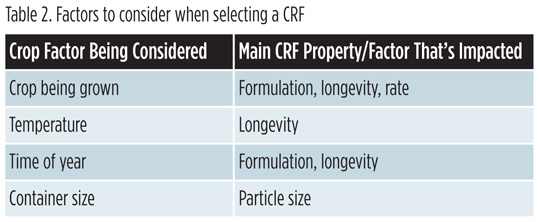
Which of the many CRF brands will work in the greenhouse? From trials we’ve done, the answer is “many” and “it depends.” Just like selection of a WSF, the selection of a CRF is dependent on many factors. Table 2 lists some of the crop factors to consider and what CRF properties or factors need to be considered.
When we select a CRF, we generally consider three properties: analysis (N-P-K), longevity and particle size. CRF manufacturers offer many different analyses, similar to WSF manufacturers. However, there aren’t as many different options in NPK analysis when selecting a CRF as opposed to selecting a WSF. The longevity of a CRF is generally the most common factor in deciding which CRF to use. Depending on CRF manufacturer, longevity will be listed in days or months. There are generally a number of different longevities available for the same NPK analysis.
Finally, particle size can be important. That’s because particle size affects how evenly a fertilizer will be distributed in a container (especially when blended into the mix). Generally, smaller containers such as cell packs and large plug trays will require the use of a mini-prill CRF. This allows for better distribution of the fertilizer and eliminates inconsistency from cell to cell. All of the major CRF manufacturers offer mini-prill fertilizers. They do cost more per pound than a similar standard size-prill CRF.
Full-cycle feed
The final question in our list relates to having your growing media provider make a mix that can feed a crop for its entire production cycle. This also applies to growers who make their own mix. There are a lot of factors to consider with this question and it can get pretty convoluted. One of the problems we run into when trying to incorporate a CRF in a mix for a grower is the sheer number of different crops being grown, many of which may have different fertility needs. This will impact the rate of fertilizer (pounds per yard) used in the mix. Therefore, the grower may need to have a number of different mixes made. The other problem we encounter goes back to one of the “cons” of a CRF: the grower needs to use the mix ASAP. It’s generally recommended that growers use a CRF-containing mix within a week to 10 days after the mix has been made. The CRF in the mix will begin to slowly release after incorporation, as there’s adequate moisture in the mix for this to happen. Storing the mix in a cooler location, out of the sun, will help slow that release and reduce the chance of excess salts.
Some of the research we’ve recently done at Sun Gro looked at growing short-term crops (about 6 weeks) with no WSF. We looked at both mini-prill and standard-prill CRF products. We found that in 4-in. pots, we didn’t need to use a mini-prill fertilizer at the rates needed to grow a decent crop. We did find that we could grow a very good pansy crop with only CRF added to the mix. Many of the treatments we had were as good as or even slightly better than the WSF standard. In fact, in one of our most recent trials, our top five treatments, as far as how the plants looked at the end of the trial (as selected by three different reviewers), were all CRF treatments. So we can make greenhouse mixes where growers won’t need to apply a WSF to the crop.
Growing a crop with CRF as the sole source of fertility is not something for all growers, but it can be an option for some growers or at least possibly for specific crops. Even so, growers should consider a combination of CRF and WSF products. This can be done by selecting a CRF and CRF rate that will allow feeding that crop—which needs the lowest amount of feed completely with CRF—then supplementing with WSF for those crops that need some additional feed. Alternatively, and maybe the most common practice, is to use a WSF program, but supplement heavy feeders with CRF. Either way, the grower can come up with a successful program that will optimize fertilizer use. And, as stated in Table 1, the CRF in the mix will be a bonus for the homeowner.
In conclusion, the CRF/WSF debate goes on and both options are viable options for the grower, that of combining the two being the most likely option for most. As with any other change, growers should approach the possibility of growing their crops with only CRF cautiously. There are a lot of factors involved when choosing to go with a CRF and there’s still a lot of research to be done to come up with even more exact recommendations for growers. Whether you decide to go the route of CRF or WSF or a combination, take advantage of the technical experts the fertilizer and mix companies have available. They can really help you in setting up a successful program.
GT
Daniel Jacques is a Technical Specialist for Sun Gro Horticulture.