12/27/2012
Why DOESN’T She Garden?
Diane Hund
Photography by Illustration by Wesley Allsbrook

What’s the best way to grow our sales and ensure the longevity of our industry? Always be bringing more people into gardening than are getting out of gardening. Growing the pie will ensure the future of our industry.
To that end, we at Ball Horticultural Company have spent a good amount of time trying to understand the barrier, the line—the “thing”—that makes an average target customer—say, a homeowner, female, age 40—decide not to garden.
This is particularly important given the evidence that the number of people who are gardening is on the decline. In fact, National Gardening Association (NGA) data shows that the number of households who participate in flower gardening has dropped from 41% of all households to just 29% in the past six years. That’s a 29% drop!
So we set out to talk to these folks—the people who, for every other reason should be a gardener, but aren’t. We did it in a statistical way, via an online survey conducted by Ipsos Research.
The data includes 342 total non-gardeners. From a demographic perspective, they look much like our gardener sample: They tend to be white females, homeowners, with a median respondent age of 49.2. Our sample included both the U.S. and Canada (interestingly, we found virtually no differences between the two nationalities) with a general distribution across the two countries from east to west.
We quickly found that this non-gardening sample actually broke into two groups: those who HAVE gardened in the past but aren’t gardening now (we’ll call these folks “lapsed” gardeners), and those who have NEVER gardened.
This is an important distinction, because we found that our lapsed gardeners actually resemble current gardeners in many respects. The lapsed gardener, in most cases, is either not gardening due to physical limitations (as they age) or due to a one-time redirection of their efforts or money. In many cases, these lapsed gardeners missed the last season because they were involved with another home improvement project, had a family or work situation that demanded an inordinate amount of time, or simply didn’t have the financial means to participate. The good news is that almost all of these lapsed gardeners expressed an interest in getting back to the garden the next season.
As for the true non-gardeners—those who have NOT gardened before—they seem beyond reach. When asked if they would “Ever” consider starting to garden, the vast majority (78%) said no. The main reason they cited was a general “lack of interest in gardening.” Beyond this, they state they simply don’t have the time or don’t have the physical space to garden. We even asked an open-ended question about what could be done that might make them want to garden, prodding them with a “could be anything from a change in plants to a change in their lifestyle” and what we got back was a resounding “nothing.” In fact, 58% actually responded that there was simply “nothing” that could be done to make them want to garden.
A few hopefuls did tempt us, with 12% saying they would garden if they had more space and 5% saying they would garden if plants were cheaper. But these aren’t encouraging statistics when we’re looking at such huge declines in participation. However, none of this is new. We’ve heard this before, which is why we knew we had to drill deeper into the “lack of interest in gardening” answer.
Intrinsic vs. Extrinsic Motivators
It’s not an easy research problem. Most people will struggle with articulating what makes something uninteresting. Even that simple open-ended question is a precursor of how challenging this is … just outright asking people about the barriers brings little useful information. So we knew we had to go about it in a slightly different manner.
The approach of our research was to focus mostly on attitudes, beliefs and sentiments of the gardening public versus the non-gardening public. From this we were able to extract a few key differences. And what we found was encouraging.
First, we found that non-gardeners are keenly aware of many of the benefits of gardening. In fact, non-gardeners are almost the SAME as gardeners in their understanding and belief that gardening is a great way to add value to your home, improve the curb appeal of the house as well as make their home more beautiful. We call these “extrinsic” motivators. They are things that are perceived not just by them, but also by others—their neighbors, friends and family. (Figure 1)
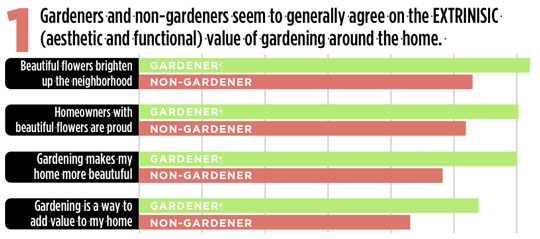
Where the difference between gardeners and non-gardeners comes into play is when you go past these extrinsic motivators. When asked if they felt that gardening was a great way to reduce stress, express their creativity or simply be closer to nature, the non-gardeners were not nearly as accepting of these benefits as the gardeners are. We call these the “intrinsic” motivators. These are things that are not apparent to their neighbors, but are added benefits to the activity that are experienced on the inside. In summary, the non-gardeners simply don’t receive (or perceive) this value from gardening activities.
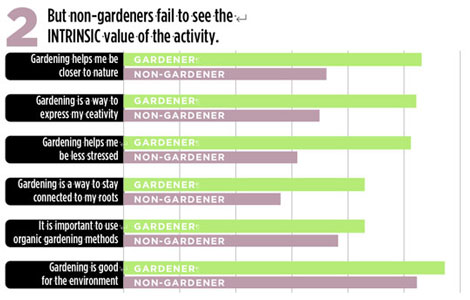
You can see from Figure 2 that two additional attitude statements were included: attitudes that pertain to the environment. For both of these questions we found very high agreement between gardeners and non-gardeners. The theory is that, while environmental actions are inherently intrinsic in their motivation, in today’s world the pressure to participate in sustainable actions is so great that this has crossed the line from intrinsic to extrinsic. What’s more, this is a huge area of appeal to Generation Y, who places more value on sustainability in their decision-making. (More on this later when we talk about the various generations.)
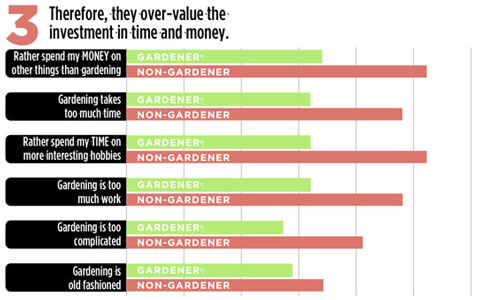
So, in putting these two items together, let’s go back to the basic principle for demand: To make a sale, the following must be true: The value of the item includes all of those benefits—both extrinsic and intrinsic, short-term and long-term—and the price of the item includes all of those things given up in the process—from the actual dollar price of the item to the time spent in the activity.
If a non-gardener only perceives half of the value, they are far more likely to believe that gardening takes too much time and money.
We spend a lot of time focusing on educating the public about the extrinsic values of marketing—telling folks about how gardening will make their home more beautiful, improve their curb appeal and market value, and so forth. Yet they already know this! If we really want to change the value equation in a way that these non-gardeners start to reap the value of the intrinsic motivators (stress relief, creativity, being closer to nature, etc.), then we need to find a way to help non-gardeners experience and engage with these intrinsic motivating factors.
Back to Childhood
The next big finding had to do with the propensity of gardeners to have “gardened as a child.” Now, this seems intuitive, but we finally have some data to back it up: Our findings show that people who gardened with their parents are twice as likely to garden as an adult. Only 31% of the non-gardening population gardened with their parents, while 60% of the gardening population did.
Knowing this, we should be focusing on encouraging today’s gardeners to bring their kids out into the garden with them. Thankfully, we may be there already. When we asked gardeners if they felt that gardening was a “family activity” or if they “preferred to garden by themselves,” the single largest generation to state that gardening is a family activity were the Generation Y respondents. In fact, 78% of these respondents indicate that they consider gardening a family activity. (Note that we only asked this question of respondents who had children under the age of 18 living with them.) This is well above the 61% of Generation X who garden with their family. This is good news and points to a glimmer of hope that a new generation of gardeners—ones who embrace it for more than simple home-improvement value—are growing.
Hard-Working, Earthy, Passionate
Finally, we wanted to see what the attitudes were about gardening as a whole. Is gardening “hip” enough to continue to be an activity that people will want to promote? We went about this through a character analysis, asking both gardeners and non-gardeners to associate various characteristics with a “gardener.” Our findings surprised us a bit.
Gardeners and non-gardeners both agreed that the most prevalent characteristics of a gardener are “hard-working,” “earthy” and “passionate.” But beyond this, gardeners were more willing to consider themselves “economical,” “smart” and “educated” while the non-gardener did not necessarily think that these words fit. They were more likely to say that gardeners were more “rural,” “methodical” and “old-fashioned” than economical and educated. And both groups were very reluctant to use terms such as “urban,” “trendy,” “sophisticated” or “modern” to describe a gardener.
We had expected to see a larger variance in response between people who garden and people who chose not to. But, in fact, the variance was rather small. This tells us that there may not be an image problem that needs to be overcome. Of course, the most prevalent characteristic, “hard-working” takes us right back to the all-important value equation of the product. While gardeners reap significant benefit from this hard work, the non-gardener sees the work as vastly overshadowing the value of the activity. Changing this equation will help change the level of participation.
We had mentioned early on about some key differences in Generation Y—particularly as it pertains to their desire to make gardening a family activity. However, the biggest difference, from a generational perspective, seems to be Generation X’s lackluster opinion of gardening. There were a few keys things that stood out in our research that point to the theory that Generation X is our “lost generation” when it comes to gardening.
First, let’s start with the most recent National Gardening Association study, which indicates that the penetration of gardening within each segment is as follows: 37% of households that are 55 and over, 33% of households that are 45-54, 25% in that critical Generation X segment, and only 19% for Generation Y.
You might just consider this a downward trend, but you must consider the fact that these are not defined as “garden ready” households. These are ALL households … renters, condo-dwellers, people who live with mom, and so on. Since this bottom age group is defined as 18-34, there is a very good chance that HALF of this population is not yet truly “garden ready.” If you agree with this, then you would increase the penetration of gardeners to 38%. This reverses that apparent downward trend and leaves Generation X out there as our least-penetrated
demographic.
Next, while we always ensure an adequate sample size of each generation in our gardening population, we didn’t “force” a sample size within the non-gardening sample. In fact, we had more non-gardeners who were Generation X than any other generation. This is surprising when you consider the fact that Generation X is the smallest of the generations out there—significantly smaller than either the Boomers who preceded them or Generation Yers who are following.
Finally, when it came to our attitude statements, no one was more “bitter” towards gardening than the Generation X group. The non-gardeners within this group were far more willing to agree with statements like “Gardening takes too much time,” “I don’t like to risk the investment” or “I would rather spend my money on other things.”
There’s both good news and bad news if this theory is true. First, the bad news: Right now, Generation X occupies the majority of the “prime gardening years.” Generation X is currently aged 34-47 and is right in the thick of things. But the good news is that Generation X is the smallest generation out there—and that on each end of this spectrum you have far greater numbers of potential gardeners, with what appears to be more interest in the activity. In just a few short years, Generation Y will be entering the golden gardening age of 35-50, and they will be coming in droves. This points to all the more reason to ensure that we are ready to take advantage of this spike in our target demographic.
To summarize, we must determine how to spread the word about those intrinsic motivators. We should leverage the strength in the environmental opportunity our category presents, as this intrinsic motivator has migrated to extrinsic and is significantly more important to the younger generations. This will be particularly important as we shift our appeal to reach that up-and-coming Generation Y gardener—who, thankfully, is going to outnumber the grumpy Generation X gardeners.
Next, we should capitalize on other extrinsic motivators—functional benefits of gardening that are easily seen and experienced by all. Vegetable gardening is one area where the function of the product greatly improves that value equation and brings more people into the industry.
There is no magic bullet, but we do have some answers. Yes, implementation will take some hard work. But that’s okay; after all, we’re all gardeners, and as our data shows, everyone knows gardeners are hard-working!
GT
Diane Hund is Marketing Director, Ball Horticultural Company, West Chicago, Illinois.