11/26/2012
27 Years of Enjoyment
Dr. P. Allen Hammer

Every month for 27 years I’ve written a column in
GrowerTalks. To put that in perspective, to the best of everyone’s memory, the first article was mailed because there wasn’t a fax machine in my office to use. It also had to be re-typed once it was received in West Chicago. I didn’t have a cell phone and certainly not a smart phone or email in 1985.
Much has changed in 27 years, but I can say I never once dreaded writing the column. I can also say once a column was completed, I began writing the very next column in my head. For 27 years, it seems that I was always thinking and writing an article. Certainly visits and discussions with growers, salespeople, owners and colleagues always provided great topics to write about. I’ve said many times, greenhouse growers and owners helped me write every single column—I couldn’t have done this alone. This will, however, be my last regular monthly column.
In the last few years, I’ve personally agonized over several retirement and life-changing decisions. I dearly enjoyed my Purdue position, my volunteer firefighter position and my
GrowerTalks column. But in every single decision to retire from a specific task, I’ve found a renewing spirit with a new challenge. I think this will not be different. I’m not retiring from the industry just yet, but will take a deep breath from the rigors of a monthly column and refocus on other things.
Every day I’m amazed at how the greenhouse floriculture industry changes and has changed in the last 27 years. I never would have dreamed it could have changed in so many ways. The changing consumer has drastically changed the crops we grow and how we market those crops. I remember all of the attempts to preserve markets and control consumer thinking. I mention this because, hopefully, we’ll remember this and not repeat the very same mistake of trying to force consumers to think like we think.
We have to continually change with an ever-changing society. Advertising can certainly sway consumer thinking, but I don’t think it can easily change consumer’s needs and wants in the products we produce. If I’ve learned anything about our industry over the last 27 years, it has been one of continually looking forward and realizing none of us can live in the past for very long. Success today doesn’t mean success tomorrow—particularly when one is determined to do “business as usual” in an ever-changing world. What floriculture will look like 27 years from now (2039) is anyone’s guess. It will be different for sure.
With this column, I would also like to thank all of those both past and present at Ball Publishing who have provided such great support to me over the years. Never once was a column rejected. I’ve always been given complete freedom to write about whatever topic I chose. The editors assigned to my column have always done an outstanding job of making the English better without changing content. It’s been a tremendous honor and blessing to me to have a page to fill in
GrowerTalks for all these years. I hope what I’ve written has been useful and has provided education and insight to the floriculture industry. I admit change is hard, but I also know it can be renewing and rewarding. That’s my wish personally and for floriculture.
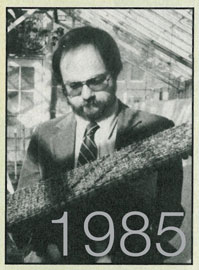 Ball Publishing would like to thank Dr. Hammer for being a valued contributor to GrowerTalks. We’ll miss him on these pages every month, but we’re glad we’ll continue to see him at industry events. We truly considered him to be part of our editorial team and wish him the best in all of his future endeavors.
As a special send-off, we’ve dedicated two pages to Allen “through the years.” We hope you enjoyed reading his columns as much as we have working with him. —Jennifer Zurko
August, 1985
“There is still so much floricultural research to do. And there is still a great deal we do not understand about the plants we grow.”
February, 1987
“We probably should all agree that the customer is not always right, but they are always the customer.”
February, 1988
“As growers, we cannot take the attitude that once the plant leaves the greenhouse it is someone else’s problem to handle it properly.”
August, 1990
“Integrated pest management is certainly the pest control approach for the 90s. Some suggest it is a new and improved way of pest control for the greenhouse. I have even heard some say IPM is a way to control pests without chemicals. My own feelings about IPM are that it is an approach to greenhouse pest control that has been given a 1990s name.”
August, 1991
“There’s no place in our industry or our society for gender, instead of skill, to be a factor in judging performance. Each individual should be allowed to succeed or fail as a person—not as a man or woman.”
April, 1992
“I have suggested many times before and will strongly suggest again that each of you as part of the floriculture industry and as a taxpayer make your wishes known to your Congressional representatives. Needed changes may occur in agriculture in the next few years. We can all sit back and let someone else determine floriculture’s future in the next century, or we can become involved and help shape a program that meets floriculture’s needs in the year 2000 and beyond.”
July, 1993
“I wonder what happened to the concept that computers and fax machines were supposed to make our lives easier? All they’ve really done for me, from a time management viewpoint, is make things run faster.”
January, 1998
“Growers often imply that they expect excellent quality from all sources and at all prices. If you believe price and quality are connected at the retail level, you must also agree that they’re connected at the grower level. It makes no sense to believe otherwise.”
March, 1999
“You can relieve a lot of stress simply by facing the reality of the greenhouse business in 1999. The new millennium isn’t going to change the greenhouse business in any significant way, but I firmly believe that each of us must change part of our thinking if we’re going to survive in the new millennium. It’s not going to be easy.”
June, 2003
“We academics are sometimes accused of being out of touch with the real world. Teaching, however, often brings reality.”
July, 2004
“It’s apparent that today’s consumers want instant plants for their patios and porches. This is a good trend. However, are we so focused on the instant gratification trend that we’re willing to let the flat and 4-in. markets fade away?”
August, 2005
“When customers can’t see a difference between products, they buy solely on price. Translating this statement to the present poinsettia market can make a large difference for those growers complaining about low returns.”
September, 2006
“I admit I have a difficult time envisioning a generic national floriculture marketing program. To me, the comparison to the promotion programs for beef, pork and peanuts don’t fit.”
February, 2008
“Crying about fake poinsettias on the TV or in your local bank will do little to improve poinsettia sales. Our focus must be on our consumers. What do they need and want in a poinsettia in 2008? And are we willing to provide it?”
December, 2010
“Let’s spend less time worrying about the plants that didn’t sell last year and more time on how to market the plants we’re growing this year. We can do little to change what happened last year, but we can do a lot to change what happens this spring.”
February, 2011
“Instead of spreading negativity, let’s all strive to improve the poinsettia market. Every comment to our customers and the consumer should be aimed at telling the important poinsettia story: It’s the Christmas plant with lots of value and tradition.”
January, 2012
“I encourage growers to approach every growing decision with great seriousness. Pay attention to the smallest of details every hour, every day. Remember trials and experiments are small-scale, high-risk plant production … not the job description of most grower positions.”
What has “Growing Ideas” meant to you?
A few of our readers kindly shared their thoughts about Allen’s contributions to GrowerTalks and his continuing service to the industry.
As long as I have been reading GrowerTalks, Allen’s columns are the first one that I read when I open the magazine. He has helped me and I am sure many others learn how to be better growers by sharing his wealth of knowledge. Thanks, Allen!
—Rob O’Hara, GrowerTalks columnist and head grower at Rainbow Greenhouses, Chilliwack, British Columbia, Canada
Dr. Hammer played a big role here in Indiana while he was at Purdue University. He assisted growers with problems, argued with us about most anything, and showed up at a lot of night meetings to share his thoughts—arriving home pretty late, I suppose. He also taught and trained some really good students. After Dr. Hammer “retired” and then went out into the “real” world, he wrote a column of apology to growers. He finally realized the difference between academia and what the rest of us dealt with on a regular basis. He also had the guts to admit it. Thanks very much for being there for us all these years, Allen.
—Joe Boarini, past OFA president and previous owner of Grande Greenhouses, Indianapolis, Indiana
A picture of Allen holding a plant upside down showing the roots has always stuck in my mind. I thought of this as I was checking poinsettia and pansy roots this fall.
—Judy Mitchell, Mitchell’s Nursery & Greenhouses, King, North Carolina
I’ve known Dr. P. Allen Hammer for nearly 40 years. During that period, Allen has researched almost every floricultural crop, whether a cut flower, a potted flowering plant, a foliage plant or a bedding/garden crop. And Allen has visited commercial growers of these crops as well, knowing that a research greenhouse and a commercial establishment don’t always treat crops the same way. Over almost this entire time span, I’ve traveled repeatedly with Allen, touring many greenhouses while he was making Extension calls on Indiana growers in the early 1970s, and having done our most recent visits together just last month, looking at poinsettias in British Columbia in mid-November. From Allen, I’ve learned to approach each visit as an opportunity to learn. We learn what a grower is doing and why, and we learn to appreciate his or her successes or challenges with a crop, with their business, and with the marketplace in which they operate. From my days at Purdue as an undergraduate to today, we’ve been friends. I think it’s safe to say we’ve learned from each other, as well, and have had many conversations about this industry and where it’s heading. I know of no other individual who’s as passionate about this industry and making growers successful, and it’s a passion that I think has come across in his monthly columns over the last 27 years. Allen has always been thought provoking in his columns, and why not: he used to plead with his students to be critical thinkers! We’ve indeed been very fortunate to have him share his visions in the pages of GrowerTalks, and I’ll continue to look forward to reading that occasional column he might write in the future.
—Dr. Marvin N. Miller, Market Research Manager, Ball Horticultural Company