7/26/2012
Tomatoes 101
Trisha Bills
 In recognition of All-America Selections 80th anniversary, GrowerTalks is featuring a series of Culture Notes articles on previous AAS winners during 2012.
Like many people, garden fresh tomatoes have always been one of my favorite summer treats. As a child, I’d regularly get caught in my grandpa’s garden picking and eating ripe tomatoes before they could be harvested for sale. Back then I didn’t understand how to grow tomatoes or how to germinate their seeds. As I grew and became more involved in horticulture, I began to understand and learn the skills needed to germinate and grow many different varieties of plants. However, tomatoes will always be a special crop to me since it was this crop my grandfather first taught me to grow.
Now that I’m a head grower, I often think of my grandpa and how the basic growing skills he instilled in me resonate as I train new growers. Therefore, in this article, I will share how these basic skills can optimize tomato seed germination and p
lug production.
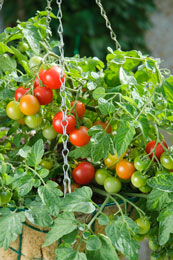
Tomato Pritchard (top) from the USDA was an AAS Gold Medal winner in 1933. The last tomato to win an AAS award was Terenzo (left) from Pro-Veg Seeds in 2011.
As most growers know, seeds need certain conditions for optimum germination. How these conditions are provided varies on growing structures and from grower to grower, but basic germination principles always apply. In order to germinate seeds, adequate temperatures need to be provided to maintain warm soil temperatures.
Next, proper moisture management is vital, along with a growing media with adequate drainage. Although light is needed for certain seeds to geminate, it’s not needed for tomato germination; however, once the radicle emerges, ample light needs to be provided to reduce hypocotyl stretch.
If all three of these principles are in harmony, germination will be successful. Tomato seeds can easily be germinated and grown in plug trays to produce seedlings that can be transplanted between 3 and 4 weeks after sowing. The following information is a general guideline of seedling growth from germination to Stage 4:
Germination through Stage 1: Maintain soil temperatures between 70F and 75F (21C and 23C). Seed germination should occur within 2 to 3 days depending on variety. Evenly moist media is very important during germination and Stage 1. Moisture levels should be maintained at a level 4 until radicle emergence.
Stage 2: Soil temperatures can be reduced between 68F and 72F (20C and 22C). Light levels and moisture management are now very important. Try to maintain moisture levels between 2 and 4. Light levels should be between 1,000 and 1,500 f.c. Once cotyledons are fully expanded, fertilization can begin; however, it’s very important to keep ammonium levels low since tomatoes are very sensitive to high salt levels. Begin feeding with 50 to 75 ppm of a basic or neutral formulation such as 11-7-23 or 15-4-15. Maintain pH levels between 5.5 and 5.8 with EC levels less than .50 mmhos/cm.
Stage 3: Soil temperatures between 60F and 65F (15C and 18C) should now be adequate. Continue to allow moisture levels to dry to a level 2 before irrigations, but avoid excessive wilting. Seedlings can now handle higher light levels; intensities can be tolerated up to 2,500 f.c. pH should still be between 5.5 and 5.8, but EC should now be no lower than .75 mmhos/cm. Continue to fertilize weekly but continue to monitor salt levels.
Stage 4: Plants are now in the toning stage and are ready for transplant or shipment. Soil temperatures now can be decreased further, but monitor moisture levels closely to reduce disease development. Preventative fungicides should be applied to prevent blight or other related issues. If managed properly, tomato plugs can be sustained in a plug tray for up to 2 weeks.
Tomato production can be optimized by proper seed germination. If growers provide proper soil temperature, moisture and growing medium, tomatoes will grow well through the four stages of growth. I learned at an early age the importance of these three factors and will always remember the skills my grandfather instilled in me and how his influence shaped the grower I am today.
GT
Trisha Bills is head grower for C. Raker & Sons, Inc. in Litchfield, Michigan.