5/21/2012
Tips for Keeping Your Greenhouse Up to Snuff
Sam Shroyer
Your structure
• Take a thorough walk around your greenhouse, both inside and out. Look for any loose, worn or rusted screws or bolts. Replace or tighten as needed. Change out any suspect hardware. Replace them now—don’t wait for them to fail! Adjust vents and lubricate rack and pinion systems.
• Carefully inspect your greenhouse covering. No matter if you’re covering with glass, poly film or polycarbonate, you should look at every square foot of your greenhouse. Make sure it’s secure and clean, not cracked or torn. Clean with a mild soap and soft cloth to improve light penetration and plant growth. Poly film that is only a year or two old can be easily repaired with greenhouse repair tape. However, if your poly film is three to five years old, it may be time to consider an upgrade to a new film or polycarbonate.
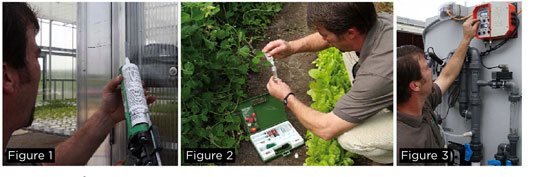
• Inspect your gutters and doors. Gutters often need to be cleaned and re-caulked to prevent leaks and your doors will need adjusting. Doors that seal properly will save you money on heating. Gutters that don’t leak prevent excess moisture and disease problems within your growing environment (Figure 1).
Air quality
• Check your heater or evaporative cooling system (depending on season). Both need to be inspected and tested annually. Evaporative cooling pads should be cleaned and disinfected to optimize airflow and minimize fungus growth. Treat your cool pads with an anti-fungal agent as your manufacturer recommends. Your heating system should also be cleaned and completely inspected. Shop-Vac any dust and debris that may have accumulated and be sure the vent is not obstructed.
• Plants generally enjoy a humidity level between 50% to 60%. If your air is too dry, transpiration is increased and the plants can become easily stressed. In this situation, plants can quickly become dehydrated. Pest problems will also be more likely to arise. If the plants are too moist, fungal diseases (such as botrytis) and mold can become a problem. Horizontal airflow (HAF) fans can help create consistent humidity levels and improve overall plant growth. Inspect all exhaust fan belts and replace as necessary.
• If you really want to optimize plant growth, consider injecting CO2 into your growing range. While humans breathe oxygen and release CO2, plants do just the opposite. Increased levels of CO2 (up to 900 ppm) can “super-charge” the plant’s photosynthesis process. You will notice increased growth and higher yields in a very short period of time. The best time to inject CO2 is during the daylight hours when the plants are photosynthesizing but while your vents are closed.
Water and soil quality
• Send in your water for analysis at least annually. Watch for high pH (most plants prefer 5.8-6.2 pH) and/or heavy metals. Acid injection can often eliminate both problems and provide a more consistent, productive crop. If you happen to grow in an area with low pH, you may need to supplement your irrigation water with sodium bicarbonate (baking soda) to reach your desired pH level.
• The same goes for your soil. Send in a soil sample to help you fine-tune your growing operation. Your local extension agent can help you with this and provide you with sample bags. A prudent grower tests both water and soil often because the pH and nutrient levels can fluctuate (Figure 2).
• Consider an upgrade to a pH/EC controller, such as the Hanna 5000 Mini Fertigation System. Take the guesswork out of your production and know exactly what your plants are getting each time they are irrigated (Figure 3).
Keeping on top of greenhouse maintenance will prevent more costly repairs down the line. By running through this easy checklist once or twice a year, you can keep your growing operation running at maximum efficiency.
GT
Sam Shroyer is greenhouse manager for Growers Supply. With a bachelor’s degree in horticulture from South Dakota State University and 20 years of horticultural experience, it’s his goal to “re-teach” the public that sustainability and self-sufficiency is well within everyone’s reach. For more information on Growers Supply and its line of greenhouses and hydroponic systems, call (800) 476-9715 or visit www.GrowersSupply.com/ADGT.