5/21/2012
The Need for Speed
Chris Beytes
Metrolina Greenhouses knows transplanters. Heck, they pretty much invented them. Blackmore’s original manual Plug Puncher notwithstanding, the Metroplanter, designed by Tom Van Wingerden and built by Hawe, was a pioneering machine in the world of high-speed bedding plant production. Since then, they have owned some 40 transplanters, from every manufacturer you can name. Today, they operate eight machines—six TTAs, one Visser and one FW Systems—to keep their 157 acres filled. But the fastest of them only manages 800 flats per hour.
When we heard they’d taken delivery on a new TTA transplanter that averages up to 1,300 flats per hour, we had to see it in action. So we paid a visit to the Huntersville, North Carolina, range in April to get the details from brothers Art and Thomas Van Wingerden.
First, why the need for more speed?
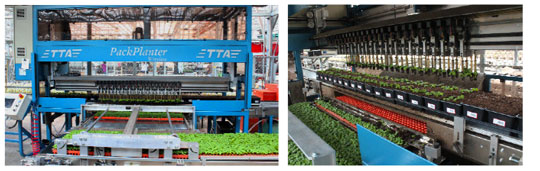
Left: TTA’s Wireless PackPlanter is the newest—and fastest—of Metrolina Greenhouses’
current stable of transplanters. Right: Wireless servo grippers pick up one line of 48 plugs, then separate into two lines of 24 for planting, resulting in high speed with smooth movement.
“Because last year, we shipped out faster than we could fill the place back up,” Art answers, then he adds, “We were like, ‘This is nuts. We can never let Abe or Michael (their brothers, who are in charge of sales and distribution) outsell or outship what we can produce. If we can ship four acres a day out of one greenhouse, then we want to be able to put four acres back in it.”
Two years ago, they were contemplating the next generation of transplanters. That year was also an early spring, like this year, and even running two shifts, 16 hours a day, they couldn’t refill houses as fast as they emptied them. Calculations said 1,200 flats per hour would meet their speed needs.
A second criteria was flexibility. Their current TTA PackPlanters, of which they have five, manage 800 flats per hour, but planting one row at a time, straight up and down. They wanted a machine that was more versatile. And they wanted to stick with TTA for ease of maintenance.
TTA’s solution? The Wireless PackPlanter, which features wireless servo gripper technology. Proven for numerous years in Europe, each servo gripper has its own motor that’s controlled wirelessly through a common bus bar that provides power and data. That eliminates wires (which eventually wear out) and allows each gripper to move independent of the others.
The Wireless PackPlanter has 48 grippers in two rows, compared to the regular PackPlanter’s 36 grippers in one row. Two rows mean each gripper moves a shorter distance, increasing speed. The servo motors can accelerate and decelerate gradually, reducing stress on the plugs when they start and stop. With 48 grippers, they can plant four trays at once time instead of three. Art says the servo grippers allow for tiny adjustments of how each gripper plants, allowing them to plant in the corners of pots or at an angle. “Basically, we can plant any way we want.”
Changeovers are a push button away. Program it to plant two plugs in a 4-in. pot at a slight angle near the edge and “once you’ve got that programmed in, it switches over right away,” Art says. “And it’s amazingly smooth for a fast machine, too.”
Thomas says the new machine is intended for packs, 4-in. and 6-in. pots and 1801 trays. “We could put bigger grippers on it and transplant out of our [88-count] liner trays,” he says. “But they’ve already got another line set up for that.”
Installed in January and run all spring, has the machine performed up to expectations?
“Overall, we’re as happy as could be with it,” Thomas says. Yes, it went through the usual real-world dirt, dust and water bugs, but this spring, running 16-hour days, it’s been averaging 1,200 to 1,300 flats per hour including downtime for changeovers—1,400 to 1,500 flats per hour when not taking stops into consideration. Adds Art, “The machine ran so fast, we had to speed up the drives on the flat filler in front of it so it spit flats out fast enough.”
In fact, they’re happy enough that they’ve ordered a second unit. You can see it at TTA’s booth at the Ohio Short Course next month.
As for payback: “It’s not a cheap machine,” Art admits. But, “When you figure out per hour what you’re getting? For Metrolina and the size we are, it is well worth what we paid for it. I’d say within two years we’ll have our payback.
“We picked a great year to do it,” he continued, “because March was so warm here, we were able to keep that machine running nonstop. Every hour we ran the machine, we ran 400 flats more per hour than we would have if we didn’t have it. Sixteen hours a day, five days a week … in one week, we ran 32,000 extra flats in that machine that we wouldn’t have been able to run.
“And that keeps Abe and Michael busy,” he adds. For more on TTA, go to
www.tta.eu.
GT
Want to see the TTA Wireless PackPlanter in action? Check out author Chris Beytes’ video at tinyurl.com/wirelesspackplanter.
 Glue Dirt
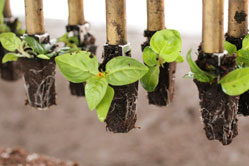
A critical aspect of Metrolina’s speed is plug quality. A plug with small roots will fall apart or not plant accurately. Waiting for roots to mature costs time. “Glue dirt” as Metrolina calls it—or “stabilized growing media” as it’s called by Grow-Tech LLC, the Maine-based provider of the “glue”— is the solution. Metrolina adds Grow-Tech’s binder to their plug mix and that glues the soil ball together so they can transplant a young plug without the root ball falling apart. It makes a big difference in how soon they can patch their plug trays, how soon they can transplant plugs and also in the quality and uniformity of the planting. Currently, 30% of Metrolina’s plugs are grown in glue dirt; they plan to get that percentage much higher.
While it helps the new Wireless PackPlanter achieve its blistering speeds (although, as Art says, “The servo machine is just so smooth, it’s a lot easier on the plant itself.”), Glue Dirt is especially useful with older transplanters, which shake the plugs more than the new, smooth servo machine.
For information on Grow-Tech’s stabilized growing media, go to www.grow-tech.com.