10/26/2011
Integrating Chlorine Dioxide into Horticulture
Peter Konjoian
Management of microbial contamination in irrigation systems and the water they deliver is understood by most growers as an ever-present and serious challenge. Greenhouse and nursery owners and managers continue to educate themselves regarding treatment technology in order to choose the best system for their operations.
One treatment option is chlorine dioxide. Globally acknowledged as one of the most powerful sanitizing agents in existence, this compound is being adopted by the horticulture industry for both production and post-production applications. Advances in generator technology coupled with a commitment by manufacturers to service food and ornamental crop producers and processors has resulted in systems that produce high-purity chlorine dioxide on-site and that are effective, economical and safe.
Municipality mentality
When it comes to understanding chlorine dioxide and how to apply its versatile potential, we need not look any further than municipal water treatment. In Europe, the use of traditional chlorination as a sanitation practice is being replaced by chlorine dioxide due to health and safety concerns. Here in the U.S., while traditional chlorination still accounts for a large portion of water treatment, chlorine dioxide is steadily being incorporated by municipalities from coast to coast. So when it comes to integrating this treatment option into an industry as applied as ours, the wheel doesn’t have to be reinvented. Rather, an effort to learn what municipal water treatment managers already know will serve to fast track the adoption of this sanitizing agent. In short, let’s adopt a municipality mentality. To do so means we need to better understand water management holistically.
Water can be thought of as having three dimensions that pose different managerial challenges. First is its physical dimension that revolves around characteristics such as pressure and flow. Managing this dimension involves a thorough understanding of pumps, filters, pipe diameter … anything that’s involved with moving it from its source to the crop.
Second is its chemical dimension that includes pH, alkalinity, dissolved elements and so on. Managing irrigation water chemistry requires injection, monitoring and adjustment to insure the quality of the water being delivered is of certain minimum standards for acceptable crop growth.
Third is its microbial dimension, which is the subject of this article. Perhaps the least understood of the three, the microbial profile of the water in a given system is now known to affect crop growth profoundly.
Woodburn Nursery Case Study
Tom Fessler’s family owns and operates Woodburn Nursery in Woodburn, Oregon. Woodburn Nursery is well-known nationally as a highly respected propagator and finisher of woody ornamentals with a specialization in azaleas.
Tom attended last winter’s Water Education Alliance for Horticulture Water Management Workshop in Portland. The Alliance is overseen by Dr. Paul Fisher at the University of Florida and a primary goal is to provide cutting-edge research results and education in water management to the horticulture industry.
Tom’s family has invested heavily in modernizing both the greenhouse and outdoor production areas of the business, setting a course for a profitable future. He is currently upgrading his irrigation system to achieve complete recirculation throughout the nursery. One of the challenges with recirculating water is of particular importance to him.
“All of our water is recycled and used back on the nursery,” said Tom. “We grow host plants for Phytophthora ramorum (Sudden Oak Death), so we need to treat our water.”
When asked what treatment options were considered and why he decided to go with chlorine dioxide, Tom replied, “We tried liquid chlorine and still used chlorine gas. Chlorine gas has worked for us but we are concerned with the safety of the material. We have used hydrogen peroxide products in our propagation, but have encountered slime build-up in our filters and nozzles. We wanted something safer than chlorine gas, but at least as effective. We realize chlorine dioxide is more expensive, but it also gives us more benefits. We get rid of the biofilm in our pipes, so there are no plugged nozzles and filters.”
 Integrating Three Dimensional Management
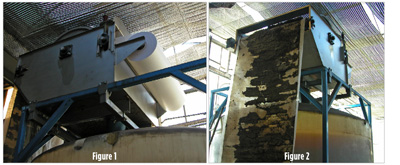
Tom is accomplishing some of his filtration via a belt filter that receives returning water from the greenhouse production area. The accompanying pictures show the filter mounted above a storage tank. The first picture (Figure 1) shows the feed side of the paper belt; the second (Figure 2) shows the spent belt after removing organic matter from the return water.
A very important point when discussing water management is that of thoughtfully integrating management practices for all three of the dimensions. Often growers address a single dimension without adequate consideration to the other two, resulting in ineffective results or wasted resources. For example, treating return water with a sanitizing agent prior to filtration wastes chemicals and money. Filtration should always be accomplished first to minimize the organic load. While on the subject of filtration, more of us could benefit by adopting the philosophy that one can never have too much. Staged filtration strategically placed throughout an irrigation system can be the best money a grower spends.
Tom chose AquaPulse Systems to install, service and monitor his chlorine dioxide generator. Describing the level of success that has been achieved with the APS generator and injection of chlorine dioxide into irrigation lines, holding tanks, ponds, etc., Tom said, “Some minor breakdowns, but they were fixed in a timely manor. It appears to be working well. One system has pipe with 30-plus years of biofilm build-up so it is taking longer to see a higher residual at the sprinkler, but our newer system cleaned up quickly.”
His knowledge of biofilm and how it affects an irrigation system is commendable. Biofilm accumulates in any irrigation line, drip tube, holding tank and even ponds. It flourishes in irrigation systems carrying fertilizer, common in every greenhouse and most nurseries. The older the pipe, the thicker the biofilm layer lining the inside. Biofilm also teams up with algae in a symbiotic fashion; what one needs the other provides. As a result, green algae is commonly found inside underground pipes even in the absence of sunlight.
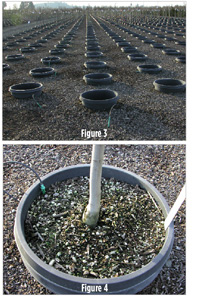
Woodburn is gradually installing the outdoor production system known as “Pot-in-Pot.” Figure 3 shows a field where the in-ground permanent holding pots have been installed. The second picture (Figure 4) shows a production pot with a tree set inside the holding pot with a drip tube for irrigation. Eliminating the clogging of these tubes with algae and biofilm are high on Tom’s list.
Two more questions posed to Tom brought the following responses. If success has not been achieved in specific areas of water management in your operation, what are these areas and what level of success would you expect to achieve?
“Pond water is an area for us to work on in the future,” he said, but admitted, “I do not have an answer yet. We will over time be switching more of our chlorine gas systems to chlorine dioxide. We wanted to be sure before going all the way.”
Tom’s scientific approach to addressing his irrigation challenges seems to be paying dividends. He sought out education, made an informed decision and is proceeding thoughtfully, all the while with an eye on the big picture.
GT
Peter Konjoian is president of Konjoian’s Floriculture Education Services, Inc. in Andover, Massachusetts. He can be reached at peterkfes@comcast.net.