8/25/2011
Monitoring Water Stress in Cuttings
Jason Fatten
The most critical key to success for any propagator is water management. Vegetative cuttings are reliant on water applied through mist or fog systems. Water-stressed cuttings are slow to form callus if not desiccated completely. However, a waterlogged cutting will continue to develop callus and likely rot. Plus, continuously wet cuttings will form large amounts of callus with little or no root initiation. Cuttings need some amount of water stress to promote root formation after callus has formed. Since the amount of stress is unknown, propagators begin reducing mist at this stage.
Vapor Pressure Deficit (VPD) has long been used for controlling mist events while propagating geraniums, but we’re now modeling all vegetative crops for moisture needs during propagation. Most computerized greenhouse control systems (i.e. Argus, Priva) and many boom systems (i.e. GTI, Quantum, Cherry Creek) have the option of controlling mist and irrigation events based on VPD.
 What is VPD?
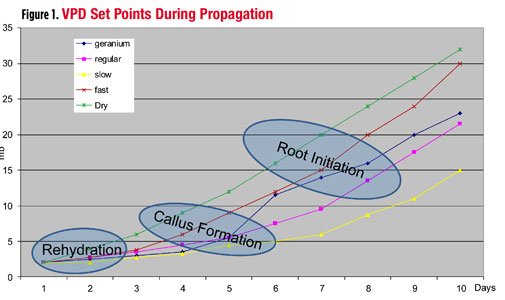
VPD is often a frightening term, but a degree in rocket science is not required. VPD uses some complex mathematical equations that seem to make sense only to environmental physicists. To the novice, VPD measures the interaction between relative humidity and leaf temperature on the environment. Think of VPD as the measure of potential water loss out of a plant. As the leaf temperature increases and relative humidity decreases, cuttings dry at a faster rate causing water stress, increasing VPD. More frequent mist events compensate for this increased water stress. When temperatures decrease, relative humidity increases. This slows water stress on cuttings and lowers VPD. VPD control systems monitor these sudden changes in environmental conditions and apply more or less frequent mist depending on the current conditions. Figure 1 shows the Argus VPD set points we developed for various crops for the first 11 days after sticking cuttings.
 Tracking changes in VPD
Tracking the daily VPD of the propagation environment can also yield changes to other environmental controls to minimize stress on cuttings during their early stages of rooting. Look at the rooting environment at a macro level: By controlling heating, cooling, humidification and dehumidification, we control the amount of stress on cuttings.
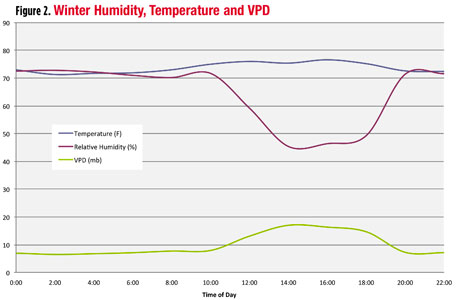
During late winter months when propagation greenhouses are full of fresh cuttings, ventilation is often required to cool the environment. But what happens to the VPD? Forcing cooler, drier air into the rooting environment causes the VPD to increase. The relative humidity and temperature decreases lead to a spike of stress on cuttings and the need for more frequent mist events. As shown in Figure 2, a sudden decrease in relative humidity and sharp increase in VPD occurs when cooling.
We found with a large water stress, many VPD control systems could not replace water lost during this mid-day spike fast enough. VPD is accumulating at a faster rate. However, by the time the controller calls for irrigation, cuttings have dried too much. We tried lowering the set point or increasing the duration of the mist events and over-saturated cuttings during the rest of the day.
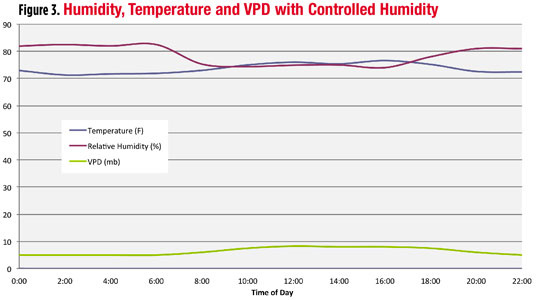
By maintaining a relative humidity, we can minimize the mid-day VPD spike and reduce additional water stress on cuttings. In our greenhouse, we chose a base of 75% RH since this reduced the drastic mid-day VPD spike, shown in Figure 3. Since the VPD during the day is still greater than during the night period, the cuttings are receiving water stress needed for rooting. This stress is much less than using no humidity control.
By using additional humidification, we are able to fine-tune the amount of water applied to cuttings. This avoids excess saturation and speeds rooting. By only replacing the volume of water cuttings lost, we also reduced the number of mist events per day.
GT
Jason Fatten is technical manager for Ball Innovations in West Chicago, Illinois.