7/26/2011
Changing Identities
Pam Buddy-D’Ambrosio
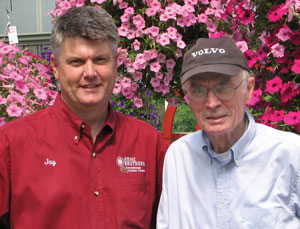
Twenty years ago when Heinz Brothers Greenhouse in St. Charles, Illinois, was featured in the August issue of
GrowerTalks, Joel Schrock was in charge with the help of general manager/grower Bob Bailey. At the time, they spoke of an identity crisis—greenhouse or garden center? With the crisis resolved and Joel’s son, Jay, at the helm of Heinz Brothers Greenhouse Garden Center, everyone is headed in the right direction.
The original name of the business was acquired when Joel bought Heinz Brothers Greenhouse in 1979. Joel continued the work of the brothers’, sending starter plants throughout the United States, and then he began the wholesale of finished materials in the area.
In 1985, Joel purchased the current Heinz Brothers’ location. Following the purchase, the first section of greenhouses was built. Presently, the total heated greenhouse space is 27,000 sq. ft. on 3 ½ acres. The retail sales area covers about 1½ acres.
The wholesale business lasted until 1990 when Joel decided to go strictly retail. Jay says that it was a major decision. As the popularity of plugs increased, growers had to either purchase all of the equipment or get out of the plug business. Joel felt retail was the better option at their location due to the size limitations and substantial real estate taxes on their property.
Twenty years ago when Joel and Bob were interviewed, their dilemma was, “Are we a garden center or a greenhouse? To be a greenhouse is too limiting.” Today, Jay says, “We know that we could produce tomatoes or peppers efficiently, but it’s easier to buy a tray of one thing; it’s easier to order from a wholesale grower due to our being limited in space.”
Heinz Brothers does grow the materials for 12-in. hanging baskets and combination planters. They also do 14-,
16-, 18- and 20-in. moss baskets. The percentage of live goods to hard goods sold is 60/40. Jay says, “The hard goods keep things going; the statuary and garden accents add to the ambience of the garden center, and capture the impulse sales.”
Water gardens were coming into vogue when Heinz Brothers sold their first one in 1991. Jay says they continue to sell them today, although the majority of the sales comes from the smaller items. “We pick up a lot of people re-stocking their water gardens,” he says.
At present, Joel and Jay own the business, although Joel is not actively involved. Jay’s mother, Joan (pronounced Joanne) works in the office.
The garden center is open all year with reduced hours in January and February. Classes for adults and children are offered from February through December including: Orchids for Beginners; Improving your Home Landscaping; and Plant a Pot for Mother’s Day. There are six year-round employees and 30 seasonal employees. In 1991, there were fewer employees, but more overtime. Jay says now they employ more part-time workers and seasonal labor to reduce overtime.
With the predominant “do-it-for-me” trend, Heinz Brothers’ employees make house calls to install plants in homeowners’ pot and planters. Jay says his customers want “color and impact with little maintenance.”
St. Charles is 40 miles west of Chicago on the Fox River. The community has been transformed into a more commercial area since 1991. Cornfields continue to be replaced by box stores and strip malls. The population has risen to approximately 33,000 from 23,000 20 years ago. Jay says that the bulk of their customers comes from within a 5- to 10-mile radius. They draw from Chicago when the once-a-month flea market is in town. The customers are predominantly female, ranging in age from mid-30s to 60s.
In 1991, Heinz Brothers sold 4,500 hanging baskets in a 12-month period. Jay says that number does not ring true today. He has seen sales decline by 15% in the last two years. Back then, his father had to reduce employees’ payroll by 50%. Jay says that they have had to reduce pay in the last two years, but not by 50%. With the May 2011 unemployment rate for Illinois at 8.9%, Jay says St. Charles has not felt the recession. “We’re not in a depressed area. People are still willing to pay for expertise, selection and quality,” he says.
Back in 1991, the prices at Heinz Brothers were the highest in the local market. Jay says the prices remain the highest today. Twenty years ago a geranium hanging basket was $19.99; a petunia hanging basket in 2011 is $49.99.
Jay says the competition for the flower dollars comes from box stores to grocery stores. “We’re aware of the competition, but we’re concerned with what’s making us the money,” he says. In a six-month period, annuals made up 42% of the sales and perennials, just 9%.
In 1991, Bob Bailey knew that amateur gardeners buy with three considerations: instant color, long-term color and low maintenance. Jay concurs and is sure to have the plants and materials that customers want.
Tips from Jay:
- “Promote fertilizers to customers. We do extra fertilizer on plants, a slow release in pots, which ensures the customers have better plants once they bring them home.” “Where can sales be increased? Where can prices be increased?”
- “If we are long on 4-in. pots, we’ll bump them into combo pots, package it differently—make a bigger pot with ‘long’ items and charge a higher price.” GT
Pam Buddy-D’Ambrosio is a freelance writer in New Rochelle, New York.