1/26/2011
Southern Hospitality
Jennifer Zurko
When you think of poinsettia growers, Texas isn’t the first state that comes to mind. But, according to the USDA’s Census of Agricultural Specialties, it’s the fourth largest state in horticulture crop sales—and this includes
poinsettias.
We did see some stellar poinsettia plants, in the greenhouse and the garden center, but we also saw lots of pansies, herbs and ferns that have made Texas a hort hotbed. (Fortunately, December is NOT one of the months with temps in the 100s.)
Nortex Wholesale N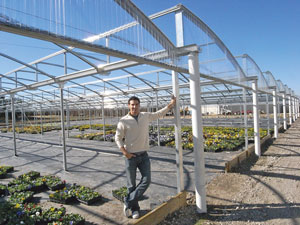 ursery
Northeast of Dallas is the town of Wylie, where Nortex is located. After a good-morning greeting from his dog, Barley, Aaron Pinkus sat down with us to talk about how he became the company’s vice president and general manager.
Aaron is Nortex’s third generation to run the business. His grandfather Ralph opened a retail garden center (Northaven Gardens) in Dallas, but needed a more reliable source for plant material, so he started the wholesale part of the business in 1971. Aaron’s father Joe took over and, after graduating from the University of Colorado with a finance degree, Aaron now helps him run Nortex, supplying local garden centers and grocery chains with bedding plants, poinsettias and herbs.
When Aaron first became involved seven years ago, there wasn’t a formal planning process in place. Both the staff and inventory was way more than they needed, resulting in a lot of waste on many levels. He designed a computer program that helped them track inventory and better manage their product offering. Now, the business is much more streamlined and efficient. They also beefed up their offering because “the more variety we have, the more sales we get,” said Aaron.
Although much of their growing space was filled with poinsettias waiting to be shipped out, Aaron said they’re only a small portion of their lineup. They grow lots of gerberas, begonias and pansies, but about 25% of their business are herbs sold under their Blue Label brand. They grow 50,000 herbs in gallons and 1.1 million in 4-in. pots.
This year, they grew more poinsettias—about 32 different varieties—mostly to test out some new cultivars because they had some nutrition issues in 2009. Ninety-nine percent of the 45,000 poinsettias Nortex grows are in 6-in. pots.
Since 2009, Aaron has been adding to the facility to keep up with the 43% increase in sales they’ve experienced during the last three years. They built a new house with heated benches and were just finishing up 1.5 acres of saw-toothed, gutter-connected greenhouses for indoor/outdoor production. These houses are only 8 ft. to the gutter and were very reasonable to build—Aaron estimates about $3.00 per sq. ft. (To see Aaron talking about these new greenhouses,
CLICK HERE.)
So, Aaron wouldn’t be building on if he weren’t optimistic about the business, right?
“You can’t build anything on pessimism,” Aaron said. “We’re not in control of the market, but we are in control of how we react to it. You have to adapt and that’s what’s made us successful.”
 Calloway’s Nursery
Calloway’s is a well-known retail chain that has 17 locations within the Dallas area, so we knew we would eventually stumble upon one of them. We stopped at the Dallas location where Assistant Manager Bill McNeese said the 800 poinsettias he had were almost all sold out—the 80 that were left over were all special order. Bill said most of his customers go for red poinsettias, and many chose to buy the Winter Rose types. Calloway’s also sells quite a few cyclamen and hand-made evergreen swags during the holidays.
What really caught our eye when we walked in was the beautiful, flocked tree. Calloway’s offers their customers Christmas trees of all sizes covered with pure-white “snow.” When we guessed at the price (it had to be over $1,000), Bill laughed and said that most of the larger flocked trees sell for about $240. Now that’s a reasonably priced way for Texans to add some Winter Wonderland inside their homes.
Ruibal’s Plants of Texas 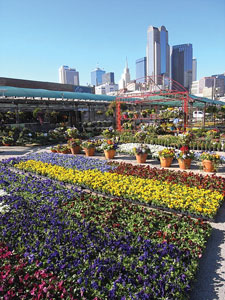
Another local garden center was also busy moving poinsettias—and pansies—out the door for the holidays. While Ruibal’s Lakewood location is the place for pansies, the store in downtown Dallas had more variety for Christmas, including ornaments, lights and other holiday fare.
When we ask Mark Ruibal how the poinsettia business was doing, he said that they were up from the previous year. This year, they sold about 5,400 plants in four different sizes, with red being the most popular choice, followed by pink and white.
One thing we noticed was that Ruibal’s merchandises all of their flats on the ground—no benches or carts anywhere. When we questioned Mark about that, he smiled and said that’s how the customers view them in the garden. And the customers don’t have to bend down to pick them up because the employees are required to be there immediately to help them, said Mark.
Seville Farms
We headed south to Mansfield, the primary location of one of the largest growers in Texas. During the last four years, Seville Farms has grown from two locations to six, and their success has allowed them to purchase facilities throughout North and West Texas.
Run by brothers Billy and Bobby Brentlinger, Seville Farms started out as a tree farm and nursery, but quickly moved into the bedding plant business in 1994. Their main customers are the big-box stores, along with a few grocery and hardware chains.
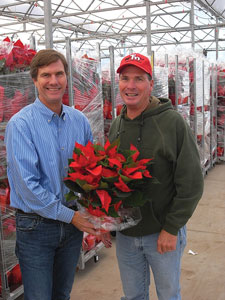
Bobby said they’re “not your basic annual provider” and never really were. They’ve maintained a simple lineup of perennial plants, shrubs, succulents and poinsettias at a premium price—which means they don’t grow those 99-cent poinsettias for Black Friday. Billy said they aren’t pressured to grow them because their customers don’t ask. Most of the poinsettias they grow are for independents, who are looking for a higher-quality plant and container.
When they first started the company, Billy said they were forced to take on every request. “Now we have enough volume where we can say no to something after we look at it,” he explained. “The key to success is knowing your cost—your true cost—and being willing to walk away from business if you have to.”
Billy said that despite the current economy, he’s optimistic about the industry. “Gardening is a long-term endeavor and demand at the retail level is strong,” he said. “Plus, we’re positioned in a part of the market that is strong—geographically and product-wise.”
Bobby sums it up with this quip and a smile: “We could be doing something that’s a little easier, but I don’t know what that would be.”
YC Nursery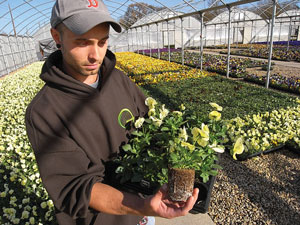
Our first thought was “We’re lost” when we turned onto Reeder Road, but then YC Nursery came into view in the midst of a very industrial area of Dallas. We soon learned that the only thing that matters is if the landscapers know where to find them.
GM Tammi Zigenfus said that 98% of YC’s business is landscapers, most who drive right up to one of their two locations to fill their trucks with flats of pansies, dianthus, dusty miller and groundcovers. In 2009, they started offering perennials and are planning on expanding to include more this year.
Although the business has seen some re-organization, it’s helped to streamline their product offering and save on labor costs. They went from producing 1,500 flats per day to 12,000 with additional automation, and the development of their Direct-Grow Tray gets more plants on the racks while helping the landscapers. The button at the bottom of each cell makes it easier for workers to remove the plant without dealing with more plastic. And YC gives their customers incentives to return the empty trays for recycling or sanitizing—which have saved them $250,000 in plastic.
Tammi said they stay competitive because of their pricing and large product offering. “Volume pricing speaks to us,” she says, and they don’t sell the same colors year after year. Plus, their willingness to adapt to change and their quick product turn-around (average crop time is four weeks) help them get new business.
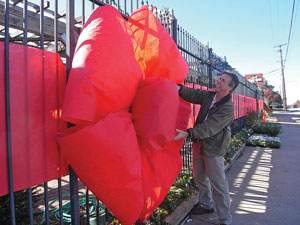 Nicholson-Hardie Nursery & Garden Center
Both of Nicholson-Hardie’s locations are down the street from each other on Lovers Lane in Dallas. The smaller location was literally wrapped in a gigantic red ribbon that hardgoods buyer Mark Jones created out of 350 ft. of floor runner material, along with chicken wire and zip ties for the bow. It was an impressive sight and certainly drew people in to buy one of their 1,100 Christmas trees. (To see a video of this giant ribbon,
CLICK HERE.)
The other location was where you could buy the ornaments for your tree, plus have your pick of poinsettias and other holiday plants.
Casa Flora
Our last stop was not poinsettia related, but it was certainly interesting. Casa Flora’s president Richard Lim invited us for a behind-the-scenes tour of the fern producer’s facility, which included a peek into their tissue culture lab. We also had the privilege of meeting owner Naud Burnett II, a landscape architect who bought the business 43 years ago after his friend talked him into growing ferns. Now 83 years old, Naud leaves the day-to-day to Richard, whom he says “brings the brains to the business.”
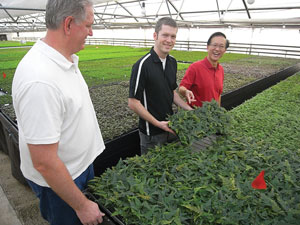
A fern’s life cycle is a long, delicate process that begins in a sterile lab. The plantlet goes from a shallow Petri-like dish and is transplanted by hand into a 512 tray. Six weeks later, it’s ready to be moved into a 72 tray, which sits in the greenhouse for six to 12 weeks before it’s shipped to the grower. Richard said they have three million ferns growing in just one of their houses at one time and sell approximately 10 to 20 million plants per year, which also includes one million heucheras.
During his six years at Casa Flora, Richard has been busy growing the business. Final negotiations are currently in the works to purchase a new facility with 240,000 sq. ft. of production space for a new collection of “boutique” ferns that will be grown and sold in a 4-in. pot. Casa Flora has also recently opened a tissue culture lab in China.
Richard said that the “Holy Grail” of success is “being a value to your customers.” He said the company has a clear, focused objective to always provide the best quality product at competitive pricing with the best service. It’s all about executing and doing it properly, he says.
GT