11/24/2010
Horti Fair 2010: Mixed Emotions
Ron van der Ploeg
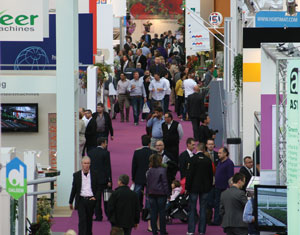
The 23,256 international visitors and 530 exhibitors from 37 countries returned from Horti Fair with mixed feelings.
On the one hand, in difficult economic times, exhibitors noticed an increasing interest in smaller, more affordable new products that can give them some cost savings. But at the same time, some participants described the show as uninspired, with an overall absence of flowers and a disconcerting lack of attendees on Friday.
The debate over the sense and nonsense of Horti Fair has never been as vivid as this year. Following the announcement during last year’s Horti Fair of a new show, the new International Floriculture Trade Fair (IFTF), which took place November 3 to 5 in nearby Vijfhuizen, pros and cons of participating in this year’s Horti Fair had to be carefully weighed. As a result, most breeders decided to opt for Vijfhuizen, in part because it offered more convenient show dates at the beginning of November. Meanwhile, most of the greenhouse and equipment companies remained faithful to Horti Fair as a premier innovation platform and internationally oriented meeting place of horticultural businesses.
Next year, Horti Fair will be held from November 1-4, 2011. This will be during the first edition of what’s being called “International HortiWeek,” the week during which Horti Fair and the FloraHolland Trade Fair will be held in association with one another. Joint promotion, carefully coordinated exhibition concepts and shuttle services will be elements of the cooperation between them. Other hot items will be the linking of the home market and internationalization. IFTF, which drew an estimated 10,000 visitors, will host a second edition at the same time, giving you three events in the Netherlands in the first week of November.
Behind-the-scenes tour 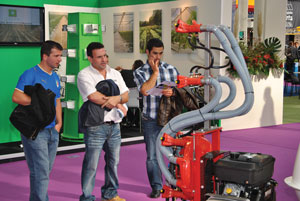
Horti Fair opened its doors on October 12, but one day earlier, growers from around the globe could visit the best of the Netherlands’ horticultural technology. The joint open day at 17 companies in Aalsmeer and the Westland continued the success of the Flower Trials, the annual open days for the bedding plant industry. The participating companies provided growers the opportunity to meet technical staff and discover more about the latest developments in the field of automation, climate control, lighting, logistics, crop protection and irrigation. Tours of nurseries also took place. Peet van Adrichem of the Technical Trials said, “The joint open day provided a good opportunity to see what Dutch horti technology can offer in terms of innovation, reliability, service and support.”
LEDs lighting up
The launch of the first series of LED products for horticulture at the 2007 Horti Fair in Amsterdam was a sound success, if you judge it by the amount of press and blog coverage devoted to the new technology. But it also left the industry with more questions than answers. Now, three years later, Dutch electronics giant Philips announced at Horti Fair that it has teamed up with no less than four new greenhouse growers to evaluate LED growth lighting.
In Denmark, Philips joined forces with kalanchoe breeder and producer Knud Jespen A/S in Hinnerup. The company will use Philips’ “GreenPower” LED modules to optimize its automated production process. In 2010, Knud Jespen A/S Queen Kalanchoe set up its first installation with GreenPower LEDS under their rolling benches, to create a second cultivation layer. By incorporating the appropriate light “recipe” in the system, it’s now possible to grow plants in the second cultivation layer at various times. This enables the control of the growth cycle and has led to an enormous increase in the company’s production and buffer capacity. This autumn the project will be completed when Philips LED modules are installed on the remaining 14,000 sq. ft.
Priva premier
Despite this year’s decline in size, participants and visitors of Horti Fair were still the place to be for Priva, a key player in the field of automated climate and process control in both the horticultural and commercial/consumer building climate sector. Commenting on this year’s Horti Fair, Priva Communications Advisor Wilma van der Lely said, “The number of visitors of the Horti Fair was a third lower than last year, but the quality of the contacts was very high. As usual, the busiest days were on Wednesday and Thursday. Friday was a particularly quiet day, even at the Priva stand!”
A new product from Priva at Horti Fair was the HP/UV-oxidation module on the Vialux HD/UV disinfection unit. Disinfecting using hydrogen peroxide results in a more effective and thorough disinfection of water. Consequently, the water and nutrients can be reused without disease problems. This provides a substantial saving in fertilizers use and costs. It’s also good for the plants because less water is discharged, it’s cost-efficient and the crops have a longer life expectancy. Moreover, hydrogen peroxide isn’t harmful to the environment. It breaks down totally into water and oxygen—no hydrogen peroxide remains in the drain water.
 Bercomex steals the show
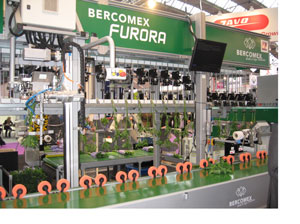
Bercomex, a leading developer and manufacturer of solid-state grading and bunching machines for the cut flower sector came to Horti Fair to introduce what it calls the new, revolutionary Bercomex bunching machine.
On the opening day of Horti Fair, a group of renowned flower growers—the first to invest in the fully automatic machine—helped to unveil its name: Furora. This breakthrough in technology is a grading and bunching combo machine, able to process 14,400 stems per hour, transforming them into sealable, takeaway bouquets. So far, the Furora is operational at calla, solidago, aster, chrysanthemum and tulip companies with full automatic stem separation and vertical suspension of the flower to reduce the interference of employees to an absolute minimum. In some cases, growers have seen a 50% reduction in costs. Furora has a modular and versatile design that allows each customer to configure their own machine with complete flexibility. The cost of a standard machine is around €300,000 ($427,000).
Bercomex took the opportunity to demonstrate Furora processing rough, unsorted alstroemerias. The display was a huge success if you judge by the number of people carrying an alstroemeria bouquet.
Less is more
Horti technology manufacturers are feeling a pinch in demand for new products as a result of growers’ tightening wallets. Therefore, they’re focusing on affordable new products that can result in cost savings for growers. One example would be Berg Product’s BergBand system, a new generation of conveyor belt that no longer require standard components such as bearings, cylinders and supporting structures.
BergBand features a special fabric belt that lies directly on the floor. It can transport up to 4,500 kg (about 10,000 lbs.) of pot plants. On one side of the pathway, the belt travels up the greenhouse, while on the other side the belt goes down the greenhouse. The advantages are numerous: It can be connected to existing transport systems; it saves space over other internal transport systems; and it’s up to 50% cheaper than traditional conveyor belts. BergBand is suitable for transport of flats as well as pots from 10 cm (4 in.) and up.
The BergBand won the prestigious Horti Fair Innovation Award for “the power of its simplicity, the wide range of applications in horticulture both in the Netherlands and abroad, and the relatively low capital outlay.”
 Welcome to the jungle
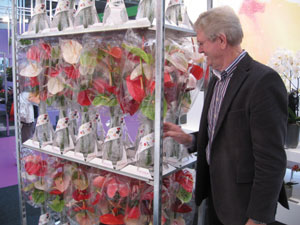
Anthura unveiled the “Full Colour—Anthuriums from the Jungle” concept, which features a wide variety of colors that make these cut anthurium perfect for creating seasonal flower arrangements, as well as for creating modern mono bouquets. Anthurium are wrongfully considered just a filler flower, and the Full Colour concept aims at changing this traditional image. Full Colour features three flow-packed bouquets, each containing four anthurium flowers, which are placed in a handmade glass vase. The vase is placed in a strong cardboard base to offer maximum stability and protection during transport. The vase can even be held upside down and laid horizontally, as there is no water contained.
The concept comes with simple care hints and tips, including a cutting tool and greeting card. Full Colour is targeting the retail supply chain offering major benefits such as 12 times less packaging material compared to the traditional anthurium package, a seven-day retail shelf life, and optimal profit per CC trolley.
Mardenkro has it covered
Mardenkro proves once again to be a true innovator in the field of high performance greenhouse coatings. It’s newest shade paint, ReduFuse, provides seasonal paint-on shading that allows the light to penetrate deeper into the crop, increasing the process of photosynthesis, improving product quality and increasing production levels while still offering the benefits of shading. ReduFuse can be easily removed in autumn, and it represents significant lower initial cost over diffused glass.
In a comparison test, a greenhouse section containing cucumbers was treated with the coating in June. At the end of the harvest, half way through August, this crop showed, despite being grown under lower light, to have produced 4.5 percent more fresh weight and over 7 percent more cucumber compared to a section that hadn’t been treated.
Mardenkro wants to test this product more in 2011 before bringing it to the market in 2012.
Staying true to innovation
Biological control company Koppert swept the board with no less than 10 innovations showcased at this year’s Horti Fair. Trade-show goers, particularly those from potted plant companies, showed special interest in the “Distribug,” an automated dispersal system that allows a better application of soil-dwelling predatory mites.
Current automated production systems makes it difficult to use existing application methods in potted plants, making it hard to achieve a balanced distribution of predatory mites and to generate a good population in each pot. With Distribug, the dosage, speed and range can all be adjusted, the number of predatory mites per square meter can be determined with precision. The system mounts above the rolling containers. Sensors register when a rolling container is approaching. The device can be filled with a day’s supply of soil-dwelling predatory mites.
GT
Ron van der Ploeg is editor of FloraCulture International, Amsterdam, the Netherlands.