10/15/2009
Thinking Outside of the Box
Barbara Mulhern
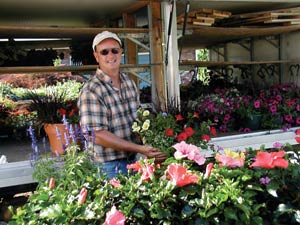
For Greg Blankenship, thinking outside of the box comes naturally.
Greg, owner of Gregory’s Greenhouse Productions LLC in Knoxville, Tennessee, increased his sales 20% this year by focusing more on vegetables, herbs and berries.
“I sell mainly wholesale to local garden centers/contract growers, but also retail at our local farm markets,” he says. “Everybody I know has a vegetable in his or her landscape or in a container or is adding a few vegetables to a flowering garden. I also offer customers a whole genre of different annuals and 50 different varieties of perennials.”
Greg, who started his business as a dogwood tree nursery in 1991, adds: “I believe all growers have got to think outside of the box. You have to learn how to recreate yourself every two to three years.”
Early on, Greg incorporated some landscaping and lawn care into his nursery in order to generate the cash needed to become established in business. Over the years, he started building greenhouses and learned how to grow many different types of plants.
Today, Gregory’s Greenhouse Productions has about 6,000 sq. ft. of greenhouse growing space and an additional 3,000 sq. ft. outdoors. “I’m not a huge operator, but I put out about $300,000 worth of product every year. As a small grower, I can manipulate what I grow pretty easily,” Greg says.
It was well before he opened his dogwood tree nursery that Greg learned to reinvent himself and to think outside of the box. A severe head injury when he was a child necessitated learning how to walk all over again. He also had to find alternate ways of learning such skills as reading and writing that would work for him.
Despite the fact that he had been labeled as someone who would never be able to read or write at a functional level without assistance, Greg graduated from high school, then took horticulture classes at both Walters State Community College and the University of Tennessee.
He now grows approximately 90% of the products he sells and has found ways to ensure that his wholesale and retail businesses “feed each other,” as he puts it.
Keys to Success
About 80% of Greg’s business is wholesale. Among his customers are independent garden centers, independent stores, one chain store, other wholesalers and fruit and garden stands. On the retail side, he sells his product at three local farmers’ markets that attract customers with incomes across the board.
“I root about 75% of my own cuttings,” Greg says, and sells a lot of his annuals in four-and-a-half inch pots. He starts his perennials from unrooted cuttings the last part of November.
With the increasing trend toward edible gardens, Greg also now grows about 50 varieties of herbs and vegetables—a focus that has brought him “huge success,” he says even in today’s down economy.
Greg’s wholesale market drives his farmers’ market demand. “I have to look at branding my product,” Greg says. “My farmers’ market customers will ask me where to buy a product and I will give them the name of an independent garden center. My wholesale and retail feed each other.”
Being able to rotate your crops quickly is another key to success for a small greenhouse grower, Greg believes. “I rotate crops through my greenhouses five to six times a year and use my outside growing space for rotations,” he says.
In order to successfully do this, Greg needs to know exactly when to get his unrooted cuttings in, when to get them rooted and when to get his other plants in.
“Educating yourself to rooting your own cuttings can result in a tremendous amount of savings,” he notes. “My overhead has dropped by about $24,000, mostly from rooting my own cuttings, and also from mixing some of my own perennial mix. When you have to pay 50 cents to 60 cents a cutting versus 8 cents to 20 cents a cutting, that adds up quickly.”
Tips for Other Growers
Greg has these suggestions for other small greenhouse growers:
Be a visionary. Envision what you can be doing, then do it. Greg attends industry events and sites such as the OFA Short Course and Longwood Gardens to get new ideas. “They (Longwood Gardens) create something that awes people. You then take that and put it in a smaller package for your customers,” he says.
Think big. Greg will order an entire tractor-trailer of soil at a time. “You make money when you spend money,” he says, adding that it’s important to spend enough money to attract a “higher quality” customer. “I know one chain of stores that buys its product at $4 to $5 a flat. But it looks really cheap and sells cheap. It hurts their market because they have a cheaper customer coming to their store.”
Be open to new products and to new approaches. This includes both new ways of packaging plants and changing what you grow. “Growing blackberries, blueberries and raspberries has been huge this year,” Greg says. “It really drives the late fall and early spring market.”
Be a customer. “You have to be willing to change with the needs of your customers. You have to talk to your customers and just be a customer. Ask your customers what they’re not getting and what you can do for them.”
Barbara Mulhern is a freelance writer from Verona, Wisconsin.