8/15/2009
Riding a New Wave
Chris Beytes
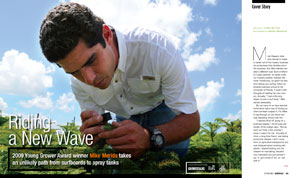
Most Hispanic kids who decide to make a career out of the nursery business do so because their families are in the business. But Mike Merida traveled a different road. Born in Miami to Cuban parents, he barely knew our industry existed. Instead, like most Florida kids, he spent his free time fishing and surfing. When he entered business school at the University of Florida, it wasn’t with thoughts of starting his own nursery. Actually, “I had a life-long dream to own a surf shop,” Mike admits sheepishly.
But as many of us have learned, horticulture has a way of finding us when we least suspect it. For Mike, it was through an old friend who was attending school with him.
“I started off at UF going for a business degree,” the 32-year-old recalls of his college days. “But as soon as I took a few courses I knew it wasn’t for me. A buddy of mine, a long-time friend, was taking some hort classes. I don’t come from an agriculture background, but was intrigued about working with plants. I started looking into the classes he was taking, became very interested and just picked it up—it got a hold of me, so I ran with it.”

Hooked on this new world of plants, the surfer changed his major and earned a bachelor’s degree in ornamental horticulture with a specialization in tropical fruits. Not content to stop there, Mike signed up for UF’s Doctor of Plant Medicine program—a four-year series of graduate level classes in all the agricultural disciplines: soil science, entomology, plant pathology, nematology and more.
Three years ago, after nearly 10 years in Gainesville, Mike returned to South Florida armed with a serious level of education and ready to enter the industry that, a decade before, he barely knew existed. Well-educated and enthusiastic, he was offered positions at every nursery he interviewed with. But it was after several meetings with Jose Costa that he “saw the infinite possibilities” at Costa Farms, where today he serves as head of Pest and Disease Management for the 1,100-acre Homestead operation. Oh, he grows 70 acres of foliage for them, too.
Agriculture as a calling
Mike’s father’s and mother’s families migrated to South Florida from Cuba in 1961, the year of the Bay of Pigs invasion. His parents met here; he and his sister were born in Miami. Those humble beginnings were the foundation of a strong desire for education and opportunity for the Merida children.
“My parents came to this country with absolutely nothing,” Mike says. “My mom arrived here with her sister and a suitcase when she was just ten years old. My grandparents had to work long hours at a factory just to provide for the family. My parents also struggled working long hours and then going to school at night after working a full day, but they never had the opportunity to just concentrate on their studies. Given their circumstance and hardships all they wanted was for their children to have an education. That’s one thing my parents pushed, for my sister and I to get a degree.”
Considering their background of hard work, it would seem that Mike’s parents would probably have wanted him to go into a profession like law or business or engineering —certainly not agriculture.
“When you’re just starting out in college they obviously try to push you to be a doctor, a lawyer, one of the big professions,” Mike replies. “But at the time they didn’t have a clear-cut idea of what I wanted to do. I can tell you right now, they’re very, very proud of where I am today.”
Then he recalls a running joke he has with his friend, Costa production manager, Rene Cairo.
“Rene has been in this industry thirty some-odd years, but he didn’t go to school for it. He always tells me, ‘My mom said don’t get into agriculture, son, it’s a very tough career!’ But he went into it anyway, and he’s now very successful at what he does. Now his joke about me when speaking to his mom is, ‘Mom, you know how you said I’d have to be dumb to go into agriculture? Well, I found someone dumber than me—he actually went to school for agriculture!’ I love that joke. I always hold on to that, and I always rib him about it.”
Times may be changing
With 38% of its residents claiming Hispanic descent, South Florida may be unique in its number of minority-owned or managed nursery operations. But that doesn’t change the fact that Hispanics most often take a support, rather than a leadership role, in horticulture. Does Mike see opportunities for Hispanics in positions other than labor?
“I think that has a lot to do with upper management,” he answers. “It depends on their outlook on the business and where they want to take it. If you’re an open person, if you’re a dynamic person, you’re seeing beyond that kind of racial boundary. You can see the person for who they are, and if they’re capable of doing a job, and doing it well. That’s my way of thinking.”
But it’s not just about an employer being open-minded, he adds. The Hispanic employee has to prove him or herself, too. “You can’t just expect to be promoted to a position without working hard for it. You really have to prove yourself out there in the field. I believe the opportunities are definitely there, if you have the drive to succeed.”
What advice would Mike give young employees—Hispanic or otherwise—who want to climb the ladder or eventually run their own business?
He pauses briefly before answering. “The most important things to keep in mind are to work as if the business was your own, stay focused on current as well as future goals, and always keep an open mind.
“But beyond that,” he continues, “there are three words I’ve realized from working here that are extremely important in the agriculture business. First is urgency. Urgency to get the job done. If you see something, you’d better act upon it or it’s going to come back and bite you if you don’t. The second is communication. Communication is vital in this industry, especially getting information across to the people who work with you. And details. That’s a cliché that’s used a lot in agriculture—‘pay attention to the details’—but it’s so true, so critical and necessary that you can’t back away from it.
“This is such a dynamic career, a dynamic career,” he emphasizes. “Nothing is stagnant. It’s always changing, there’s always something new coming up. So always be open, be responsive, be reactive … and think before you speak,” he adds. “If you don’t know the answer, it’s not a bad thing to say, ‘I don’t know.’ Because you’ll find out.”
And as for that surf shop … is that maybe still in the back of his mind?
“The surf shop is nonexistent!” he says with a laugh. “I’m lucky if I get in two surf trips a year. It’s not like it used to be when I could go on vacation whenever I wanted.”