2/15/2009
Going Up?
Chris Beytes
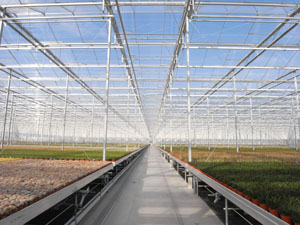
Back in the day (the ’70s and ’80s) you wanted your greenhouse as short as possible to reduce heating costs (or so went the common belief). Some gutters were barely above head-banging height, and 8- to 9-ft. gutters became the norm.
But today, with the abundance of overhead equipment like curtains, booms and basket systems, plus the desire for more light and more precise environmental control, taller greenhouses—14 ft., 16 ft., 18 ft. and even higher—are now de rigueur.
So the question is: Is there an optimum height for your greenhouse? We asked nine greenhouse experts for their views and recommendations.
How high?
“I like a 14-ft. house,” says Gord Van Egmond, who handles U.S. sales for Westbrook Greenhouse Systems. “For the average grower, with one shade system, maybe two, and the average equipment overhead, it’s nice.” He adds that 15 or 16 ft. is a bonus, “but 14 ft. is plenty.”
Scott Thompson, vice president of X.S. Smith, concurs. “What we see more of than anything else is 14 ft., both for production and for retail applications.”
Matt Stuppy, president of Stuppy Greenhouse Manufacturing, expands on that. “On naturally ventilated houses we like to start at 14 ft. and move to 16 ft. if the conditions allow for it. Some growers request lower heights, and 12 ft. still works well for nursery, perennials, and annuals being grown on the ground.”
For various reasons, however, that 14-ft. figure isn’t universally accepted by growers. The biggest resistance is the old (and now debunked) belief that the taller the house, the more expensive it is to heat.
“I still have one or two old-fashioned guys who’ll call up and say, ‘I want a 10-ft. greenhouse—it’s cheaper to heat,’” says Gord Van Egmond, “but I explain to them that that’s not the case.”
Ask any grower who’s gone from shorter to taller houses over the years and he’ll tell you that the heating cost increase (if any) is negligible. That’s because the outside surface of the greenhouse—the part that’s in contact with cold air—is only slightly greater on a tall house than on a shorter house, says Bill Vietas, Rough Brothers’ commercial division manager.
“Your heating bill will increase some if you increase the height of the greenhouse, but not as much as most think, because the surface area doesn’t increase that much the higher you go, especially when you look at a large gutter-connected block.”
Consider a 200 ft. by 200 ft. greenhouse with 12-ft. gutters. It has 9,600 sq. ft. of sidewall area. Raise that house to 14 ft. and the sidewall surface area goes to 11,200 sq. ft.—an increase of just 1,600 sq. ft. Compared to the roof surface area of over 40,000 sq. ft., that’s a small increase of the total surface area of the greenhouse compared to the gain in interior space.
Also offsetting any increases in heating costs is a major gain in the quality and consistency of its growing environment. Says Gary Baze, general manager of Golden Pacific Structures, “Most plant material doesn’t react well to sudden changes in the environment. Increasing the volume of air in a greenhouse has the effect of buffering the plants against sudden changes to the environment.”
Agricultural engineer Peter Ling of The Ohio State University offers a scientific explanation: “From a control engineering point of view, the combination of small but sufficient actuators (heaters/fans) and a larger buffer (the interior greenhouse volume) provides a smaller temperature overshoot/undershoot than that of a large actuator/small buffer combination.”
In other words, the larger the air mass, the easier it is to hold your greenhouse at a certain temperature. It won’t fluctuate above and below your desired set-point, which means you’ll save energy, and your heating and ventilation equipment won’t operate unnecessarily. You can get accurate control in a lower house, but it
takes more sophisticated environmental controls.
The downside to going up
To make your house taller, you can’t just make your columns taller. Columns and other structural components have to be beefier, to resist wind and snow loads and to meet building codes. And don’t forget about all that heavy overhead equipment you’re going to put in your tall house.
That, of course, raises your construction costs, but it’s a negligible increase compared to the total cost of the structure, says Gord Van Egmond. He says that going from 14 ft. to 16 ft. would probably increase your costs by about 5%. “If you have a basic plastic-covered greenhouse running at $3.75 a square foot, you add 5% to that, you’re now at $3.93.” That’s just 18 cents a sq. ft. more for the taller house, which matches Bill Vietas’ estimate of 10 to 20 cents more per square foot to add two feet of height to a house.
Also, as with any structure, the quality of the steel is essential. You don’t want your investment rusting off at the ground.
Allied Tube & Conduit’s Dan Kuzniewski says their “GatorShield” tubing has a unique galvanizing process that helps “give the longest service life in the field.” It’s a triple-coat process of pure zinc, conversion coating, and a clear organic top coat that is “friendly for fabrication by the greenhouse manufacturers performing bends and swaging,” he says. “And contrary to popular belief, it’s a weldable coating system, too.” Plus, Dan says they offer higher strength steel than your “ordinary, everyday” tube mill.
When tall isn’t tall enough
One thing about growers: their greenhouse is never big enough … and it’s never tall enough.
“We’re at 14 ft., and wish it was higher,” says Lloyd Traven, Peace Tree Farms, of his almost-new Nexus greenhouse. “It seems like 18-plus feet is more de rigueur nowadays.”
But is 18 ft. enough?
“When we built [our Van Wingerden Greenhouse Company] MX 1 and 2s, our gutter height was 18 ft,” says Art Van Wingerden of Metrolina Greenhouses. “If we rebuilt today we would go with probably 20 ft.”
These two growers illustrate a good point: What seems to be more than plenty today will be barely adequate tomorrow. Consider this thought by Art when you’re finalizing the deal for your new greenhouse.
“We feel the extra cost is well worth the height you gain. The nice thing is, if you have the height from the start you can add anything you need—curtains, lights, ECHOs and so forth—later on.
“Also, I’ve never seen anyone cut height away from a greenhouse, but I’ve seen plenty of people add height to a greenhouse after the fact.”