November Farm Update
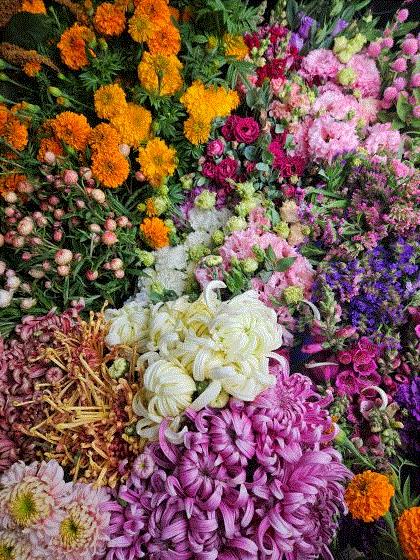
Heirloom chrysanthemum season is one of our favorites.
Somehow we've made it into November without experiencing our first hard freeze! That’s pretty astounding, but it greatly facilitates fall cleanup. All the dahlias are safely put away into storage, waiting to be divided. This is the first year I can remember not wearing gloves to keep my hands from freezing while lifting dahlias. It’s been pretty warm!
One of my favorite parts of November is heirloom chrysanthemum season. The more years we grow heirloom chrysanthemums, the more Tater and I fall in love with them. There's something incredibly special about these flowers, although I struggle to pinpoint why they are so special to me. Perhaps it is because they are one of the crops that represent the locally grown flower renaissance. It’s a flower that fell out of the limelight, and many varieties were lost, so now the few that we have are treasured unicorns.
Admittedly, they are a fair amount of work and sometimes it is a struggle to give them the care they need when all the field flowers are in bloom at the same time. Between harvesting dahlias, filling orders and keeping everything else on the farm moving, finding the time to meticulously disbud chrysanthemums can feel like just one more thing to do. But every November, when we see those gorgeous blooms beginning to unfurl, the chrysanthemums remind Tater and I why we make the effort. That investment of time during the busiest part of our season pays dividends when the field flowers are nonexistent.
Heirloom chrysanthemums have become a real treasure here at the farm, and Tater and I are hoping that with our upcoming greenhouse expansion we'll be able to grow even more in 2027. Mums are one of my passion projects and I hope by growing more varieties and expanding production, our clients will continue to learn to cherish their heritage and beauty as much as we do.
Of course, admiring chrysanthemums isn't the only thing that keeps us busy. We're also in the thick of flipping our greenhouses over for spring production. We’re preparing beds and steaming soil. But our most recent diesel delivery came in at nearly $6 per gallon, and when you're burning through a lot of fuel to steam greenhouses, those expenses add up in a hurry. Soil steaming is an important part of our production program, but it certainly isn't cheap!
It's also prompted Tater and me to ask ourselves where we can become more efficient. Sometimes improving profitability isn't about growing more flowers or finding more customers. Sometimes it's about taking a closer look at where our money is going and finding ways to make every dollar work a little harder. Especially when some of our biggest costs of production are outside of our control, so we’re thinking about what things we can change.
In between the hustle and bustle of flipping greenhouses and fall cleanup, Tater and I are trying to approach things a little differently as we head toward the end of the year. We're also making a conscious effort to slow down occasionally, recalibrate and invest a little more time in ourselves. We think 2027 is going to be an incredibly busy year, filled with new opportunities and plenty of growing pains (hopefully more of the good kind!). And if there's one thing I've been reminded of this season, it's that taking care of the farm also means taking care of the people responsible for running it. We spend so much time thinking about what our crops need to thrive, but how often do we extend that same consideration to ourselves?
In other words, there's a lot of planning and pondering on the horizon. But in the meantime, we’re talking about some webinars, chrysanthemum white rust and more! With all that being said, let’s talk shop!

Chrysanthemum White Rust: A New Chapter for Mum Growers
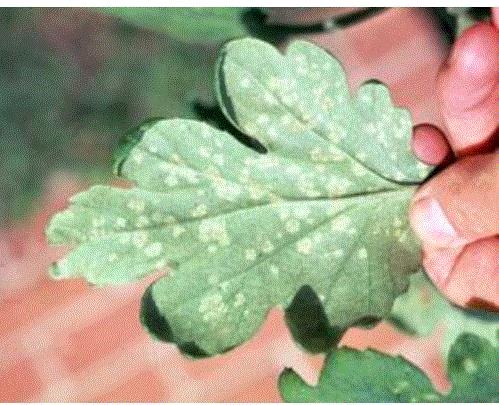
CWR damage to mum foliage. Photo by USDA
There's some pretty significant news coming out of USDA's Animal and Plant Health Inspection Service (APHIS) that could have implications for growers across the country. After years of treating chrysanthemum white rust (CWR) as a quarantine pest, APHIS has announced that it is officially deregulating the disease, effective November 9, 2026. And while regulatory changes don't always make for the most exciting reading, this one is worth paying attention to!
Chrysanthemum white rust, caused by the fungal pathogen Puccinia horiana, is a serious disease affecting chrysanthemums and several related genera. Symptoms typically begin as pale yellow spots on the upper leaf surfaces, followed by distinctive white to buff-colored pustules on the undersides. Under favorable environmental conditions, the disease can spread rapidly, causing leaf distortion and premature defoliation.
CWR has long been a quarantine pest in the United States, meaning an outbreak could trigger federal regulatory action, including restrictions on plant movement and potentially the destruction of infected plants. For commercial mum producers, that could translate into substantial financial losses beyond the actual damage caused by the disease itself.
However, APHIS has concluded that its eradication-based approach to CWR is no longer justified. The agency now considers CWR established in the United States and recognizes that growers can manage the disease using available fungicides and established cultural practices. Also, the pathogen's ability to survive in dormant plant material and remain undetected before symptoms develop has made complete eradication challenging. As a result, APHIS is shifting its approach from eradication to management.
How will these new rules affect chrysanthemum propagation? In addition to the deregulation announcement, APHIS is authorizing the importation of chrysanthemum cuttings and tissue-cultured plantlets from 20 countries, provided they meet the requirements of an approved systems approach. This could give major chrysanthemum breeders and propagators greater flexibility in where they produce their young plants, potentially diversifying the supply chain for American growers.
Bossman Chris Beytes, Editor-in-Chief of GrowerTalks, recently explored what these changes could mean for chrysanthemum producers in his Acres Online newsletter (if you're not already a subscriber, you're missing out!). Bossman Beytes spoke with several industry representatives, including Jim Kennedy of Ball Seed, who shared that major chrysanthemum breeders are exploring offshore propagation opportunities, although Syngenta reportedly intends to maintain its production in Florida. Jim doesn't anticipate significant changes for the 2027 growing season, with exploratory shipments potentially beginning in 2028.
And what about pricing? Would moving chrysanthemum propagation offshore translate into cheaper cuttings for American growers? Not necessarily. Ball's Market Research Manager Dr. Marvin Miller pointed out that while offshore production could help address labor availability and help offset various production costs (including labor and tariffs), the biggest benefit could be greater supply chain flexibility rather than lowering cutting prices.
Previously, chrysanthemums imported from countries where CWR was present were subject to additional phytosanitary requirements, including registered production facilities, inspections and documentation certifying freedom from the disease. APHIS is now removing these CWR-specific restrictions.
Could this increase competition for domestically grown cut chrysanthemums? Does that put domestic chrysanthemum plant stock at risk due to deregulation of imported cuttings? Possibly, although APHIS doesn't anticipate a significant change in wholesale prices. According to APHIS, Colombia currently supplies more than 98% of chrysanthemum imports, and imported mums were already entering the United States under the previous regulations. APHIS expects any additional imports to have a limited effect on domestic cutting costs. Although it acknowledges that reliable market data are insufficient to quantify the impact.
For those of us growing chrysanthemums, I think the biggest takeaway is that deregulation doesn't mean the disease has become any less important. What has changed is the regulatory framework for the disease and potentially the way chrysanthemum propagation and international trade will evolve in the future. And with Tater and me falling a little bit more in love with heirloom chrysanthemums every season, you can bet we'll be keeping an eye on how these changes affect our industry.

A Thousand Blooms (and Then Some!) at Longwood Gardens
 One plant, more than 1,000 flowers. Impressive work by Longwood Gardens!
Speaking of chrysanthemums, Tater and I think disbudding a few hundred heirloom mums is a lot of work, so you can imagine what we thought seeing YouTube videos of this thousand-bloom chrysanthemum at Longwood Gardens!
Longwood's annual Chrysanthemum Festival, running through November 15, features a bodacious Thousand Bloom Chrysanthemum boasting an incredible 1,355 flowers! This year's mum, 'Susono-no-Tsuki,' measures 12 ft. wide and 10 ft. tall. And if that isn't impressive enough, producing this masterpiece requires 18 months of care and more than 2,000 hours of labor.
The display is created using a traditional Japanese technique known as ōzukuri, commonly translated as “large cultivation.” Japanese horticulturists developed increasingly elaborate methods of training over the centuries to create exceptional chrysanthemums. First developed in Japan in 1884, the ōzukuri form established the model for what we now recognize as the Thousand Bloom Chrysanthemum—hundreds, or even thousands of flowers, produced from a single plant that has been trained into a carefully proportioned dome.
Rather than allowing the plant to develop its natural growth habit, horticulturists spend months manipulating its architecture through successive pinching, photoperiod management, selective shoot removal and an elaborate system of structural supports. The objective is to develop an enormous, symmetrical canopy with hundreds of flowering stems, each producing a large terminal bloom. The more Tater and I read about ōzukuri the more it reminded us of bonsai.
Interestingly, the process doesn't begin with just one plant. Longwood's staff start with 10 vegetative cuttings in June, approximately 18 months before the exhibition. Before rooting, the bases of the cuttings are slit to encourage additional root development. As the plants establish, their growing tips are repeatedly pinched to stimulate lateral branching. Each lateral shoot is pinched again, gradually multiplying the number of potential flowering stems. By late fall the two most promising specimens are selected based on overall vigor, symmetry and root-to-shoot balance. Both are grown to maturity, providing a backup should one plant fail.
And here's where things get particularly interesting from a production standpoint. Because a single root system must eventually support more than a thousand flowering stems, root development is just as important as the canopy above it. Longwood uses specially constructed growing containers designed with removable interior dividers. Think of it as creating a box within a box. Early in production, the young plant occupies a small volume of growing medium. As the root system develops and the plant increases in size, the dividers are removed and additional growing medium is introduced. The exterior panels can also be removed to inspect root development and check moisture.
Meanwhile, the plants are kept vegetative by manipulating photoperiod. Since chrysanthemums are short-day plants, night interruption is used to prevent premature flower initiation. This allows growers to continue pinching and developing the framework of shoots without triggering flowering before the plant has reached its desired size.
By February of the exhibition year, the plants are large enough to start installing their custom metal support structures. Additional fiberglass support rings are incorporated approximately once a month as the plants expand and the developing branches are trained outward and secured to these supports. According to JSTOR Daily, more than 4,000 ties may be used throughout the training process!
As the time gets closer for flowering, the focus shifts from producing shoots to developing uniform blooms. In mid-September, horticulturists begin disbudding—removing the side buds while leaving one terminal bud per stem. Each developing flower is then individually secured to a circular wire support known as a rindai, which helps support the bloom's weight and allows it to be positioned precisely within the dome. Growers arrange the flowers into evenly spaced, concentric horizontal rows. More than a thousand individual rindai supports may be installed. This process can take approximately 10 days! Longwood's horticulturists may even allow the stems to wilt slightly before repositioning them, making the tissue more pliable and reducing the risk of breakage.
Keeping a plant of this size healthy presents its own challenges. Longwood actually lost its Thousand Bloom specimens in 2021 and 2022, due to root-borne pathogens. After investigating the failures, they determined that excessive shoot growth relative to root development had contributed to plant stress. As a result, they implemented a stricter sanitation regimen and refined their irrigation practices. They even began measuring irrigation water by counting ladlefuls to improve consistency and avoid overwatering.
Longwood began experimenting with the Thousand Bloom technique in 1994. Initial specimens had approximately 150 to 250 flowers. After its horticulturists traveled to Japan to study with master chrysanthemum growers, the displays became increasingly bigger. In 2009, Longwood exhibited a plant with 718 blooms, followed by 1,167 in 2011 and a record-breaking 1,542 flowers in 2019.
Tater and I have a whole new appreciation for the patience, precision and expertise required to create these living sculptures. Suddenly, finding time to disbud our heirloom chrysanthemums in August doesn't seem quite so bad! This was a good reality check. And while I don't think we'll be attempting a 1,355-bloom chrysanthemum anytime soon, it's inspiring to see just how far a little ingenuity and a tremendous amount of patience can take a single plant.

50k to Grow 50k Seed Your Future Fundraiser
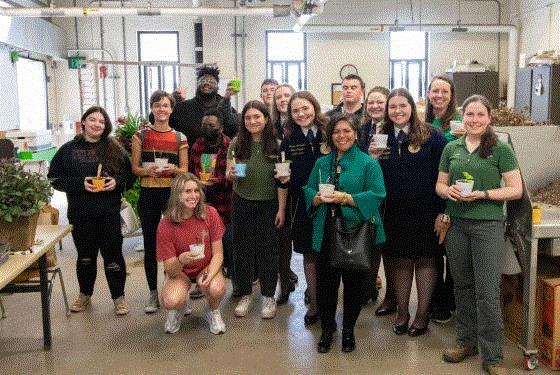
The folks at Seed Your Future are hoping to inspire a few more future plant professionals through their year-end fundraising campaign, “From Classroom to Career: Grow the Next Generation.”
Seed Your Future (SYF) hopes to raise $50,000 by December 31 to help introduce at least 50,000 students to our industry. And here's something worth considering. A donation of just $8.50 can help provide one teacher with free green industry career resources, potentially introducing an entire class of kids to opportunities they might never have considered. As SYF’s Executive Director Jazmin Albarran reminds us, “Students can’t pursue careers they don’t know exist.”
SYF has free Seed-to-STEM educational resources, career exploration bios and lots of classroom activities. SYF helps educators connect students with careers ranging from plant science and greenhouse production to technology, design, business and sustainability. SYF has developed 156 horticultural career profiles and more than 50 high school lessons to help students discover where their talents might fit into our industry.
Tater and I are avid believers in the notion that you reap what you sow. It’s a wonderful reminder that investing in the future of horticulture doesn't always mean building another greenhouse or developing the next legendary dahlia. Sometimes it's as simple as introducing a young person to the incredible opportunities our industry has to offer.
Interested in helping plant a few seeds for the future? Learn more about the campaign or make a contribution through Seed Your Future's fundraising page. All donations made by December 31 will count toward the organization's $50,000 goal.

Webinar: How Metrolina Does Sustainability
Looking for ways to make your farm a little “greener”?
The folks at Sustainabloom are hosting a webinar later this month featuring the team at Metrolina Greenhouses. The topic?
Growing with Sustainability in Mind
Thursday November 19
1 p.m. Eastern/Noon Central
Head Grower Juan Ponce, Director of Research Dr. Mark Yelanich and Chief Horticulture Officer Ivan Tchakarov will share how Metrolina's sustainability initiatives have evolved from small manageable changes into much more advanced strategies. They'll discuss what prompted their efforts, lessons learned along the way, and how growers can develop their own sustainability plans, including the potential role of third-party certification.
Whether you're just beginning your sustainability journey or looking for ways to improve existing practices, this should be an interesting opportunity to learn from one of the industry's leading greenhouse operations!
HERE is the link to register.
Until next time!
Lindsay Daschner (and Tater)
Editor-at-Large—Bloom Beat
Owner—Forget-Me-Not Farms
This email was received by 6,142 of your fellow fresh-cut flower growers!
If you're interested in advertising in Bloom Beat, contact Kim Brown and she will hook you up!