What the ... ?
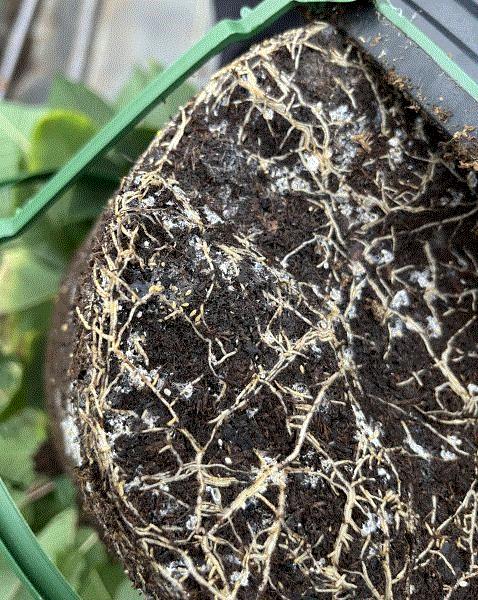
Last week, a grower sent me several pictures of a poinsettia root ball covered with white, waxy fuzz. The grower correctly identified the critters, but wanted my confirmation.
What's causing that fuzz?
An Update on Hellebore Root Rot
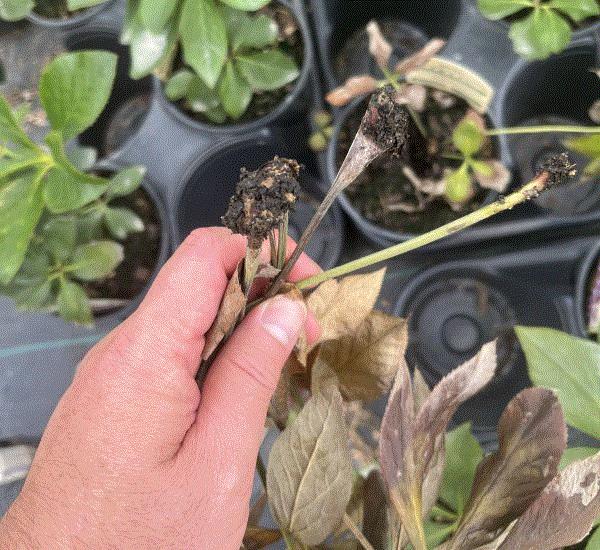
The “What the … ?” mystery in the last issue featured what I thought was Phytophthora root rot of hellebores. Steve Jeffers, ornamental plant pathologist and a long-time colleague at Clemson University, sent me an email, which made me overturn that diagnosis.
Well, I’ll let Steve explain why he thought the diagnosis of Phytophthora root rot may not be accurate:
“In 30-plus years at Clemson, I have never seen Phytophthora infection on hellebores. In fact, the only peer-reviewed paper I found was published this year in Japan evaluating cultivars for resistance. So I'm dubious about the diagnosis of Phytophthora root rot on your Helleborus plants. I suggest the grower gets some plants to a qualified plant disease clinic for an accurate diagnosis. I suspect one of the other common root rot pathogens is causing the problem and this will affect the type of treatment.”
Indeed, root rot caused by a fungal pathogen, such as Rhizoctonia, will require a different management approach from a disease caused by oomytes, such as Pythium and Phytophthora. Even Pythium and Phytophthora may require different management tools more on this later), so accurate identification of the causal agent is an important first step.
"So what other culprits may there be?" I asked.
Steve responded that Pythium, Phytopythium and Rhizoctonia are the most common pathogens that cause root and crown rots on herbaceous plants in greenhouses and nurseries. The hellebore chapter in "Diseases of Herbaceous Perennials" by Mark Gleason, Margery Daughtrey, Ann Chase, Gary Moorman and Daren Mueller (published by the American Phytopathological Society in 2009) listed Pythium (now most likely Phytopythium), Rhizoctonia, Sclerotinia and Sclerotium as the primary stem and crown rot pathogens.
Although several hellebore gardening websites Steve and I’d visited identify Phytophthora as a potential root rot pathogen, no Phytophthora was mentioned in the authoritative book cited above. Should our books about hellebore diseases be updated if the pathogen in this case turns out to be Phytophthora? Or is this a case of folks (including myself) promulgating the idea that Phytophthora is a root rot pathogen on hellebores without any real evidence? I was once again educated on the importance of getting an accurate diagnosis of a disease problem instead of relying on experience, intuition or what everybody says.

Fungicides for Phytophthora vs. Pythium
While Phytophthora and Pythium are both oomycetes and water molds, I don’t think I’m courting controversy by stating in this newsletter that management approaches for these two genera are different. There’re obvious differences in biology, environmental preferences, host plants and symptoms between the two genera. More importantly for pest managers, fungicide choices also differ between the two. (We haven’t even mentioned Phytopythium! That group is utterly weird to me.)
I was lucky enough to team up with Janna Beckerman of Envu on a grower training recently. I got some valuable information, experience and recommendations from Janna, and I’m going to shamelessly parrot her recommendations here.
First thing to mention is the fact that mefenoxam (Subdue Maxx and other generics and premixes; FRAC 4) resistance may be widespread out there. Mefenoxam has been the work horse against oomycetes for three decades and it’s getting real tired now. So let’s give mefenoxam a rest if you could or if you aren’t getting sufficient control with it anymore.
For Phytophthora root rot, Janna recommends Teclara (formerly Aliette, fosetyl Al; P07) rotated with Stature (dimethomorph; 40) and Terrazole (etridiazole; 14).
For foliar Phytophthora, Janna’s recommendation is Segovis (oxathiapiprolin; 49) rotated with Stature and Terrazole. On my own fungicide cheat sheet, FRAC 11 fungicides also have efficacy, but Fenstop (fenamidone; 11) seems to be the most effective, and FRAC 40 fungicides (Stature, as well as Micora or mandipropamid and Orvego or dimethomorph + ametoctradin) are more Phytophthora-specific. Adorn (fluopicolide; 43) may also be used.
As for Pythium, Banol (propamocarb; 28), Segway (cyazofamid; 21) and Terrazole are Janna’s favorites. That’s about it for Janna’s first-string products.
The second string, which is used mainly for prevention and in rotation with the first string, include Adorn, FRAC 11 (Compass or trifloxystrobin, Empress or pyraclostrobin, Fenstop, and Heritage or azoxystrobin), phosphorous acid salts (such as Alude; 33) and Teclera.
Check out this GrowerTalks article from Ann Chase for additional recommendations on Phytophthora and Pythium, including using Trichoderma (in products such as Obtego and RootShield Plus) for Pythium management. IR-4’s research summaries on Phytophthora and Pythium also contain valuable information on which fungicides are effective. Envu will introduce a new fungicide for Pythium and Phytophthora soon and I’ll talk more about it when it’s officially introduced.
Lastly, at the risk of sounding like a broken record, I’d like to remind y’all to please rotate among fungicide modes of action (MOA). As an entomologist, trying to put all those fungicide FRAC codes (which indicate different MOAs) together don't come naturally to me, so don’t let my effort go to waste.

A Course on Field Diagnosis of Diseases
I’m too old to be sitting in a classroom doing rote memorization. I did’t mind doing that to my students when I was a professor, but it isn’t fun if I’m on the receiving end. I prefer learning through osmosis, or at the very least, at my own pace.
Y’all can also learn at your own pace (well, at least within the timeframe you’re given) if you attend the Greenhouse Training Online course offered by the University of Florida IFAS Extension.
A month-long course on Field Diagnosis of Plant Diseases will begin on November 2. This online course is taught by Carrie Harmon of the University of Florida and the course contents include detecting and diagnosing common diseases in greenhouses and nurseries, and differentiating diseases from biotic disorders and pests. This course is available in both English and Spanish.
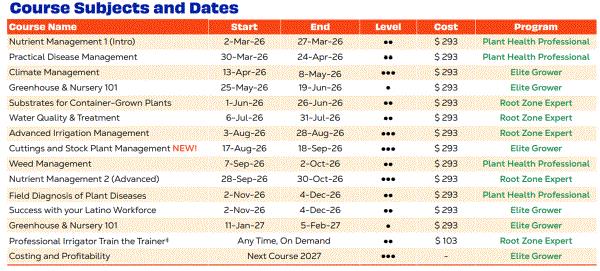
The cost of the course is $293 per person with a discount for group registration of five or more. After you register, you can complete the course at your own pace from your computer and comfort of home (or office?) before the end of the course on December 4.
Other courses available from this online training program are listed in the table above. Don't worry if you miss any of them this year because you can register for them next year.

Red-Banded Thrips—A New Invasive Pest in Texas?
Chris Beytes passed on an interesting communication from Eric Putnam BCMA Inc., an arboricultural company operating in greater Houston (Texas) and the Gulf Coast area, informing us that earlier this month the red-banded thrips had been confirmed by USDA identifiers on samples submitted by the company. The confirmation makes the first official state record of red-banded thrips in Texas. I find this communication interesting because I’m usually informed of new invasive species from state or federal regulators, not from private companies. I applaud Eric Putnam BCMA for sharing the news.
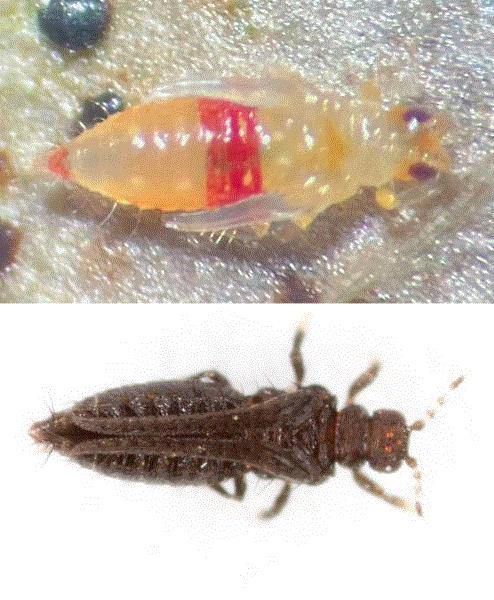
A red-banded thrips larva found in North Carolina (top) and an adult in Texas (bottom). (Photo credit: Miles Buddy and John Schneider, both from bugguide.net.)
The news also sent me down a rabbit hole.
Although the red-banded thrips is widely distributed in Central and South America and the Caribbean, as well as Mexico and other continents, it’s only known records in the U.S. are from Florida, Hawaii and Puerto Rico, according to a fact sheet from the European and Mediterranean Plant Protection Organization.
But, wait, there are actually more records, albeit not in the official channels! I found two records of this species on the website Bugguide.net: one from Wilmington, North Carolina, in 2024 on a mature Parrotia persica and one from Houston in 2016 on blue plumbago.
I found more non-Florida records on iNaturalist: two records from North Carolina (Wilmington and Durham) in 2024, one record in Texas (near Huntsville) in 2025, and one record in Louisiana (near New Orleans) in 2024. Photographs accompanying these records are good enough (i.e., research grade) that I and other identifiers on the websites can identify the thrips as red-banded thrips, which are pretty distinctive and easily identifiable.
Obviously, these records from Bugguide.net and iNaturalist weren’t confirmed officially, so they don’t really count as confirmed state records. It’s interesting that many of the observations were made in 2024 and 2025, which perhaps indicate a massive outflow of infested plants from somewhere into these states? It isn’t clear whether the observed populations were on recently purchased potted plants or an established population on established plants. It’s also not clear what happened to these infestations. Some investigative work still needs to be done here.
The origin of the red-banded thrips is uncertain. It could be the tropical or subtropical regions in Africa or South America. This species is widely distributed enough that it’ll be hard to pinpoint its origin without genetic analysis.
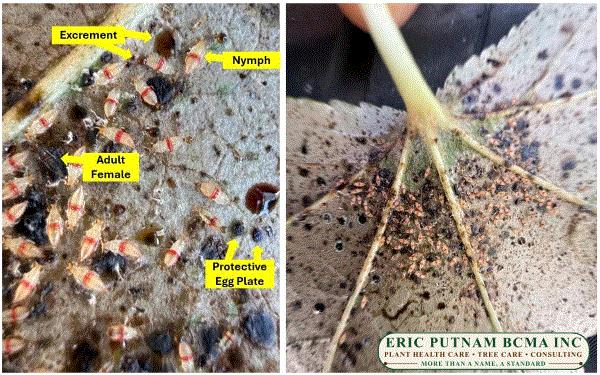
Based on known records, the red-banded thrips has a broad host range that include many broadleaf fruit and nut trees, and ornamental trees and shrubs. The infestations in Houston seem to affect sweetgum, causing sun scorch-like streaks or chlorosis and black streaks on leaves and defoliation. An infestation on sweetgum was also found in northern Italy in 2015, according to a paper. There may be three generations in Florida and up to eight generations in southern China.
It’s not clear if the red-banded thrips will become a damaging species in the increasingly larger complex of thrips pests on ornamental plants and other crops. And it’s too early to say whether there will be regulatory action taken against this new invasive species. I’ll keep an eye on this issue and update y’all if there’s any significant development or update.

Answer to "What the ... ?"
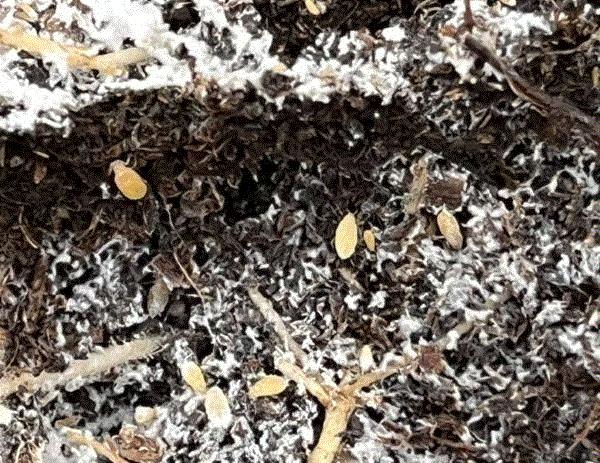
“Bingo!” if you said the white, waxy fuzz on the root ball is created by root aphids. Look closely—you’ll even see them around those fuzzes.
The host plant is poinsettia. A Pemphigus species was recorded to feed on poinsettia root in a paper published in 1938. In that paper, the aphids were described as small, yellowish green, feeding on roots and surrounded by wax. These descriptions fit what I see.
Knowing it’s a root aphid is good, but I really want to know which aphid species is involved and whether it’s still classified as a Pemphigus species. The genus Pemphigus contains mainly gall-forming aphid species, but the aphids in this case clearly didn’t form galls. We'll need to have samples sent in for identification to really solve this mistery.
Well, that sent me down another rabbit hole.
I found the paper published in 1938, which I mentioned above and where this Pemphigus species was mentioned. Control methods were studied in this century-old paper, but I’m not going to summarize the results because nicotine, rotenone and cyanide gas were tested. These pesticides are no longer applicable to our situation.
A fact sheet from Texas A&M University listed Pemphigus root aphid as a pest of poinsettia, but I suspect this is based on the 1938 paper. And I found a couple of databases of aphid scientific records, which I think only the people making those databases know how to use. I also found an online aphid identification tool, which I might use one of these days. Other than that, not much else …
Anyone know what this aphid species is? If so, send me an email.

How to Control Root Aphids
Root aphids, especially rice root aphid, really came into the spotlight when cannabis growing was all the rage. But we've been dealing with them on and off for quite some time. Not a whole lot of research has been done on species that don’t bother cannabis, evidenced by my failure to determine which root aphid species feed on poinsettia. Trying to figure out how to control these root aphids in the absence of recent data can be tricky.
I think, however, lessons learned from rice root aphids and root mealybugs can help us develop management methods for root aphids in general. I wrote about a series of research that Brian Kunkle (University of Delaware) and the late Stanton Gill (University of Maryland) had conducted on root aphids and root mealybugs. As I recall, Brian and Stanton weren’t too interested in cannabis; they focused on problematic species that impact nursery crops and plants used for green roofs.
Since root aphids feed on the roots, you need to deliver the insecticide solution by drench or sprench. Brian and Stanton found that Acelepryn at 8 fl. oz., Endeavor at 3 and 5 oz., Mainspring at 8 fl. oz. and Mycotrol at 32 oz. (all application rates are on per 100 gallons basis) essentially eliminated root aphid populations 28 days after one sprench application.
You can read about controlling root aphids and root mealybugs on ornamental plants by going to the April 2022 issue of this newsletter, Brian and Stanton's article in GrowerTalks or to their original research paper published in the Journal of Environmental Horticulture.


See y'all later!

JC Chong
Editor-at-Large
PestTalks
This e-mail received by 27,847 subscribers like you!
If you're interested in advertising on PestTalks contact Kim Brown ASAP!