Exploring Peat Bogs in Saskatchewan
Nearly everyone reading this newsletter likely uses peat moss in some way or shape. Many are growers who use peat as a primary or complementary substrate component, and others are installing, selling or enjoying plants that have been grown in peat. Have you ever stopped to think about peat on a deep level?
I’m sure some here know it very well, but others might not realize exactly where peat comes from or even what peat is. While I have a good idea and likely have spent more time investigating peat than your average horticulturist, I still have so much to learn. That’s why when I was asked if I would like to travel to Canada (and I mean far north in Canada) to tour a peat bog, there wasn't question. Of course I was going.
Now, this isn’t my first trip to a peat bog—a few years ago I had the opportunity to tour a bog in Quebec that was very close to the St. Lawrence River in southern Canada. This time, I headed to central Canada—Saskatchewan, to be precise—to visit some peat bogs and manufacturing facilities.
What a fun and exciting trip! I was lucky enough to be invited to tour the Sunterra peat facilities, which are located up on the 52nd parallel, making this the furthest north I've ever been. I also learned the bogs in Canada are also quite different across the country, which makes quite a bit of sense—Canada is huge! As you travel from east to west or north to south, the various moss species change, as does the biome, so, of course, the materials will be slightly different. This was a unique experience for me.
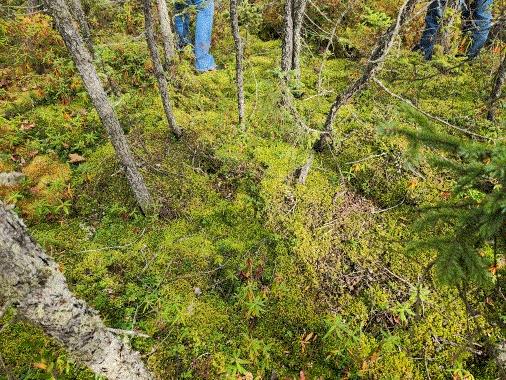
So what is peat? Well, peat is the term for organic materials (often plants) that have been slowly decomposed for a long time in acidic and anerobic (no oxygen) conditions. Basically, plant material that has decomposed for thousands of years in saturated conditions.
As this is a vague definition, there are many different peat materials. We often just think of peat as peat. Some of the more savvy growers know the distinction between Canadian and European peat, which include several differences like particle size and physical structure—mostly related to the harvesting methods, but these are actually formed from different moss species. There are, in fact, more peats in the market.
Here in Florida, we have what is commonly referred to as “Florida Peat,” but that product is nothing like the European or Canadian materials. Instead, this is sedge peat or peat made from decomposed sedges instead of mosses. Canadian peat is primarily sphagnum mosses, which is why its sometimes referred to as sphagnum peat.
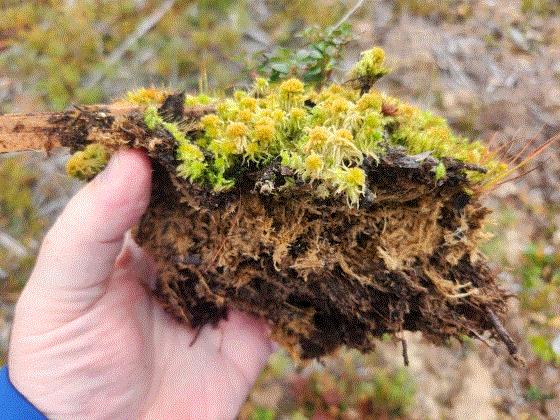
Anyway, sphagnum peat grows slowly in a bog. As water levels rise moss grows upwards and the old gets “buried” by new moss. This old moss will start the slow process of decomposition while a fresh living layer thrives above. As you dig down in a sphagnum peat bog, you see the different layers just like in soil, but in this case, there are levels of decomposition. I'm definitely going to try and pull some strings to get a little mound of sphagnum moss to keep as a pet in a terrarium in my lab. If anyone has any connections, please let me know.
Peat quality is measured on the Von Post scale, which is related to the peat’s “cleanness” and decomposition level. You might have heard the term “Blonde Peat,” which is high quality. That comes from the lighter color of the material that's found in the highest quality material. The Von Post scale is a 1 to 10 assessment of peat color and quality. The darker the peat, the lower quality and more decomposed. When you can make out individual fibers, it’s a lower number (higher quality), and as the decomposition continues, the individual particles get less apparent. Very interesting.
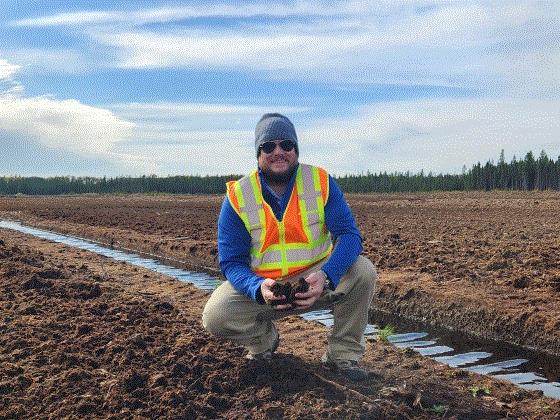
We got a demonstration on a rough way to estimate peat quality—pull some out of the ground and squeeze it. If the water runs out clear and there are no particles left on your hand, it's very high quality. Dirty water and dirty hands lowers the quality a bit.
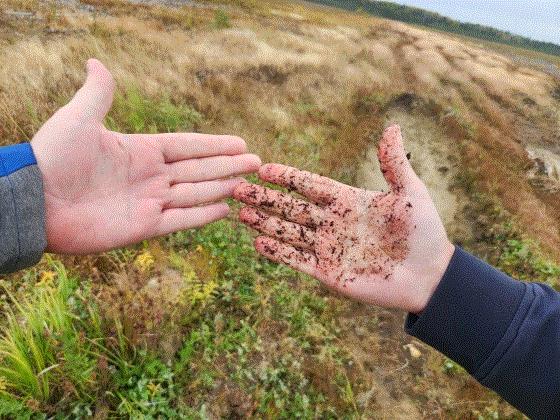
I found the amount of high-quality material that was being mined interesting. Each operation is different, but, overall, most producers target peat harvest in the 1 to 4 range, so only the highest quality for grower-grade peat.
Do you know how the peat is harvested? It's different all over the world, but Canadian peat is primarily harvested with giant vacuums—really. When the fields are cleared, tractors rake the peat that's just sitting on the surface to loosen it. Another tractor will pull a giant vacuum across the field and suck up peat particles.
The harvest is very slow and only pulls a few inches a year, so the bogs can be productive for decades. After which, the bogs are restored through several methods to start becoming a carbon sink again. Some restoration methods include the Moss Layer Transfer technique, which involves putting living mosses and plant materials back directly on top to let them restore; while other methods involve flooding the bogs to create a fen let the systems return naturally.
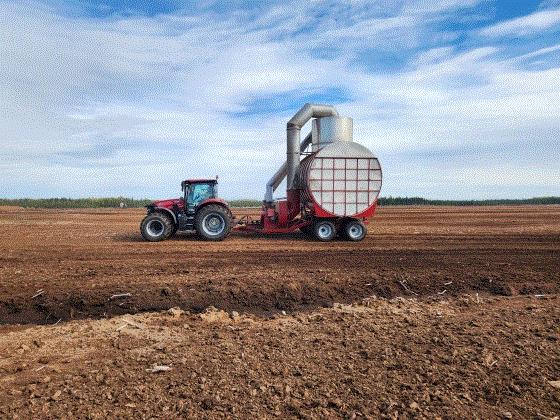
But it takes so much more than just vacuuming. The bog area needs to be scouted and cleared first, then trenches are cut to drain the fields. Remember these are saturated, ancient lake beds. It takes quite a while to drain the bogs, but the material needs to be dry for the vacuums to work. If it's too wet, the weight of water will prevent the vacuum from collecting the peat. This is why extended rains can limit harvest—if the rains prevent the fields from draining, then harvests stop. They typically run until the ground freezes each year, which, depending on where you're at, can be fairly early. We got lucky with perfect weather on our trip!
I also learned that if the bogs are drained too soon problems can occur. Heated peat was a term I'd never heard before. We're all familiar with composting—bacterial breakdown of organic materials, which generates heat. Well, as peat bogs are drained, they're exposed to air for the first time in quite a long time. Aerobic (in the presence of oxygen) bacteria can now start to decompose the less-decomposed material (high quality peat). This can lower the quality quickly and therefore must be monitored closely. It's all such a more technical process that I'd considered.
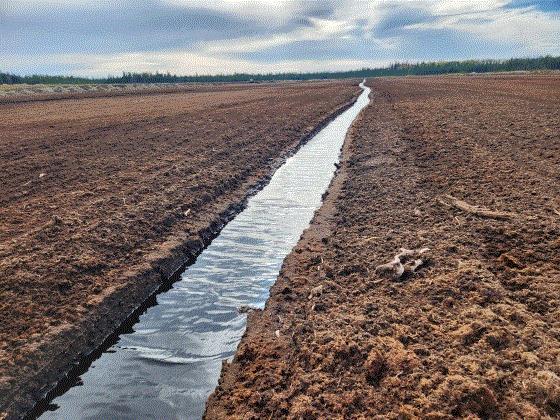
I'm so grateful to Sunterra and Profile Products for their invitation and openness showing me (and the rest of the group) around the bogs. This was an incredible experience for a substrate scientist and I couldn’t be happier. We got to see old bogs that are almost ready to be restored, new bogs in early production and even some bogs still being prepared for upcoming harvest. It was exciting and I haven’t even had a chance to talk about the processing facilities—maybe I’ll save that for another newsletter.

Information for Nurseries Affected by Isaias
This year has been a mild year for Atlantic storms. In fact, we made it so close and thought we would get a year without any major hurricanes. Unfortunately, that wasn't the case and, just as we thought we were out of the woods, Hurricane Isaias crept up and brought us back to reality.
I truly hope that everyone is well. However, as Isaias moved through the Gulf States, many operations were adversely impacted. I think after the past few years, most of us know the drill, but if not it's important to document any damage.
Dr. Jeremy Pickens from Auburn was kind enough to share some insights for damage documentation provided by Alabama Cooperative Extension Services. While this information is specifically for growers in Alabama, I can assure you that the same procedures should be followed by affected growers in any other states.
In the aftermath of Hurricane Isaias, Alabama farmers are encouraged to work with their county Extension office to share time- and date-stamped pictures of agricultural damages. Documentation can be submitted online at aces.edu/go/Isaias by 5:00 p.m. Friday, October 16.
-
Make sure each photo includes a time and date stamp. This information is typically stored automatically in image files created by digital cameras and smartphones. If you're unsure how to confirm that, then you should be able to Google/AI instructions.
-
Use high-quality images that remain clear when enlarged on a computer.
-
Avoid using your device’s digital zoom when possible because it can reduce image quality. Instead, move closer to the subject to capture detailed photos. (I'm saying this because sometimes growers send me blurry photos.)
If you have questions, contact your county extension office. Producers should also work with local FSA offices to report losses.
Sorry for the short notice, but the deadline is Friday (TOMORROW) at 5:00 p.m.
For more information, go HERE.

Greenhouse Training Online
If you're a regular reader of this newsletter, you've no doubt heard of the University of Florida Greenhouse Training Online program, which supports industry advancement and education in short, easy, online programs. Each year, several training courses are released and updated to teach all different grower-oriented topics. There are two final courses for 2026, both starting November 2. Each course is four weeks with eight individual learning modules that you can follow along at your own pace. You can find out more about the entire program HERE.
The two upcoming programs are Success with Your Latino Workforce and Field Diagnosis of Plant Diseases.
Success with your Latino Workforce is taught by Dr. Claudio Pasian, Professor Emeritus at the Department of Horticulture and Crop Science at The Ohio State University where he taught for 25 years. This course will prepare non-Latino supervisors or coworkers of Latino employees to improve communication and efficiency in the workplace with a mixed culture workforce and a Spanish language training component of the course, including an AI chatbot to help translating Spanish horticulture terms. This intermediate course is only offered in English. This course counts towards the NEW! Elite Grower Program.
Field Diagnosis of Plant Diseases is taught by Dr. Carrie Harmon, Director of the UF/IFAS Plant Diagnostic Center in Gainesville, Florida, and Co-Director of the National Plant Diagnostic Network. Growers in the course have described her as a “clear, concise and informative instructor” who help them “feel more capable identifying disease problems and less intimidated by the disease books on the shelf.” The course will help you identify diseases and differentiate between disease and other issues, and learn field-friendly diagnostic methods. This intermediate course is part of the Plant Health Professional Certificate.

LEAP Survey
Several of my colleagues are working together on a major nursery-related project intended to support automation and labor-saving activities in the nursery industry. One group at the University of Florida is working with growers to develop insights as to what's needed and how to best deliver these technologies. They asked if we can try and identify any growers willing to interview with them and they're offering cash to help.
Please see the below request from Vashti Tatman at the University of Florida:
Are you a nursery grower in the United States?
Are you responsible for making decisions around your nursery?
If these criteria fit you, then the national Labor, Efficiency, Automation & Production (LEAP) team wants to interview you! A $75 incentive will be given to those who complete an interview. Your insights and thoughts on automated technologies and specifically pruning technologies are needed to help guide the future of this research.
The national LEAP Nursery Crops Toward Sustainability grant team is exploring ways to help growers make the best choices about automated nursery technologies. This information will help those who serve the U.S. nursery industry better understand your views of and preferences of these automated technologies and inform education initiatives on automated technologies.
If you match the criteria above and are willing to participate in a 40– to 60-minute interview, please email Vashti. They will happily set up a time at your convenience and answer any questions.
General information about the LEAP project can be found at nurseryleap.com. Thank you for your time and consideration, and we look forward to hearing from you!


Think big,

Jeb Fields
Editor-at-Large
Nursery & Landscape Insider
This has been received by 31,202 of the hardest-working horticulturists in show business!
If you're interested in reaching more than 31,000 readers who eagerly await every Nursery & Landscape Insider (and surely read every word!), contact Kim Brown ASAP and she'll hook you up.