What the ... ?
Last week, Paul Pilon devoted a good part of his Perennial Pulse newsletter to hellebores. That made me remember that I also had a hellebore issue that I haven’t share with y’all.
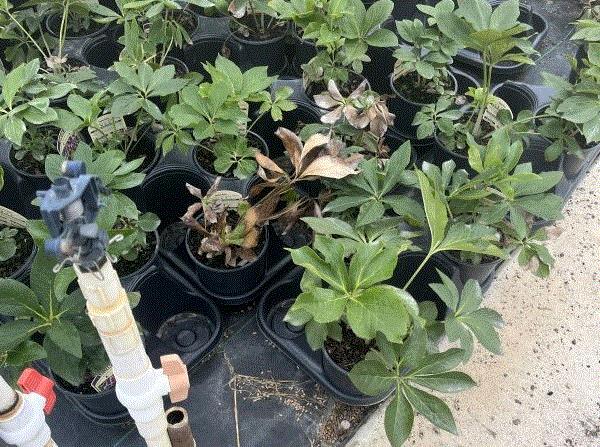
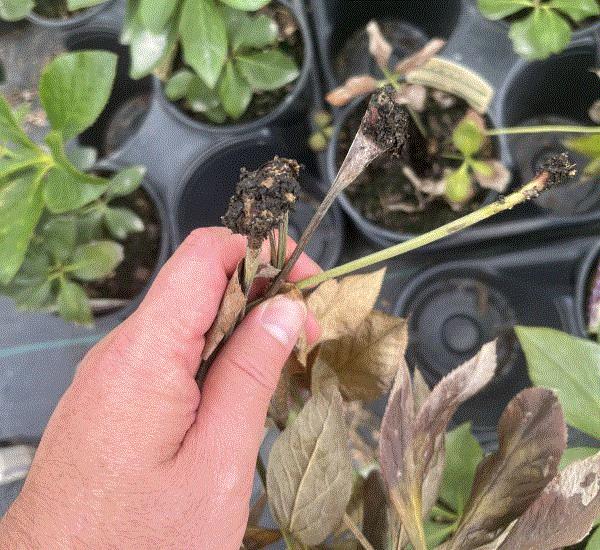
I visited a grower in July and noticed a few declining hellebores. The affected plants were scattered and showed a progression of symptoms (not related to where they were placed). Some were just turning chlorotic and some were obviously dead. When I pulled on one of the plants, the tops came right out of the crown.
What’s causing the decline?
Save With the 2026 Envu Early Order Program
The Early Order Program (EOP) season is in full swing. Growers can save a significant amount of dollars on the pesticides they use by participating in their suppliers' EOP. Here’s a message from the folks at Envu:
Last month, Envu launched its 2026 Ornamentals EOP, which runs through December 4, 2026. The Envu Ornamentals EOP is designed to help growers move from reactive purchasing to proactive planning. By building their programs before weed, disease and pest pressures appear, growers can enter the next production season prepared with needed products while taking advantage of competitive savings.
Through the program, growers get access to four different ways to stack savings—off-invoice agency discounts, non-agency rebates, multi-brand rebates and volume tier rebates—bringing their potential savings to as high as 19%. Additionally, all agency purchases on Early Order Programs receive payment terms of June 4, 2027, allowing growers to use products on an as-needed basis while paying later on.
Travis Hammonds of Altman Plants has been using the Envu Ornamentals EOP for years: “It really provides us with a level of flexibility and to be able to control costs, which I think in this day and age, with the margin, is huge.”
Dan Waterhouse of Neuhouse Farms started using the program to stack savings when it was first launched: “The Envu EOP has really helped us solidify the supply of product, help us plan ahead. And, obviously, we enjoy the discount it gives us.”
Through the 2026 Envu Ornamentals EOP, growers can replenish their inventory of products like Marengo herbicide and Kontos insecticide. Marengo is a preemergence herbicide with long-lasting weed control for more than 90 weeds, and Kontos offers highly effective control of sucking pests with true systemic activity.
Jean-Marc Versolato trusts Kontos to combat sucking pests in his role as Midwest Plant Health Manager at Bailey Nurseries: “It’s a very good insecticide. As long as you apply it early enough in the crop cycle, we’ve seen some very good benefits on the spider mite.”
The Envu Ornamentals EOP helps growers to get ahead of next season while maximizing savings on select products. To maximize savings while securing needed products from the diverse portfolio Envu offers, enroll at us.envu.com/ornamentals-eop, download the easy-to-use calculator to determine what your savings could be and see full program details.
“The Envu Ornamentals EOP program is definitely something that I would recommend,” said Clay Wilkerson of BWI Companies. “It’s definitely something that I would want to promote to our growers. It’s a great program.”

Thrips parvispinus Webinars
The short-spined thrips (SST) or Thrips parvispinus has become a global pest in a few short years. It caused enormous damage and regulatory headaches for folks down in Florida after its detection in 2020. The problem spread to other states and Canada soon after.
Research on SST is continuing, and several webinars and research updates on this pest have been hosted over the past few months.
I missed a webinar organized by Alexandra Revynthi of the University of Florida (UF) on August 31. Lucky for me, the webinar is now available online, so I didn’t really miss it. The webinar is a collection of research updates from several researchers from UF and Florida’s Division of Plant Industry (DPI).
Felipe Soto-Adames of the Florida DPI started the webinar by introducing a pictorial identification guide for SST. Folks can use the step-by-step descriptions and colored pictures in the guide to identify SST and several thrips species that they may come across frequently or may be confused with SST. Felipe also stated that SST is now found in 30 countries and a long list of host plants are available from Florida (with gardenia, hibiscus, mandevilla and pepper being the most common hosts).
Alexandra summarized research on biological control in her lab. Lab studies suggest that minute pirate bugs feed on both adult and immature SST and mirid bugs (Dicyphus hesperus), and lacewing larvae feed on immature SST. In greenhouse experiments, lacewing larvae reduced thrips population within the first week of release, but minute pirate bug was the most effective species in keeping thrips population consistently low over a three-week period.
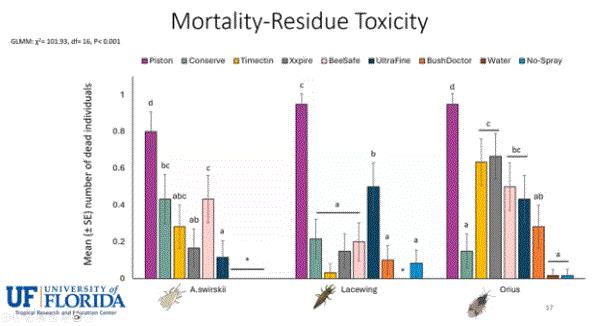
Mortality of A. swirskii mites, larcewing larvae and minute pirate bugs after contact with fresh residue of selected insecticides. A higher bar means greater mortality. (Graph credit: Alexandria Revynthi, University of Florida.)
In another lab experiment where insecticide solution was sprayed directly on the predators, insecticides that caused low mortality (i.e. similar to water check) were BushDoctor (garlic oil) for A. swirskii mites; Conserve, Timectin (abamectin) and BushDoctor for lacewing larvae; and BeeSafe (sesame + fish oil) for minute pirate bugs. The residual toxicity (assessed by releasing the predators immediately after the solution had dried and observing up to four days) of some of the tested insecticides was much lower than direct exposure (see graph below). Overall, lacewing larvae seemed most susceptible to insecticide treatment, A. swirskii mites moderately susceptible and minute pirate bugs least susceptible.
Lance Osborne of UF talked about controlling SST with Franklinothrips vespiformis, which is a native predatory thrips that feed on thrips, whiteflies, mites and supplemental food sources such as artemia cysts and moth eggs. (Beneficial Insectary is securing permits to produce and sell this predatory thrips species.) Preliminary results show that Franklinothrips vespiformis can reduce the number of adult SST and may be best used in hot spots because they'll disperse when food availability is reduced. Because they feed on other food, this predatory thrips may be a candidate for developing a banker plant system.
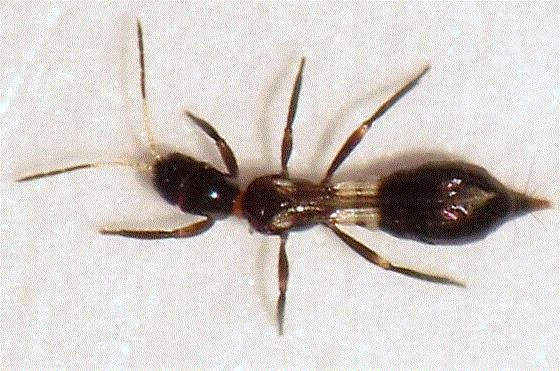
Yes, this is a thrips, not an ant or a wasp. This is an adult Franklinothrips vespiformis. Isn't it cute? (Photo credit: John Schneider, bugguide.net.)
Paola Villamarin, a Ph.D. student in Alexandra’s lab, evaluated five species of predatory mites on controlling SST in greenhouse experiments. Amblyseius swirskii, Neoseiulus cucumeris, the soil-dwelling Stratiolaelaps scimitus, and the combination of Amblyseius swirskii and Stratiolaelaps scimitus appeared to have the greatest potential. The crazee-mite, Anystis baccarum, tended to disperse when thrips density was reduced.
Alexandra and her students and colleagues at UF are certainly on the frontier of finding solutions for SST. The webinar showcased the contributions their research has made to tackling this pest.
Another center of SST research is in Ontario, Canada, where folks at the Vineland Research & Innovation Centre and OMAFRA are developing and teaching about managing SST the Canadian way (i.e. with less insecticide inputs). Check out Bill Calkin’s Tech On Demand from last week where he summarized and linked to research results about how SST differs from western flower thrips, how to scout for SST using plant wash and sticky cards, and some recent findings on using biological control to control SST. Much of the information is available on the website ONfloriculture. There are also three recorded webinars for your viewing pleasure:
FCG Webinar 1: Cutting treatments for SST
FCG Webinar 2: SST behavior and how to use that in control
FCG Webinar 3: Exploring biological control of SST
I feel like fewer people (in the U.S.) talked about SST this summer compared to the last couple of years. Perhaps folks don’t talk to me anymore (which is concerning) or they’ve gotten more comfortable managing the pest (which means applied research and extension are doing a decent job). How’s your SST or Thrips parvispinus issue this year? Email me and let me know.

Answer to “What the … ?”
The hellebores were likely infected with Phytophthora, according to the grower who based this diagnosis on his experience. To be honest, I’m not familiar with hellebores, which aren’t common in Zone 8 and 9. Neither have I grown hellebores in the past. So I accepted the diagnosis of Phytophthora crown and root rot readily.
July is a tough time for hellebores. It’s hot and the plants are supposed to be semi-dormant. Even if they aren’t using as much water, we still give them plenty. We also pack them tight in the greenhouse so they can be shaded from the sun, but also suffer from reduced airflow. Lots of issues can cause a serious problem to blow up.
Hellebore Diseases
Hellebores have other diseases, too. As I was researching this topic, the term hellebore black death kept popping up. Now, that’s a disease name that’ll get anybody’s attention. This disease is caused by the Helleborus net necrosis virus or HeNNV. (I think the name “black death” is still cooler.) The symptoms may include black streaks along the leaf margins or veins and yellow mottles on the leaves. Over time, the infected plant is deformed.
Botrytis can also infect hellebores. Botrytis first appears as brown spots on leaves and flowers. When warm and humid weather continues, infected tissue turns brown, collapses and eventually gray fuzz grows.
Paul Pilon’s Perennial Pulse talked about hellebore downy mildew. Dark purple blotches may be noticeable on the upper leaf surface of infected plants. Grayish sporulation may occur on the underside of leaves. Downy mildew infects both leaves and flowers, and can eventually kill the plants.
The more common disease I see on hellebores is black spot. This fungal disease first appears as round dark spots on leaves. The spots enlarge and become ringed as the disease progresses. This disease eventually causes wilt, rot and deformation in any part of the plant.
As for pests, the most common ones are snails and slugs. Hellebores are typically grown in the shade, which is perfect for snails and slugs. Aphids are also noted as a pest, but I personally haven’t seen them infesting hellebores.


See y'all later!

JC Chong
Editor-at-Large
PestTalks
This e-mail received by 27,847 subscribers like you!
If you're interested in advertising on PestTalks contact Kim Brown ASAP!