April Farm Update
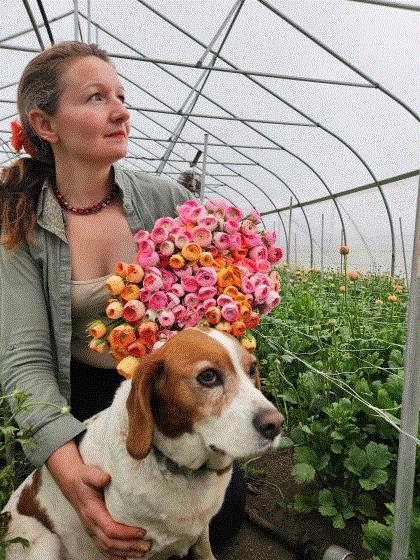
Tater's ranunculus crop looks great this year!
Tater and I love April; it’s one of our favorite months of the year! Finally, we see all our work this winter starting to pay dividends and we’re gearing up for peak season. It’s also time to presell our Mother’s Day flowers. It looks like we are going to have a great offering of snapdragons, ranunculus and stock this year. Let this be a gentle reminder for you to start getting your customers excited for your Mother’s Day offerings.
Meanwhile, summer and fall are coming, so Team Forget Me Not stuck chrysanthemum cuttings and sowed our first succession of heat-loving summer annuals this week. Over the years I have learned that sowing our summer crop plug trays a month before frost is perfect timing for us. Very seldom can we get the field tilled and prepped before Mother’s Day. It takes a lot of discipline for me to sit on my hands and wait an extra two weeks—especially when my social media feed shows other farmers starting their zinnia seeds! But each season I get a little wiser and remember that what’s best for my farm may be unique to me. It’s okay to follow your own plan—plus, root bound, floppy plugs don’t perform well in the field anyways ...
In this edition of Bloom Beat, we’re talking about indoor seed starting set ups, cutting dips and more. With all that being said, let’s talk shop!

Indoor Seed Starting Tips from University of Maryland
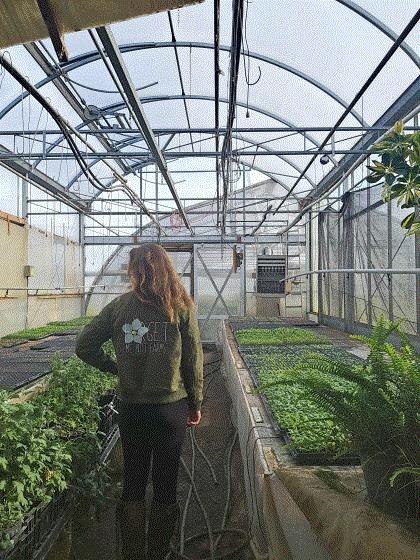
It's peak seed starting season. If you are just starting your flower farming journey
a greenhouse is helpful, but not required. Read on for some tips to set up your indoor set up.
I love starting seedlings—it’s one of my favorite tasks on the farm. Seeds are a prime example of the miracle of life. For instance, a snapdragon seed can sit on the top of sowing needle, and in less than three months it becomes a beautiful, towering spike that is over 3 ft. tall!
In order to have a successful finished crop you need to start with quality plants. For folks that don’t have a greenhouse this can be challenging. Since ambient light from a window is seldom enough, you will need to have an indoor lighting setup. Adequate supplemental lighting will prevent leggy and anemic seedlings—your plants will thank you for the extra lighting! Tater and I scoured the internet and found some key considerations for deciding what kind of fixtures you should buy for your at home setup. Below are some tips from the University of Maryland Extension:
- Make sure the lights are close enough to the plants, bright enough and running for the adequate number of hours per day. Plants need enough light for consistent durations and the lights have to be close enough to the plants (see below).
- Fluorescent and LED lights can work for your seed starting setup. LEDs are more efficient and longer-lasting, but T5 fluorescents and T8 fluorescents are affordable options, as well.
- Seedlings need 14-16 hours of light per day. Use an inexpensive holiday light timer to help automate this.
- A 4-ft. shop light (4,000-5,000 lumens) work well for one seedling tray. Remember, lumens are based on how humans perceive light—but it’s still a useful tool for assessing intensity of non-horticultural fixtures.
- Keep lights close to the plants, approximately 2 in. above the canopy.
- As plants grow, raise the lights to maintain the proper distance—you don’t want the foliage touching the lights.
- It’s important to keep tabs on the light intensity of your bulbs. Over time, fixtures lose their intensity. T-8 bulbs lose 10% of their initial brightness after 7,000 hours. T-12s can lose 20% brightness after 7,000 hours.
Keep your lights close to the plant canopy to prevent stretching. Photo by Joe Gardener.com
You can also check out this
LINK on how to make a simple light stand from PVC pipe. Your setup doesn’t have to be lavish or expensive to be effective. If you understand the interaction between chlorophyll, light and the light spectrum, you can do a lot with a little!

Cutting Dip Primer
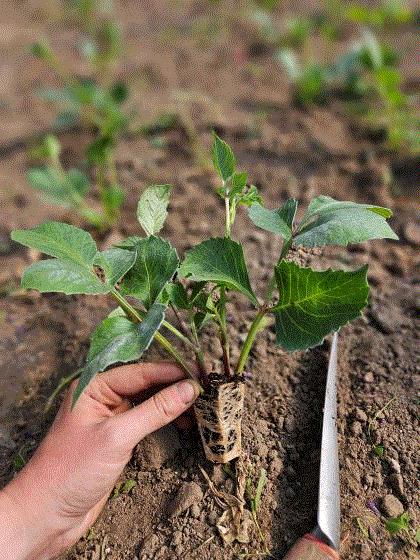
Dipping your cuttings before sticking sets your crop up for success.
One of my favorite resources from MSU extension is their annual
Greenhouse Insect and Pest Management Guide (shout out to author Jeremy Jubenville, and JC Chong, who reviewed the info). It’s an invaluable resources that will help make your integrated pest management decisions easier. For those of you who are new to growing commercial crops, this handout outlines the different kinds of chemicals, discusses scouting basics and more! Be sure to bookmark this.
We took our first round of heirloom chrysanthemum cuttings this week. It’s a fun season on the farm right now, as we’re sowing all of our summer annuals and also thinking about November flowers already! For those of you getting your spring shipments of heirloom chrysanthemum and dahlia URCs (unrooted cuttings), it’s worth giving them a preventative insect-management dip. Granted, no one sends bugs on plants intentionally, but it does happen. We all have our own challenges on our farm, so let’s try to prevent another pest from getting a foothold. Believe it or not, aphids may differ from one farm to the next. In this case, an ounce of prevention is worth a pound of cure. By dipping your cuttings you can prevent a problem before it starts. It also dovetails well into the “start clean, stay clean” approach to IPM.
This
EGro Alert from MSU Extension and Vineland Research and Innovation Centre will walk you through this step by step. The Vineland Research and Innovation Centre conducted a study looking at chrysanthemum cuttings, 84% contained one to two thrips per batch of 20 cuttings. So for chrysanthemums, this is a critical step! Dipping cuttings in different rates of biopesticides reduced initial pest numbers by 70 to 80%.
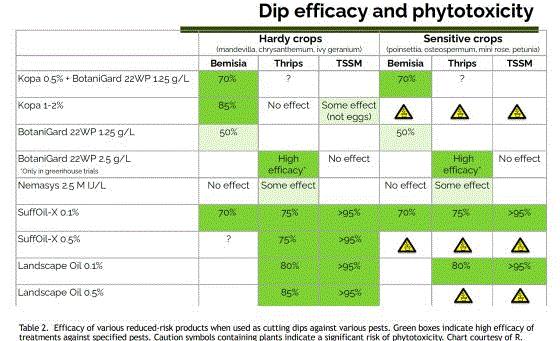
If you decide to implement a dip program, be sure to test your formulation on a small set of cuttings first to test for phytotoxicity. When deciding what product to select, it’s important to consider what pest you are trying to eliminate. Oils have the highest efficacy against thrips, whitefly and spider mites. Soaps are generally only effective for whitefly. Botaniguard is a popular dip, but according to Dr. Rose Buitenhuis’ research, Botaniguard is generally only effective for thrips. Also, too high a rate of Botaniguard can also lead to phytotoxicity.
Dr. Buitenhuis runs the Biocontrol Lab at the Vineland Research and Innovation Centre in Canada, and this
LINK outlines different dips, their application rates and efficacy on various pests. The table above is from her research.
Also check out MSU’s recommendations for products. You can also find the MSU Extension Disease 2026 management guide
HERE. This is another great link to bookmark.
Tater and I hope this will help your dahlia and chrysanthemum season!

Good Friction vs. Bad Friction in Your Business
It’s spring and we’re all making hundreds of decisions a day. It can be exhausting, and the challenge is sometimes in our exhaustion—we don’t always address the pain points for our employees and customers in a timely fashion. This is called bad friction.
But have you ever thought about how friction can be positive? I’m a
Harvard Business Review junkie, and Stanford professors Bob Sutton and Huggy Rao were recently on an
HBR PODCAST. Profs Rao and Sutton study all types of friction in businesses and have coached leaders of all sizes of organizations on how to identify and manage friction. As organizations get bigger, it can be more challenging for things to get done, and friction can even inhibit customer experience.
Dr. Rao’s take on bad friction is that it infuriates people; it’s the type of friction that makes an employee’s job difficult and inhibits progress. It’s no secret that people are very busy during their work day—time is a valuable commodity and there is never enough of it. It’s hard for employees to be curious and enthusiastic about their work when they struggle to make strides in their everyday tasks—especially since time is the limiting factor. The work is frustrating due to too many long processes and procedures that can slow progress. This is especially prevalent when upper tier management takes too long to decide. This can be a byproduct of too much bureaucracy. Bad friction can even hurt the customer experience if it’s difficult for customers to get the experience they already paid for. This is very common in healthcare. If your process for your company is too difficult for your employee, then the customer experience also takes a back seat and this leads to loss of revenue.
So how do we implement strategies to reduce bad friction on our small farms? At the end of the day, as leaders we are “trustees of other people’s time,” according to Dr. Rao. Encourage employees to voice their opinions and have dialogs with you or your manager about processes and inefficiencies. This encourages employees to take ownership of the success of the company. If there is a process that the employee is knowledgeable in, let them streamline that process and show you the final product. Sometimes I’ve found if we allow employees some autonomy, they will address the inefficiencies better than I ever could.
What about good friction? According to Dr. Rao, “good friction is “intentional resistance built into a system to improve decision-making and outcomes.” It is when businesses strategically insert pauses in places where poor decision-making could cost the business and cause major damage. This is especially important if the decisions are costly and hard to reverse.
How can we all make the best use of our time and make the best decisions possible? How can we make sure our employees feel empowered? At the end of the day, according to Dr. Sutton, “Friction should be placed where the cost of error is high, and removed where speed and ease matter.”.
An example of positive friction is doing a cost-benefit analysis when purchasing a new piece of equipment or hiring middle-tier management. It may be worth intentionally engineering positive friction into your farm to give pause and careful calculation the next time you are faced with a major decision like these.
If you want to take a deep dive on this, feel free to check out the Think Fast, Talk Smart
PODCAST by the Standford Graduate School of Business. If you are looking to expand your farm, this is worth the listen. It might give you a new appreciation for “friction” and how you can use it to your advantage.
You can also read (or listen to) their book “The Friction Project: How Smart Leaders Make the Right Things Easier and the Wrong Things Harder.” I added it to my Spotify audiobook list—you should, too!


Stay Warm!
Lindsay Daschner (and Tater)
Editor-at-Large—Bloom Beat
Owner—Forget-Me-Not Farms
This email was received by 6,198 of your fellow fresh-cut flower growers!
If you're interested in advertising in Bloom Beat, contact Kim Brown and she will hook you up!