March Farm Update
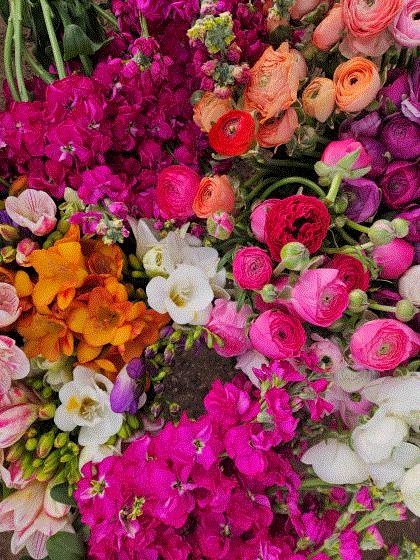
One of my favorite moments from this week. The stock and ranunculus are hitting their stride.
March is a fun month on the farm. It’s time to start heirloom chrysanthemum cuttings, and dahlias, too. We are starting to sow annuals for outdoor production, such as rudbeckia and delphinium. I’m itching to start more seeds, but over the years I have learned to sit on my hands. I can never get the outdoor field planted before Mother’s Day (even if the weather cooperates) since it’s a busy holiday for us. So as painful as it is to watch other growers start their zinnias and celosia, I have learned that a plug transplanted on time will outperform a sad, root-bound plug every time. Self-control is an art, and it’s one I haven’t mastered completely.
I’m excited for peak flower season! We fit ground yesterday for the outdoor fields and it’s going to be great. "Fitting ground" is how we prepare our soil for planting in May. We use a disk to chop up the leftover chaff and turn the soil over. This makes the soil more uniform and creates a more even surface—this makes our plastic mulch less prone to tearing. The disk also helps break down the chaff and turning the soil, exposing darker, moister layers. This helps the ground warm up faster. There are many schools of thought on field preparation, this is one of the tools that works well for us.
Another important tool: We are investing in additional drain tile this season, to ensure our fields don’t flood. It’s not the most exciting thing to write a check for, but I know 10 years down the road we will be grateful that we’ve incrementally invested in this.
In this edition of Bloom Beat, we are talking about new dahlia research from my alma mater, considerations for your next greenhouse build and more. With all that being said, let’s talk shop!

New Dahlia Research (Go Green!)
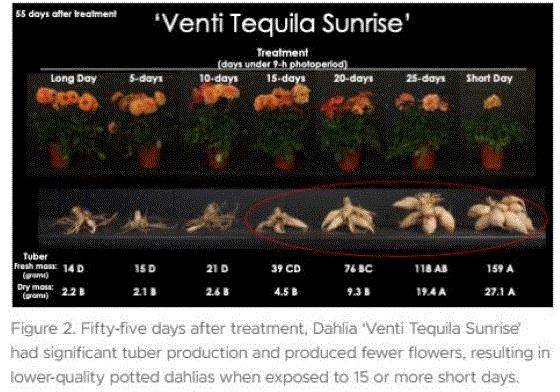
Tater’s friends at Michigan State University are at it again with the latest and greatest cut flower research! Dr. Roberto Lopez and his lab just published their research on reducing flower time in dahlias. Dr. Lopez and his team sought to find out how many short days are needed to induce flowering in dahlias during natural long days in the early-mid summer.
They found out if dahlias are provided 5 to 10 days of short days, it can reduce flowering time by anywhere from 3 to 24 days and can even increase flower bud count. Remember, dahlias are facultative short day plants. Meaning they can flower faster under shorter days—they grow vegetatively during long summer days and start flowering when the days get shorter later in the summer.
The takeaway: Dahlias can flower faster with just a brief exposure to short days, although the number of short days needed varies by cultivar. Dr. Lopez and his team recommend delivering 10 short days to an established plant. Growers will see the benefits of early production without sacrificing number of flowers or tuber production—the best of both worlds! But you don’t want to get carried away with the blackcloth. If you apply too many short days you get the opposite effect—so be strategic!
Bear in mind, the varieties used in this study are for potted annual production, but more likely than not our favorite cut dahlia varieties would benefit from this. I think photoperiod manipulation is an underused tool and can be just as powerful as temperature control. Manipulating photoperiod is much easier in a high tunnel than out in the field. There are a few varieties I would like to try this on. I think it’s worth conducting our own trial to see what might work and how some of our most cherished varieties would respond.
For more information check out this
LINK. Go Green!

New Bloom Solutions—Post V'Day Survey
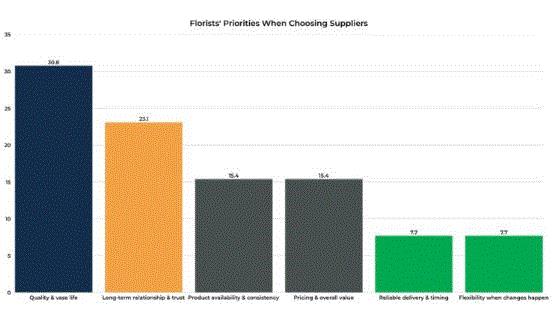
Survey shows florists value vase life and quality more than another factor when choosing their supplier for Valentine's Day blooms.
It’s wild to think that Valentine’s Day was only a month ago! Each year, New Bloom Media conducts a pre- and post-Valentine’s Day
SURVEY. Florists across North American are surveyed and this provides a snapshot of the state of independent brick & mortar flower shops during Valentine’s Day. This is real life insight and something you should key into—especially if you wholesale to florists! Below are the key findings from the 2026 survey:
- 77% of respondents felt confident in product availability for the holiday.
- 30.8% of respondents reported flower and quality dictates where they purchase their flowers.
- 23.1% of respondents reported the relationship with their wholesaler determines where they place the Valentine’s Day preorder.
Overall, florists showed optimism and confidence in the floral supply chain—which is a nice change of pace compared to the Covid era. It’s been a rough couple years for all of us, but things are finally stabilizing and florists are confident in the supply chain again. I think flower farmers have a unique opportunity with their florist clients. As an industry we need to grow into this role. Florists value quality relationships and pristine blooms. Guess what? Your farm can fulfill both of those needs. Your story even adds value because it adds a layer of depth to where the flowers come from.
If your florist can count on you for Valentine’s Day, that will give you a strong start to secure a weekly order for the rest of the growing season. If they can trust you when they are under pressure, Valentine’s Day can help set the stage for bigger floral holidays such as Mother’s Day (this is a big one on our farm!). When a florist buys from you, they aren’t just buying flowers, they are purchasing confidence. High-quality blooms and consistent quantities build relational equity between you and their shop. Now is the time to start dreaming up your winter flower offering. And if you are in the north? ... Start budgeting for a greenhouse! Valentine’s Day is a largely untapped market for most of us. I believe we have a tremendous opportunity here to become a strategic asset in our regional floral supply chains.

To Build or Rebuild—That is the Question!
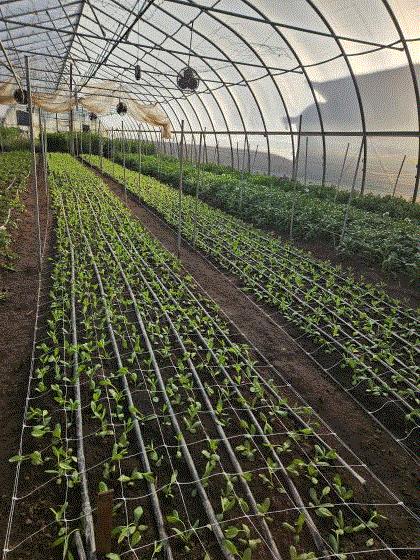
We've rebuilt greenhouses and also bought new kits over the years.
There are important considerations when deciding which path to take.
We all know that there is an insatiable demand for local flowers in the spring. Here are a few things to consider when deciding whether to purchase a new greenhouse kit or rebuild an existing greenhouse on your farm. There are incredible greenhouse kits available, and I have dreams of one day have a state-of-the-art greenhouse range at our farm. But it’s equally important to consider your budget. Start with your checkbook, not your dreams. On the surface this might make retrofitting an existing structure look very attractive.
There are hidden costs associated with rebuilding a greenhouse that might not be on your radar. Usually older greenhouses are less energy efficient and will likely need new hardware to ensure they are ready for another 20 years of service. Conversely, when considering new construction, it begs the question: Are you better off with a base-model greenhouse that’s brand new and can be upgraded over time, or should you invest capital into an older structure that’s limited in capability and technology?
I’ve done it both ways, and my best advice to you is to retrofit if your funds are limited. Especially if you build freestanding gothic houses, this is an easier decision to make. If the frame is solid, and you need covered space quickly, this may be a good solution, provided you understand the limitations. However, new construction may provide better scalability long-term, especially when you consider how adaptable the kit is to technology over time.
Tater and I have a 30 ft. x144 ft. gothic-style greenhouse in storage that’s 30 years old. I bought the kit for a couple of thousand dollars and I got an estimate from the manufacturer for new crossties, posts and hardware and it was over $25,000. I got another estimate for comparable brand new kit—it was just $30,000. The cost savings of a salvage house can be deceiving—which is why it’s important to go into these new ventures with eyes wide open. I was lucky enough the previous owner took it down so at least I didn’t have the labor in the teardown piece of the project!
If you want to take a deep dive into this, check out
THIS resource from USDA and American Council for Energy Efficient Economy. It’s over 40 pages and will definitely keep you busy for a while!
According to
Mississippi State University Extension it’s also important to anticipate the cash flow and operating costs of the structure you choose. Not only is it important to have the funds available to construct the project, you also should map out how long it will take you to recoup your investment. If you are starting your new greenhouse adventure from scratch, it’s wise to have enough cash in the bank to cover expenses until you harvest your first crop. Also, I found it interesting that they recommend a minimum of 5,500 sq. ft. of greenhouse space for a one-person business.
Tater and I also found this fun
STUDY based on greenhouses in the Mediterranean Basin. It’s important to account for labor—which accounts for approximately 40% of operating costs, so whatever you build, make sure you have enough funds to hire the manpower needed to run it.
At the end of the day, whether you are salvaging a tried-and-true structure or pouring concrete for your new state-of-the-art facility, the key is choosing a path that matches your labor needs and long-term vision.
Happy growing! Tater and I would love to hear about your next construction plan. Drop us a line
HERE.

Calling All Students!
If you are a student, there are some scholarship opportunities this spring you can capitalize on. Now is the time to get your recommendation letters, resumes and transcripts in order. One of my favorite things about our industry is how we invest in future leaders. Trust me, these opportunities are more than just a check, they can be catalysts to your career! So take some time during your spring break to get your applications in.
- Dave Dowling Scholarship (Deadline 15)
Are you interested in cut flower production? Are you also enrolled in a two- or four-year horticulture/floriculture program? This may be the scholarship for you! Ideal candidates have worked or are currently working in the floriculture industry and plan to pursue a career in cut flower production after graduation. Graduate students who are interested in this award need to be researching a cut flower-related topic. For more information, check out the
ASCFG website for the application.
- American Floral Endowment (Deadline May 1)
AFE has over 30 scholarships available each year ranging from $500 to $5,000. Applicants may select up to six scholarships to be considered for. Select wisely! Applicants must be pursuing a career in horticulture or floriculture, maintain a GPA of at least 2.0 and be a citizen or resident in the U.S. or Canada. For more information, click
HERE.

Stay Warm!
Lindsay Daschner (and Tater)
Editor-at-Large—Bloom Beat
Owner—Forget-Me-Not Farms
This email was received by 6,195 of your fellow fresh-cut flower growers!
If you're interested in advertising in Bloom Beat, contact Kim Brown and she will hook you up!