Phytotoxicity is the Talk of the Town
Phytotoxicity is a hot topic these days.
In January, Chris Currey of Iowa State University put out an e-GRO Alert on phytotoxicity he had observed on impatiens and mealycup sage. (I misspelled “mealycup” as “mealybug” three times.) Although Chris didn’t point out the offending chemical, he was clear that this is a result of not reading the pesticide label before making the application.
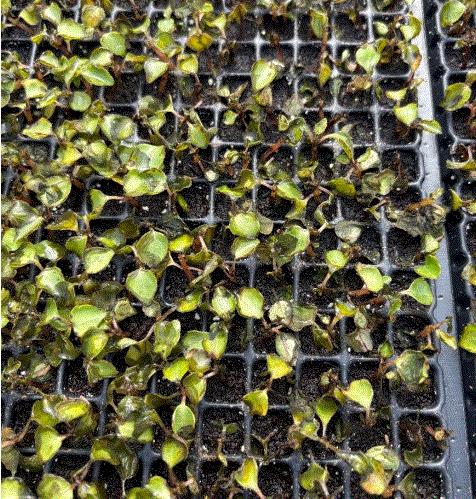
Bedding impatiens (Impatiens walleriana) seedling plugs grown in a 512-tray with necrotic and melting-out cotyledons and true leaves. (Photo credit: Chris Currey, e-GRO Alert)
In February, Chris struck again with another e-GRO Alert on what might happen when the application of chelated iron, which was meant to correct iron deficiency, ended up hurting a spring crop. This happened when the iron chelate was applied to all crops, instead of the crops that needed it. Also, iron chelate residue wasn’t rinsed off from the foliage after the overhead application. Again, this is a result of not knowing or following label instructions.
It’s difficult to spray some plants and not the others when the greenhouse is at capacity, all the while more plants want to squeeze in. But a few minutes spent on knowing if a product will cause problems with your crops, or not, will save thousands of dollars in damage.
In last week’s Tech On Demand, our own Bill Calkins summarized the experience of Nick Flax, a technical services expert at Ball, on this topic. As Nick puts it,
“The moral of the story here is: Always read the label and take a couple of extra minutes to make sure your IPM product is safe to apply to your target crop. It’s easy to get caught up in the hectic nature of spring and grab the first thing on your chemical storage shelf, but an accidental misapplication could be the difference between getting a premium for your plants and getting them to retail a week or two late.”
I know, it’s hard to read the fine prints and footnotes on a product label with aging eyes. If you’re like me, you might even refuse to wear bifocal or progressive lens even though your optometrist prescribed them for the very first time in your life. I love Nick’s suggestions of zooming in on a digital copy of the label on the computer (Control + F, my friends) and write “DO NOT apply to X, Y, Z crop” on the side of the bottle. I can do that without hurting my pride.

So, What Causes Phytotoxicity?
There are so many reasons why phytotoxicity may occur that it’s going to take me quite a bit of time to write about all of them in detail. Nah, I’m not going to subject myself to that kind of torture. Instead, I’ll just broadly categorize them. Again, I’m generalizing here so there’re bound to be exceptions to what I say. If I’m totally wrong about something, email me.
Some products are inherently more toxic than others. That may have something to do with the active ingredients or the formulations (including carriers, solvents and emulsifiers) of the product. Herbicides, plant growth regulators, fertilizers and supplemental nutrients (the latter two are basically salts) have greater risks of causing phytotoxicity than insecticides and fungicides because they’re designed to disrupt or manipulate plant physiology and functions. Oils and soaps that can disrupt the waxy layer or cuticular integrity of plants (just like what they do to insect cuticles) can also have greater risks of phytotoxicity. It’s advisable to understand these chemicals and know when to use and when not to use, as well as when it’s okay to put crops in the treated area. (This is particularly important for preemergence herbicides.)
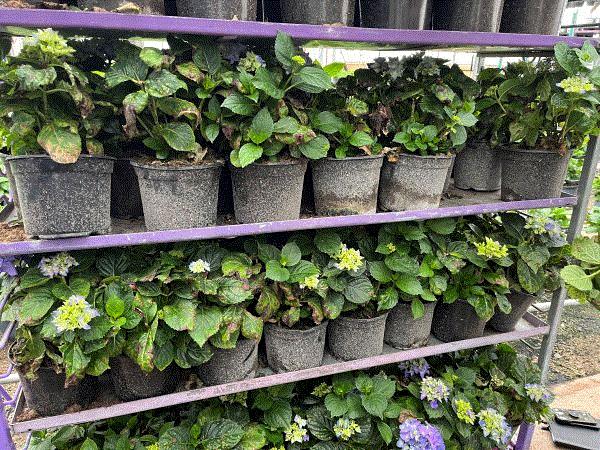
These hydrangeas were damaged after being placed on ground treated with a root-absorbed preemergence herbicide. They're taking a ride to the dump.
I’ve seen more phytotoxicity from the applications of products with oil-based formulations, such as EC (emulsifiable concentration) and OD (oil dispersion). They may be functioning the same way as oil and soap by dissolving the waxy layer or disrupting the integrity or normal functions of cuticles on the outside of plant tissues.
It takes two to tango. Chemicals by themselves may not be toxic to all plants. Some plant species or cultivars, and even growth stages (such as during poinsettia bract formulation), are more sensitive to certain chemicals or formulations than others. This is when reading product labels carefully becomes very important because sensitive plant species and cultivars are often listed on the labels.
Know that even if a plant species isn’t listed as sensitive in the “Plant Tolerance,” “Phytotoxicity” or “Crop Safety” section of the label, it doesn’t mean that damage won’t occur to that plant species. Despite pesticide manufacturers’ best efforts, they simply cannot evaluate phytotoxicity of their products on all plant species and cultivars. So, it’s important that we take time to test for phytotoxicity on a few plants the first time we use a product on a species or cultivar. It never hurts to be careful. A few days devoted to making sure a product is safe to your crops can save you lots of hassles and headaches later.
In addition to product property and plant sensitivity, environmental impact and plant stress are the third major group of causes. Some otherwise perfectly safe products may become problematic when the application is made under the wrong environmental conditions (too hot, too dry) or to stressed or injured plants. For example, horticultural oil (whether mineral or botanical oils) should not be used when it is too hot (above 90 F) or too cold (below 32 F), when it’s too humid (high humidity allows the solution to sit on the leaf tissues for too long, which then cause damage), or to drought-stressed plants. I often recommend that plants should be well hydrated before any chemical applications.
The last category of causes is how we use the chemicals, especially in tank mix. I’m not a fan of tank mix. One of my main objections to tank mix is that I won’t know which one of the many components in a mix is to blame when phytotoxicity occurs.
There’re products that simply shouldn’t be mixed together because of physical and chemical incompatibility. Adding an adjuvant or surfactant can generally improve product efficacy; however, this practice may not be advisable with some products. Often, the product or adjuvant combinations to avoid are listed on the labels. If it isn’t, check with the pesticide manufacturers.
As always, it’s a good idea to do a jar test to make sure the products are compatible. Spraying an incompatible tank mix on plants can certainly cause phytotoxicity, if not residue issues. Sometimes, physically compatible products can also cause phytotoxicity. For example, Tame 2.4 EC’s label specifically prohibits mixing with Orthene for application to poinsettia after bract formation.
Hey, an idea just came to me, y’all—what if I extract plant species or cultivars that are listed as sensitive in insecticide and fungicide labels and share them in this newsletter in the next couple of weeks? I think that might be helpful to you. I can’t do that this week because I still have a few more stories to get to and it’ll take me a few weeks of working on-and-off to get the information corralled. (I do have a real job, you know.)
Now, I must say this: The list of sensitive plants that I’m planning is NOT permission for you to skip label reading. It’s meant to be a quick reference for sensitive plants. You must read the pesticide labels for instructions on REI, PPE, use sites, use rates, application methods, target pests, and, yes, sensitive plants. I ain’t taking the legal responsibility when you don’t read the label and cause damage to your crops. (This is where the legal team at Ball Publishing or SePRO, as well as my wife, may want talk me out of digging a seriously deep hole for myself.)

Recorded Webinars on Cotton Leafhopper and Short-Spined Thrips
I want to give a shout-out to Alexandria Revynthi of the University of Florida and Anthony Witcher of Tennessee State University for their recent webinars. The webinars are now available online and are free to all.
Alexandria talked about the two-spot cotton leafhopper on March 2 and the short-spined thrips on March 19. (If you wonder what in the world is a short-spined thrips, this is now the official common name of Thrips parvispinus according to the Entomological Society of America.) Recordings of these webinars are now available on YouTube (go HERE for the two-spot cotton leafhopper webinar recording and HERE for the short-spined thrips webinar recording) or through Alexandria’s website.
In addition to reviewing the biology of two-spot cotton leafhopper, Alexandria also reported on her recent studies on managing this invasive pest in her webinar. This is an update to her previous tHRIve webinar on this pest, presented on November 14, 2025. In the tHRIve webinar, Alexandria reported that Hachi-Hachi SC (tolfenpyrad) is the most effective insecticide, followed by acephate, Talstar (bifenthrin), Aria (flonicamid) and Merit (imidacloprid). In the updated webinar, she reported that these insecticides, as well as Talus (buprofezin) and Kontos (spirotetramat) are effective against most nymphal instars. Insecticidal soap and horticultural and botanical oils provide knockdown of population when applied directly to the insects, but they don’t provide sufficient residual control.
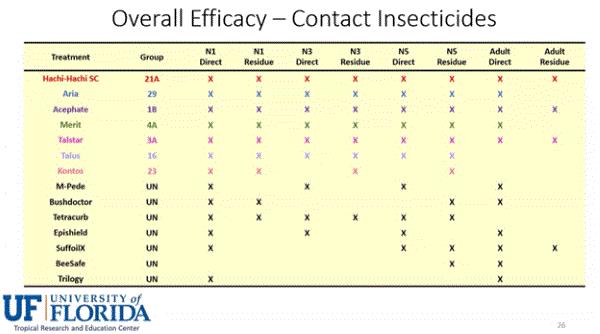
Insecticides proven effective against various life stages of the two-spot cotton leafhopper in Alexandria Revynthi's studies are marked with "X" in this table. (Credit: Alexandria Revynthi, University of Florida.)
Alexandria teamed up with Young-gyun Park, a post-doctoral researcher in Lance Osborne’s lab, for her short-spined thrips webinar. Alexandria shared that preventive and curative drenching of gardenia plants with Altus (flupyradifurone), Kontos (spirotetramat), Mainspring (cyantraniliprole), AzaDirect (azadirachtin) and two soluble silicon products (Dune and Bio-Supersil) didn’t seem to reduce thrips number and infestation level significantly.
Alexandria also found that Ancora (Isaria fumosorosea Apopka strain 97), Isarid (Isaria fumosorosea strain FE 9901), Lalguard M52 (Metarhizium brunneum strain F52) and Velifer (Beauveria bassiana strain PPRI 5339) reduced thrips population with the liquid products (M52 and Velifer) appearing to have greater efficacy. Nematodes Steinernema riobrave and Steinernema carpocapsae showed promises in control efficacy.
Lacewing larvae, predatory bug (Dicyphus) and minute pirate bug were able to reduce thrips abundance up to two weeks in Alexandria’s study. Among the predatory mite species, Amblyseius swirskii, Neoseiulus cucumeris and Stratiolaelaps scimitus showed the greatest promise. But Alexandria stressed the importance of establishing predatory mites before the arrival of thrips. Young-gyun discussed his study on the functional responses (i.e. how many prey a predator eats at different prey densities) of two predatory mite species (Amblydromalus limonicus and Amblyseius swirskii) and a predatory thrips species (Franklinothrips vespiformis).
Alexandria also has recordings of previous webinars and useful management information on her webpages on two-spot cotton leafhopper and short-spined thrips.

Recorded Webinar on Weed Management in Propagation
On March 12, Anthony Witcher gave a tHRIve webinar (hosted by the Horticultural Research Institute or HRI) on weed management in propagation. Propagation is a very sensitive part of a production cycle simply because cuttings and young plants are so tender and highly susceptible to damage from chemicals. It doesn’t matter if the liners are produced in the fields, greenhouses or shadehouses, weeds will show up eventually. Seeds may be blown in by the wind, mixed in media, or attached to workers’ boots and pants. They have months to grow and reproduce before the liners are transplanted. Weedy liners beget weedy crops.
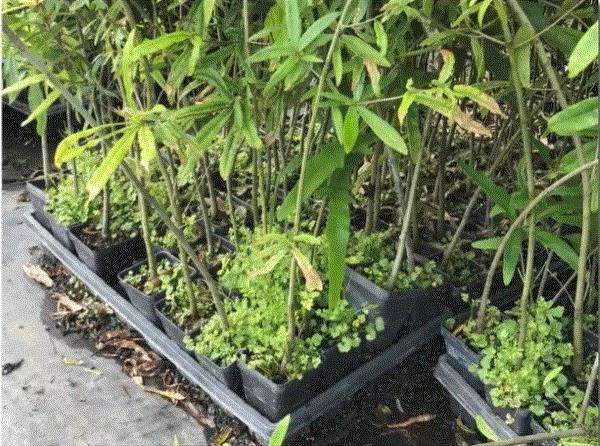
Weed management in liner production can be tricky because of the senvitivity of young plants to preemergence herbicides. (Photo Credit: Anthony Witcher, Tennessee State University)
Anthony talked about several sanitation practices that should be considered, as well as several mulch and post- and preemergence herbicide options available for use during propagation. Anthony also presented results from his recent studies on using different types of mulches and preemergence herbicides for weed management in propagation. Unsurprisingly, preemergence herbicides have different impacts on rooting success of different plant species. For example, dogwood was sensitive to more preemergence herbicides than yellow poplar. Isoxaben reduced rooting of butterfly bush, but not holly or viburnum. Impacts on rooting also differ depending on when you make the application.
Anthony’s webinar has lots of good information that will help you get better weed management and rooting success. Go HERE to watch the recording.

New Greenhouse Training Online Courses
Many of you know about the University of Florida’s Greenhouse Training Online Program. I want to pass on some information about the courses scheduled for this year. The first course, Nutrient Management, has already started. It’s still not too late to sign up for the next course on Practical Disease Management.
The online training course added two new sessions this year.
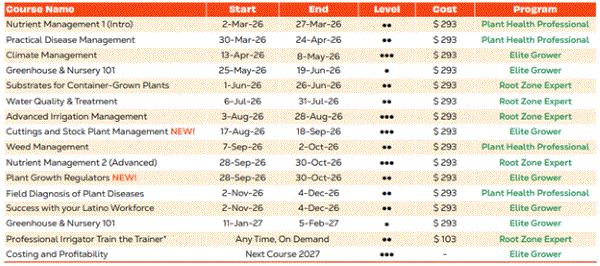
Cuttings and Stock Plant Management will begin on August 17. This new course will be taught by Jim Faust of Clemson University and John Dole of North Carolina State University. Participants in this course will learn about the processes of producing clean, healthy, well-rooted cuttings.
A new course on Plant Growth Regulators will begin on September 28. This course will be taught by Garrett Owen of The Ohio State University. Participants in this course will learn how to select the right PGR, how to use them and how to adjust based on crop stage, vigor and environment. This course is great for those who want consistent results and fewer costly errors.
As in the past, all courses are available in English and Spanish. The cost of each course is $293 per person, with a 20% discount for five or more registrations.


See y'all later!

JC Chong
Editor-at-Large
PestTalks
This e-mail received by 27,847 subscribers like you!
If you're interested in advertising on PestTalks contact Kim Brown ASAP!