A new Deep South trial comes to Homestead
For more than a decade, the Florida industry (and beyond) enjoyed Costa Farms’ Season Premiere Trial, held every winter at Costa Color. It was well laid out, well grown, featured pretty much all the breeding companies, timed with TPIE in January for a visit, as well as throughout the winter and spring, and gave the industry a chance to see how our varieties held up in extreme sun, heat and humidity. But, alas, the cost in money and manpower to run a trial like that is considerable, and Costa made the decision to focus on other projects. The final Season Premiere was 2023.
But don’t despair because the University of Florida has your back! They’ve launched a new trial in Homestead at the Tropical Research & Education Center, just 10 minutes from Costa’s old trial grounds, and under the able direction of Assistant Professor Xingbo Wu. He’s been stationed in Homestead since 2022 and is working on breeding and researching a range of interesting plants (more on that below).

Dr. Wu attended Season Premiere a couple of times and as a plant breeder he appreciated the value it brought to the industry, which is why he took on the project of launching a UF trial. But it’s not a relocation of Season Premiere—it’s a whole new trial under a different name (TBD). He’s had the support of Costa’s R&D VP John Sieg and Marta Maria Garcia from Dümmen Orange (and formerly with Costa) in getting it off the ground. They started out “trialing the trial” in 2024 and 2025, testing the growing conditions and bed layout. This year was their first “official” trial, with ten 8-ft. by 50-ft. raised beds and five breeders: Dümmen Orange, Ball FloraPlant, PanAmerican Seed, Danziger and Benary. Plants go in Week 35 and stay in the ground until the summer heat melts them away … and if they survive that, well, the breeders know they’ve got something extra tough!
Long-range, he’s got an acre of ground at his disposal and space enough for 50 beds, so the trial can grow if the industry supports his efforts. He’s also got a grad student and a Trial Manager to help.
Dr. Wu emphasized that this will be a truly independent trial. Not that Costa’s wasn’t … but there was always the lingering thought that perhaps breeders were participating to stay on the good side of an important customer. I’m not saying they were … just that at UF, there will be zero commercial connections or relationships.
I’d hoped to make it down for the debut year, but other travels and writing deadlines prevented it. However, Dr. Wu sent me these photos of the trial, taken by their social media specialist Yomiris Reyes. Looks like he’s off to a good start! And he’s planning on getting out to other trials to compare notes and get ideas—namely, the Southern Garden Tour Trials in June.
What’s he breeding?
While I had Dr. Wu on a Teams call, I asked him what he was doing besides organizing this trial. His job description says Assistant Professor - Tropical Plant Breeding & Genetics, with a primary focus on nursery crops and underutilized tropical plant species. He told me that title actually changed from an ornamental plant breeder because there are so many other tropical crops that UF wanted him to consider.
For instance, he’s working on okra. Yes, that spiny, slimy vegetable that thickens soups and tastes great fried. And there are ornamental/edible okra varieties—the University of Georgia developed at least one, UGA Red. Oh, and it’s got lots of potential medicinal uses, too!
Vanilla orchids is another area of interest. He’s principal investigator for a Sustainable Agriculture Research & Education project to establish domestic vanilla cultivation in Florida, Puerto Rico and the U.S. Virgin Islands. Talk about a cash crop—vanilla is one of the highest-grossing agricultural commodities by weight. Perhaps only saffron and cannabis beat it. Maybe someday, thanks to his work, I’ll visit an 8-acre vanilla bean greenhouse in Florida!
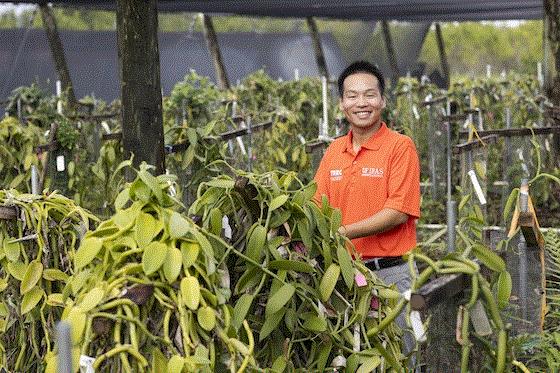
Dr. Wu with vanilla orchids in production.
Tropical hibiscus is another breeding area and who can’t use more colors, bigger flowers and longer-lasting flowers on their hibiscus? And they’re a relative of okra … wonder if you could get those bright colors on an okra plant?
And, lastly, another tropical that’s also an edible, passion flower, which has spectacular flowers and delicious fruit. Plus, as a vining plant, it’s got excellent patio potential … maybe a nice accompaniment to all those racks of mandevilla we see at retail!

Perennial Livestream now available to view
If you missed the excellent presentation “The Hottest New Perennials for 2026 (and a sneak peek at 2027 standouts),” well, don’t worry, you didn’t miss it! That’s because I recorded it and posted it HERE.
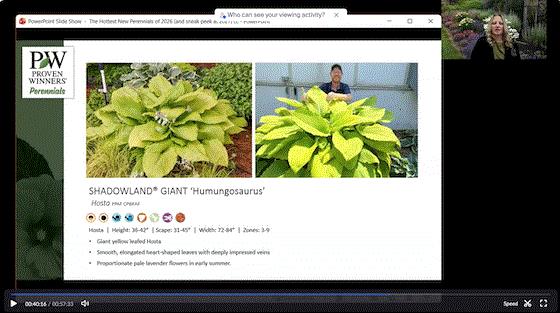
That’s Hosta Shadowland Giant Humongosaurus, coming to Proven Winners in 2027. It looks like it’s about to devour breeder Hans Hansen.
In the hour-long livestream, my guest expert Laura Robles of Walters Gardens shared the details on about 30 great perennials coming from Walters and their partner Proven Winners. They include allium, carex, cerastium, crocosmia, delphinium, dicentra, epimedium, heliopsis, hibiscus, hosta, nepeta, primula, rudbeckia, sarracenia (yup, pitcher plants!), veronia, yucca and more!
An biological IPM strategy for battling thrips
In my 40-plus years in the industry, I’ve seen biological controls go from “Bio-what?” to “You mean ladybugs?” to “Too complicated” to “Tried it—didn’t work” to “Got a young gal on my staff who says it’ll work” to “Love ‘em—got anything new?”
Our reporting on the topic has always tried to be two steps ahead of you (check out our Third Biosolutions Guide for the latest on the topic). As you’ve gained interest and trust, we’ve been there with answers, thanks to the persistence of folks like columnist Roger McGaughey, who kept after us to publish more.
That’s why I found a recent release from Biobest to be interesting. They’re offering a thrips control strategy that's fully integrated—from detection and monitoring to the correct friendly bug to combat the pests and the effective means of dispersing them.
First up, early detection of thrips. Biobest recommends their Bug-Scan sticky traps and rolls. They mention that blue traps are highly attractive to species such as Thrips parvispinus and Frankliniella occidentalis, while green traps are optimal for detecting Echinothrips americanus.
For monitoring, go automated with their AI-powered Trap-Eye system, which eliminates manual stick trap counting and delivers accurate species ID. Then use the Crop-Scanner app to maintain all your crop monitoring data in one place. Its dashboard provides a real-time overview of pest and beneficial dynamics in your greenhouse.
Then the right biological control choice with predatory mites like Swirskii-System, Montdorensis-System and Cucumeris-System, which target mobile thrips stages. In pollen-producing crops, Orius-System can establish early, supporting preventative control, while delivering strong curative performance under high pest pressure. And the Vespiformis-System seeks out leaf-dwelling thrips and consumes all life stages.
Lastly, disperse your biological controls with the Entomatic multi-row and handheld dispensers, which ensure optimal placement and uniform distribution of beneficials.
Biological control has come a long way, baby. And, thankfully, it seems to be putting a nail in the coffin of the “spray and pray” that we did back in the day. If you’re still in the skeptical stage, hit up a supplier—whether Biobest or Koppert or any other—and see what you’ve been missing!

Stonehouse Nursery now in hands of long-time manager
When you don’t have family to give (or sell) your business to, how about a seasoned manager? That’s how the succession plan went down at Stonehouse Nursery in Berrien Springs, Michigan. The founders and owners, Jay and Patty Steinhauser, are retiring and they’re selling the business to nursery manager and seasoned horticulturist Amy Ryan, who's worked for the business since almost its start 35 years ago.
“Having served as friends and business partners with Amy for a number of years, this transition is a natural evolution for our nursery,” said the Steinhausers, when asked about the sale. “Her deep-rooted passion for horticulture and commitment to our industry ensure that the high standards we have established over the last 35 years will continue to hold true.”

Amy Ryan, the proud new owner of Stonehouse Nursery.
Amy’s roots in Stonehouse Nursery go back nearly 30 years when she first joined the summer potting crew. While earning her degree in Nursery and Greenhouse Production and Management from The Ohio State University, she returned as an intern. After gaining additional industry experience, she returned to Stonehouse Nursery in 2016 as the nursery manager.
“I am delighted to have the opportunity to advance my passion for horticulture and my involvement in our industry through the ownership of Stonehouse Nursery,” Amy said. “I am dedicated to continuing our diverse, interesting plant line and hope to continue to expand it as we grow into the future.”
All existing orders will be fulfilled without disruption; new orders will continue to be taken through independent sales representatives, brokers and directly with the nursery.

A pair of worth-watching videos
I spend way too much time on YouTube. I mean, the world is at my fingertips! One minute I’m finding tricks for getting stuck wheels off my F150 (beat the tires with a sledgehammer); the next I’m learning about the Circle of Fifths from musical prodigy Jacob Collier. But, mostly, I like greenhouse videos. Here are two you’ll enjoy:
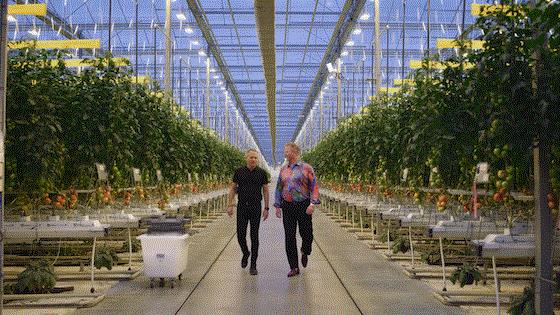
Mucci Farms. From the series “Bringing it to the Table” is this 25-minute documentary about greenhouse vegetable grower Mucci Farms. I watched it because Mucci is a sister company to BrightFarms, whom I visited last week in Georgia. Mucci is fascinating because they’re one of the oldest CEA growers in North America, dating back to the 1970s (before that, they were field growers). You even get some recipe ideas at the end!
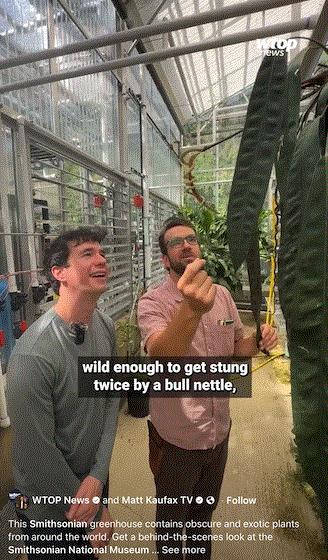
The Smithsonian’s Botany Research Greenhouse. I stumbled across this news report by Matt Kaufax of WTOP’s “Matt About Town,” who takes us on a brief tour of the very cool Botany Research Greenhouse at the Smithsonian Gardens in Suitland, Maryland, the Smithsonian’s “museum without walls.” We learn that pretty much all of the 600 to 900 varieties on display are unusual, unique and in many cases still unidentified. For instance, they have a new genus of ginger called Larsenianthus careyanus. And there’s an anthurium called wendlingeri that can get leaves 7-ft. long.

Finally …

Photo: National Parks Board
Want attention? Set a world record!
This is an ongoing topic of mine: Using the world record folks at Guinness to grab some attention for our products. The Singapore Garden Festival just did it by setting a record in a new category: “Most Flowers on a Swing.” Which is now 12,888, if you’d like to take a stab at it. The record was to promote the 10th edition of the Festival, which is held at the spectacular Gardens by the Bay (a bucket list destination of ours).
The swing, which is about 15-ft. tall, featured more than 60 cut flower varieties, including roses, carnations, lilies, orchids and hydrangeas, carefully arranged by some 200 community gardeners, students, volunteers and park staff over two days.
Now, 12,888 flowers is a lot. But it’s a first-time record, meaning you could have put a few bunches of cuts on a backyard swing set, sent in the $5 application and earned the record yourself!
I’ve talked about another record worth trying to bring to the U.S.: The largest display of hanging baskets. It’s record is 2,968, set in 2011 in the United Arab Emirates at a display at the Al Ain Paradise Garden. Nobody has since broken it.

You could also try for the hanging basket record ...
I may have once hinted that Metrolina probably ships more hanging baskets than that in a spring morning. All they need to do is arrange them on a whole mess of HB hooks before sending them out!


Feel free to email me at beytes@growertalks.com if you have ideas, comments or questions.
See you next time!

Chris Beytes
Editor-in-Chief
GrowerTalks & Green Profit
This e-mail received by 31,270 loyal readers!
Thanks to my loyal sponsors, who help me reach the 31,270 readers of Acres Online in more than 60 countries. Want to be one of them (a sponsor, that is)? Give Kim Brown a shout and she will tell you about our many advertising opportunities.