Anthropic AI Job Prediction
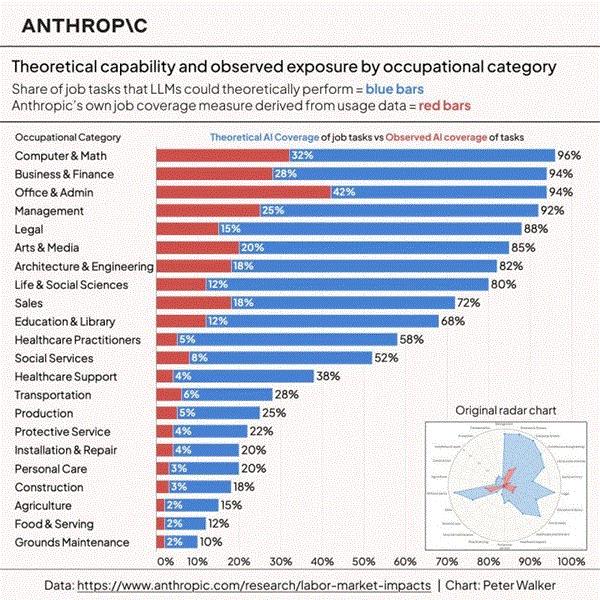
I was perusing the interweb the other day in search of new and interesting forms of entertainment when I came across Anthropic’s viral report and graph predicting how quickly AI will take all of our jobs. Unfortunately for those of us in agriculture, it looks like we will still have to work for a while longer. Not only did agriculture rank among the least replaceable industries by AI (next to other obvious categories like construction and grounds maintenance), but the currently observed impact on our industry was essentially nonexistent compared to other fields. So if you still get dirt under your nails, calluses on your hands, or habitually have soaking wet shoes like me, you can count on having plenty of work in the future.
Hilariously (and you can’t make this stuff up), an Amazon AI commercial was the next thing to cross my screen. In the ad, there’s a futuristic greenhouse, and just looking at it we know we are safe from being replaced. From the ripe fruit all the way up the vine to the horizontal beams that would prevent the lean and lower technique, it’s quite clear that the makers of this ad, and the AI that generated the content, aren’t greenhouse growers.
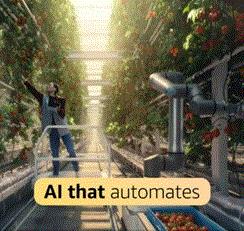
Screenshot from an Amazon AI advertisement showing a futuristic greenhouse.
Now, I’m not claiming that AI won’t have a role in our industry. Areas where we are already seeing headway include greenhouse environmental controls, IPM and pest scouting, and yield prediction. Personally, I long for the day I have a full dashboard monitoring everything from environmental conditions to plant health metrics using tools like chlorophyll fluorescence or electrophysiological sensors, and even economic gauges such as operating costs and market demand. Within the confines of CEA, I think we can be comfortably optimistic that new technology headed our way in the near future will continue to benefit both the industry and the people working within it.

Surveys
At my research center at CSU Spur, we convened our advisory group for the first time. I could write a whole piece about the group itself, but the discussion of what would actually help the industry stood out. Some themes were familiar, including a strong focus on labor, but there were also insights I didn’t expect, such as a healthy amount of skepticism toward automation, especially among smaller-scale operations. The feedback from the group was incredibly meaningful. If you’d like to contribute to helping research institutions in this way as well, I have two great opportunities for you to participate in.
Vertical Farming Survey
A wide group of collaborating institutions, including Cornell, UC Davis, Texas A&M, the University of Minnesota, the University of New Hampshire and Alcorn State, has released a survey to gather information on challenges and needs in U.S. indoor vertical farming. If you work in a vertical farm, or in a career adjacent to vertical farming, please take a few minutes to share your knowledge with this group at the link here!
Urban Ag Survey
Another great opportunity to help inform researchers about the industry comes from Purdue. Researchers there are asking for folks like you to help advance research in urban agriculture, CEA and vertical farming. This two-part survey doesn’t take long to complete and will help researchers conduct meaningful work that benefits the industry.
Click the link to take the survey!

Fluence's Red Light Sandwich
Fluence, a supplier of LED lighting systems, recently held a webinar on lighting techniques for cannabis production. In the session, Dr. David Hawley outlined a strategy that applies a high red spectrum using both top lighting and canopy lighting to maximize production efficiency and yield.
Even if you’re not a cannabis grower, the webinar is worth watching. David covers a lot of useful information about LEDs in general, including a great discussion on the intersection of operational expenses and plant physiology. For example, he notes that, within reason, higher light intensity outperforms regardless of spectra, a finding that agrees with my own PhD work on lettuce that I’ll be publishing this year (I promise, Neil).
Even if you’re a lettuce or tomato grower, Dr. Hawley’s webinar will teach you a lot about grow lights, the importance of lighting the entire plant, and how to think about lighting decisions from an economic perspective. After all, who am I to disagree with someone who shares my name, at least phonetically.
Watch the webinar here.

Sollum SF-INFINITE LED Fixture
Sollum has recently launched its newest LED fixture, the SF-INFINITE. The fixture brings together many of the features growers have come to expect from modern LED technology, along with some capabilities that allow for more advanced lighting strategies. As usual, the first place I went to learn more was the spec sheet.
The SF-INFINITE boasts an electrical efficiency of 3.5 µmol/J, which has become something of an industry benchmark for top-tier fixtures, with the potential to reach 3.9 µmol/J when using dimming capabilities. For perspective, just 10 years ago anything above 2.5 µmol/J was considered leading-edge technology. The rapid improvements in efficiency over the past decade continue to show just how quickly LED technology has advanced.
Beyond efficiency, the fixture also features dynamic intensity control across four channels. When paired with Sollum’s broader lighting platform, this allows growers to implement sophisticated strategies such as real-time DLI management and spectrum tuning throughout the photoperiod. For growers interested in dialing in lighting for both plant physiology and operational efficiency, that level of control could open the door to some interesting applications.
Check out Sollum’s website and the spec sheet using the links.

Biostimulant Report
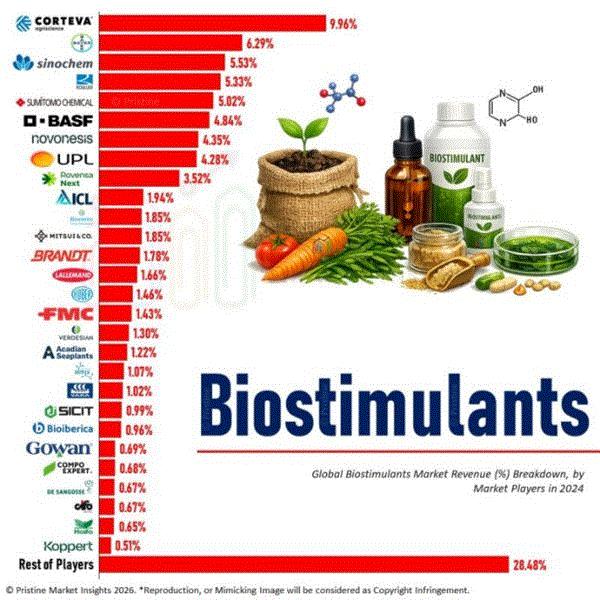
Pristine Market Insights recently published its Biostimulants Market Report. The report shares several key insights about biostimulants that are both exciting and give some reason for pause.
First, the market is booming. Much of this growth is driven by rising demand from the organic sector, which in the U.S. recently surpassed $70 billion. Technology and research are also playing an increasing role in developing new formulations and helping quantify the benefits of these products.
One of the more interesting trends is the growing incorporation of biostimulants into fertilizers. This is particularly notable with organic fertilizers, where there is a strong belief that factors such as microbes or organic compounds help plants maximize nutrient uptake. The report highlights how this integration not only benefits farmers, but may also help reduce agricultural runoff by keeping more nutrients in plants and soil.
However, there are still many unknowns when it comes to biostimulants. One challenge is the lack of clear regulation, both domestically and internationally. Many countries do not yet have a formal biostimulant category, and the lack of standardized definitions can lead to inconsistency and ambiguity when growers try different products and brands.
Perhaps most interesting to me is how the market share is distributed among companies. The major agrochemical firms remain among the top producers, with Corteva leading the group. That said, smaller companies collectively account for roughly three times the market share of Corteva, highlighting both the large number of players entering the space and the opportunities for growth, while also underscoring the challenges of standardization.
Check out the article and report here.



Dr. Jake Holley
Editor-at-Large
Inside Grower
This email received by 36,757 loyal readers!
Interested in advertising in Inside Grower? Contact Paul Black or Kim Brown and they'll show you how easy, effective and affordable it is.