Leaf Spot and Rust
I received some extremely helpful information from tropical plant industry consultant Lynn Griffith. He’s been kind enough to supply some growing and cultural information over the years and I am happy he does so for the betterment of your businesses.
The topic he’s addressing is leaf spot issues on palms, especially the arecas, and rust on monstera. Both of these are exacerbated by cool temperatures, which many Florida growers have been experiencing. However, both these leaf spots and rusts are troublesome year round.
From Lynn:
“This leaf spot issue on palms, especially the arecas, is sometimes referred to as the Helminthosporium complex. There are three very closely related fungi in this complex: Bipolaris, Drechslera and Phaeotricoconis. The only real differences between these three fungi are in the morphology of the spore structures. These distinctions are really nothing we need to worry about as growers.
“Young arecas are much more affected by this disease than more mature palms. Once you get out of the juvenile foliage and into the more mature foliage structure, the problem largely vanishes. Mature foliage begins to form on fully grown 10-in. arecas. It becomes predominant in the 14-in. stage and beyond. Arecas growing in higher light are more susceptible to the leaf spot than palms growing in darker shade.
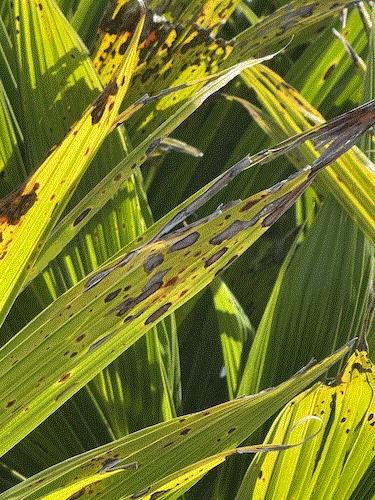
“The relationship between palm nutrition and the leaf spot is not totally understood. Generally, greener, healthier arecas have less spot than palms with weaker color and weaker nutrition. Fungicide options are numerous, including Avelyo, Heritage, Orkestra, Mural, Medallion and Daconil. Most areca palm growers are applying these products in some sort of rotation.
“It is known that Thiophanate methyl products such as Cleary’s 3336 have no efficacy on Helminthosporium. One report indicates that Thiophanate methyl makes Helminthosporium worse, more by killing off competing fungi without affecting the pathogen. I also generally don’t recommend copper fungicides on this problem, for two reasons. One, grassy plants like palms don’t like a lot of copper. You can do it once in a while, but not frequently. Second, to my knowledge there are no reported bacterial pathogens of areca palms, at least not in Florida.
“We have certainly had some cold weather lately. In palms as well as other plants, a lot of the chlorophyll is found in the chloroplasts. These are bodies near the surface of the leaf that can be damaged in cool weather. This results in what some growers call “winter color”. The palms are not underfed, they just don’t have quite the chlorophyll content that they perhaps did before it got cold. Podocarpus will do this as well.
“When this happens, you can correct it to some degree by spraying with magnesium nitrate. Magnesium nitrate is a direct precursor of chlorophyll. Harrell’s has a good liquid one called Nitrate Plus, which also has some chelated micronutrients. Magnesium nitrate is usually sold as a liquid, as it is very hygroscopic. It sucks a lot of moisture out of our humid atmosphere. You normally need to spray numerous times in order to bring the color back. You will see improvement.
“As for rust, particularly on monstera, it is a cool weather pathogen. It is most virulent between 10-15C or 50-59F. Wet conditions combined with cool temperatures make it even worse. When you have rust on monstera it helps to trim off the infected leaves to reduce inoculum. Sprays immediately afterward with Avelyo, Heritage, Mural, Orkestra and Postiva do a good job controlling it, but you need to stay on the sprays.”
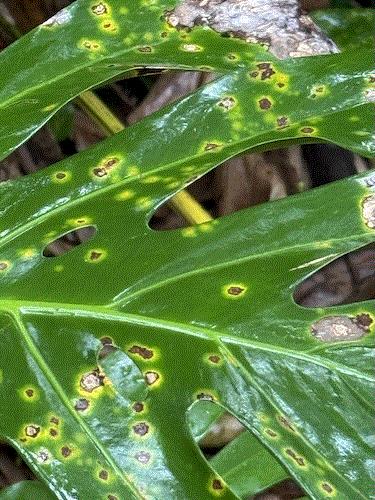
Thanks for the cultural information, Lynn! Your advice and suggestions are welcome anytime. Lynn also noted that the monstera rust is also present in Hawaii, as he saw it there about six months ago.

Three from Agri-Starts
Okay, plant geeks. Agri-Starts has a couple of cool plants for you. I do enjoy stopping by the Agri-Starts booth each January at the Tropical Plant International Expo because I am assured they have something both beautiful and available. And they did this year, too.
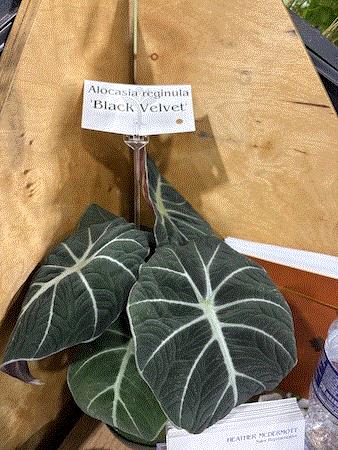
First, here’s a lovely jewel alocasia called Black Velvet. Those leaves do indeed feel like velvet. Agri-Starts’ Ty Strode told me it’s a collector-type alocasia, and with that coloration and large leaf, he’s totally right. Ty tells me Black Velvet is great for 4-6-in. production and is a bulletproof indoor alocasia.
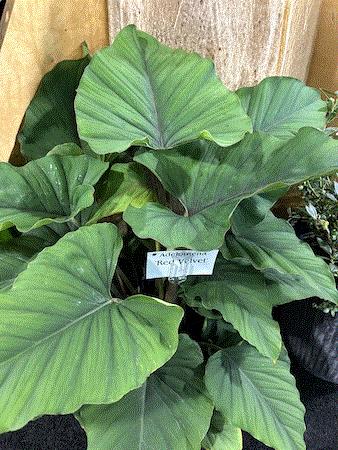
Then here’s a super beautiful adelomena called Red Velvet with velvety-looking leaves but in a totally different way from the alocasia. Ty said this variety fills a 10-in. pot very well and said this is a totally new and different color than others out there. I took a quick look at other adelomenas online and Red Velvet does look a lot different.
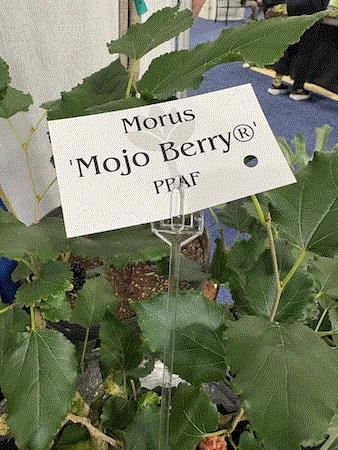
Agri-Starts also reliably has some sort of fruiting bush, and this year was no different. They were featuring a mulberry from Concept Plants called Mojo Berry. It’s an “ultra compact” variety at just 1-2 ft. tall and wide. “Not weedy” was the message for this one.
Here are the fruits, which seem plump and delicious.
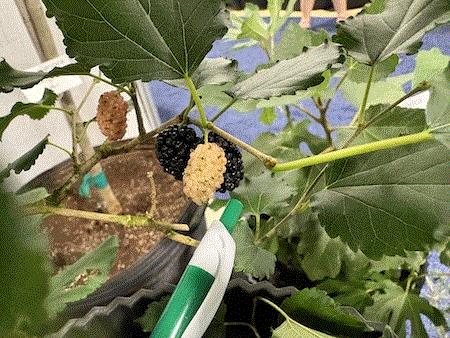
All types of fruits are becoming more and more popular, so getting into fruiting bushes, especially compact and home gardener-friendly ones, is a great idea.

Three from Lucanne
In Bossman Beytes’ January 27th edition of Acres Online, Chris introduced you to the line of tropicals from Lucanne, a company formed by former Dümmen Orange partner Perry Wismans. Chris included a photo of Perry at TPIE holding a very lovely double hibiscus, just one of the handful of tropical lines carried by Lucanne.
Scrolling through my TPIE pics I found a few other items from the Lucanne booth. I reached out to Perry for more information on them. First, he explained Lucanne offers three types of products under their brand Ticket to the Tropics:
-
Their own breeding Heliconia
-
Exclusive partnerships CannaSun
-
Curated products considered best in class and having consumer appeal
Keep that in mind as we look at these:
This is Chocolate Chill Dipladenia. That color is just so luscious, chocolate is the exact correct term for it. Perry explained that this is a selection from Dümmen Orange’s Floradenia series, and fits in the last of the categories mentioned above. He tells me Chocolate Chill is not exclusive, but it is a great extension of the Ticket to the Tropics offering.
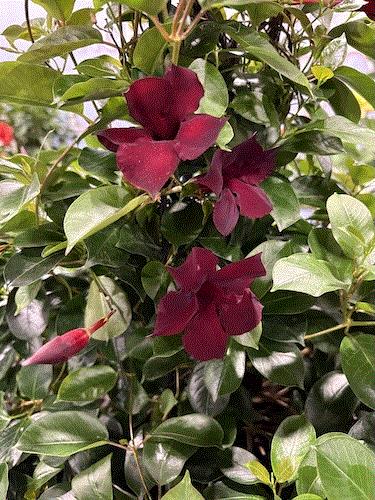
The color is even deeper and darker in real life.
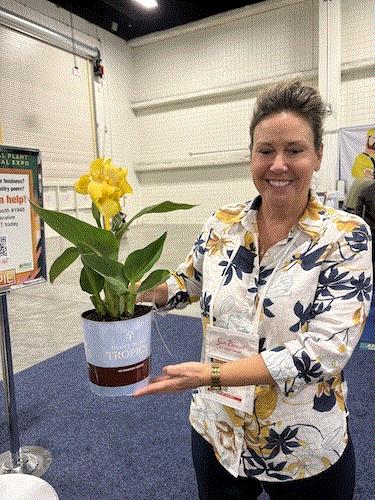
Then there is the line of cannas called CannaSuns, which sits in that middle category of exclusive partnerships. The CannaSuns are a series grown from seed, known for their uniform pot production and are an excellent “thriller” in a mixed container. This lovely yellow one is being joyfully presented by Rebecca Lusk who, although now with McHutchison, is helping her friend Perry spread the word about his new lines.
And then there is the still-unnamed series of heliconias, which is in that first category of Lucanne’s own genetics. They currently have two varieties—Love Bird and Ruby Parrot—which just received Plant Breeders Rights approval. Heliconias came to Lucanne by way of Dümmen Orange, which acquired the genetics when they bought Rijnplant. Perry sees some great opportunities in this line of heliconias, for which the breeding focus is compact growth, early flowering and improved performance under cooler conditions.
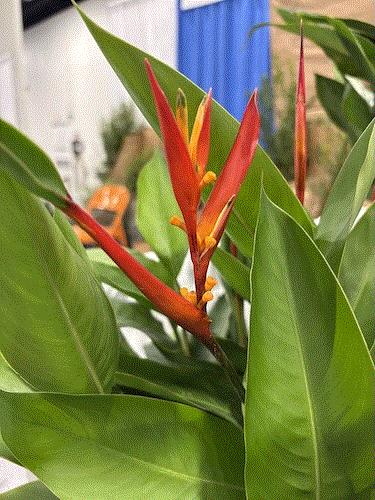
And I love the branding!

By the way, if you have a name suggestion for this heliconia series, Perry would love to hear it! Email me your suggestion and I’ll pass it along.
As Chris mentioned in his Acres Online, Perry is hoping to offer growers something beautiful and with a tropical feel for June and afterwards, when the crazy spring season eases up a bit. All of the above plus the hibiscus certainly exude that tropical vibe.

A PlantCon in Florida?
Speaking of Chris, he noticed last December that the folks at PlantCon—the plant convention that gathers the plant organizations, vendors, sellers, growers exhibitors and super fans in cities across the country—had not re-upped its visit to Orlando for 2026. In fact, no city in Florida, the state known for its houseplant and tropicals industry, was listed. Chris wanted to know why—and you likely do, too.

The intrepid investigative journalist that he is, Chris hunted down the answer. He reached out to PlantCon founder and president Kenny Nguyen, who had this reason for not including Orlando for 2026: Attendance at the Orlando event was low; in fact, it was less than half of the next lowest attended show.
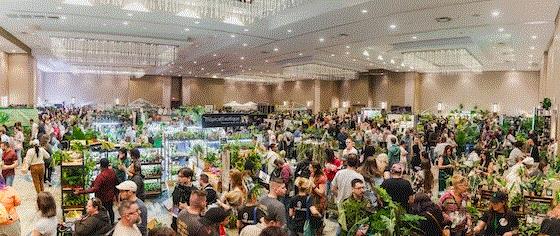
PlantCon Orlando back in February 2025.
From a business standpoint, I see where it would make sense to cut a show that was poorly attended. But Kenny told Chris that after being approached by multiple plant sellers, wholesalers and PlantCon attendees at this year’s TPIE with requests to add a Florida show to its mix, “I am launching an effort to add a PlantCon Florida on the first weekend of December,” Kenny wrote.
Kenny continued, “Our bandwidth is past its limits with the six shows lined up for this year, and as much as we loved Orlando and the Floridian community, it didn’t make financial sense to prioritize Florida over the new and current markets that would perform as well as, if not better than Orlando’s show. With all of that being said, I have been floored and honored by the sheer number of requests for a return to Florida, and it’s just so humbling to see that our presence in this community was so appreciated. It makes it very hard not to return as soon as possible.”
And “as soon as possible” is exactly what happened! Kenny and the PlantCon team launched a Kickstarter-like campaign to gauge interest in a show in a major Florida metropolis (Miami? Tampa? Orlando?).
The messaging on the PlantCon: Project Florida page speaks to how much the organization values the contributions and input of the plant community:
“This is the first time in our history allowing you to make the decision of where we go next! Our goal is to raise $100,000 for PlantCon Florida by March 15 so we can find and secure a venue, start the planning process and launch marketing for a PlantCon in Florida.
“Support our mission! We have never been one to shy away from asking for help. After all, our supporters are the only reason we have made it this far. Time and time again, we are shown that real community lies in asking for support and letting people show up.”
With many of these Kickstarter-like campaigns, those folks who pledge funds get some sort of deal. Find ways to support the campaign by signing up for booths early, signing up for sponsorships and getting admission tickets for a discount. Check it all out on the PlantCon Project Florida page.
If you have any comments, questions or suggestions for content, email me about them at ewells@ballpublishing.com.

Ellen Wells
Senior Editor
Green Profit
This edition of Tropical Topics was sent to 28,860 loyal readers!
If you're interested in advertising on Tropical Topics, contact Kim Brown ASAP!