End-of-February Farm Update
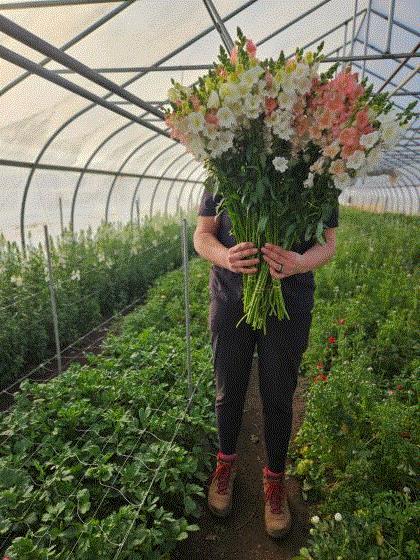
Specialty snapdragons are a florist favorite for Valentine's Day.
Valentine’s Day is over and Tater and I are relieved! We were able to fil all of our orders in spite of the cold snap we had at the end of last month. The ranunculus were the star of our crop offering and it was nice to see our designers get excited for them. They are our prized spring crop and I hope that never changes.
However, our specialty snapdragons have the potential to take the spotlight, especially the Snapstar series by Sakata. I think our florist customers enjoy the local-flower twist on an old-time staple. The best part for us is that snapdragons are incredibly profitable.
Tater and I took great notes about the holiday and already have our Valentine’s Day 2027 crop planned and seeds ordered. Don’t wait too long to take holiday notes; it’s easy to move on to the next item on your to-do list. Your future self will thank you for your diligence and detail, and it sure does make next year’s holiday easier.
It’s been a fun game of Tetris on the farm lately—every inch of greenhouse space is priceless. The remains of the Valentine’s Day crops are getting pulled this week and we’re on to the next major holiday, planting Mother’s Day snapdragon, stock and ranunculus. The longer days are fueling my spirit, and it won’t be long until we’ll be planting dahlias again. I honestly look forward to it!
That said, I need to temper my enthusiasm with a dose of practicality, so Tater and I are tightening up the 2026 field plan. I’m entering my ninth year farming, and the novelty and allure of unicorn varieties still traps my attention. However, I’m learning that in the throes of peak season, the idea of me or an employee sowing 12 ft. of four different specialty sunflowers each week might be a good thought, but it's probably not a practical one (but we still might keep it in the plan).
Are there any varieties you are excited about in your crop plan this year? Tater and I would love to hear from you, so
DROP US A LINE!
In this edition of Bloom Beat, we’re talking about Green Career Week, pansies, a surprise in some Valentine’s day roses shipments and more!
With all that being said, let’s talk shop!

Green Career Week
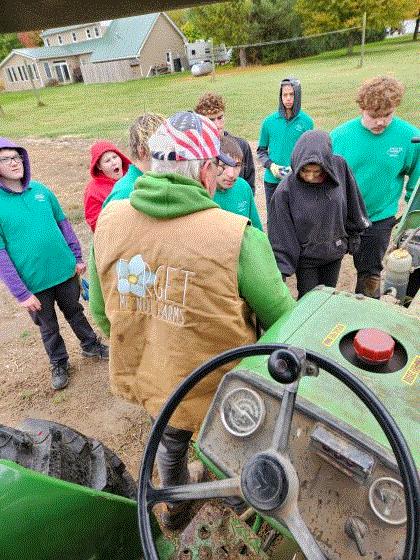
We have students out to the farm multiple times every season. Last fall, Rich gave a tractor safety talk.
Mark your calendars friends, because it’s that time of year again! Seed Your Future’s Green Career Week will be March 2-6 and you should join in. Green Career Week is a national initiative led by green industry leaders (like you) to increase awareness of our industry among young people. Not only do you get to share your story and showcase opportunities at your farm, you also get to build relationships with local high schools, colleges and universities. It's a creative way to engage with the youth in your community—and who knows, you might get a budding flower farmer to join your crew this summer! It’s a win-win for everyone. Tater and I hope you will consider participating, because the future of our industry depends on all of us engaging with the next generation.
At Forget Me Not, we cherish our relationships with our local agriscience and FFA programs. It’s one of the most meaningful projects Tater and I participate in each season. I highly recommend reaching out to your local programs even if you can’t formally participate in Green Career Week. You can still use the resource guide to connect with teachers and students.
Tap
HERE to register your farm and receive a free resource guide and template to help you successfully connect with high school vocational programs in your area.

Leaf Spotting on Spring Pansies
Are you growing pansies this spring? They are one of my all-time favorite spring flowers and it’s a tremendous ego boost when we get stems over 10 in. tall! Most of the pansy varieties we grow are incredibly special and the seeds come with a hefty price tag. Tater and I watch them carefully this time of year since they are prone to disease.
Below is an excerpt from Bill Calkins'
Tech on Demand newsletter from earlier this month that covers leaf spot on pansies. If you aren’t already subscribed to Tech on Demand you should be! It’s an exceptional weekly newsletter focused exclusively on dealing with crop problems happening right now. Granted, it’s geared toward bedding plant production. But there is a lot of overlap into cut flowers. Thank you, Bill, for writing this piece and making sure our pansy season is off to a strong start.
Leaf Spotting on Spring Pansies
Leaf spotting on pansies is common, and although they are a low-pH-loving crop, when pH drops too low, dark spots can appear—signaling iron and manganese toxicity. Be sure to monitor soil pH regularly to avoid this issue. Your pH should be between 5.5 and 6.0, ideally.
But leaf spots can also be caused by a range of foliar diseases—namely Colletotrichum (anthracnose) and Cercospora. According to Tech On Demand experts, these pathogens favor moderate to cool temperatures and free moisture on leaves, so cooler nights and rain in the late afternoon/evening is a perfect recipe for an outbreak.
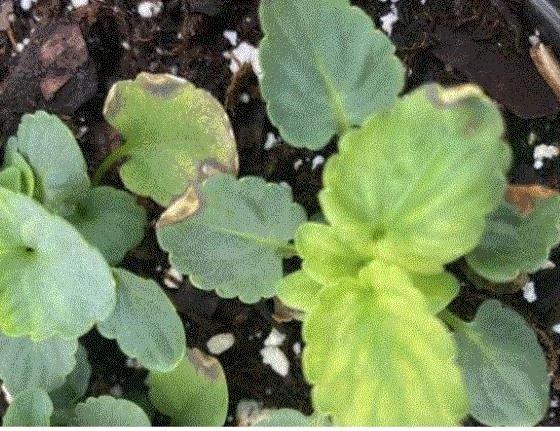
However, a common factor leading to disease that is often overlooked is low nutrition, so be sure to check your soil EC (soluble salt levels) when you are monitoring soil pH. Maintaining soil EC around 1.5 mS/cm (via Pour-Thru method for testing) and below 2.0 mS/cm will ensure your crops are receiving adequate (but not too much) fertilizer and reduce susceptibility to foliar leaf spot diseases. Below are a few key ID traits for these leaf spot diseases and how to manage them if an outbreak occurs:
Colletotrichum. Starts as small grayish/tan spots with black margins under warm, moist conditions. Spots often develop a concentric ring pattern, which can be confused with a viral disease. Lesions grow to infect stems and eventually cause the plant to collapse. Remove heavily infected plants and fallen debris to reduce spread, and apply fungicide with mancozeb or thiophanate-methyl + mancozeb ASAP when symptoms first appear.
Cercospora. Purple spots with “fuzzy” margins typically start on lower leaves. If untreated, small purple spots will begin appearing on upper leaves, and older lesions will expand into irregularly shaped tan spots with purple borders. Heavy infection will cause lower leaf chlorosis followed by leaf drop and overall stunting. Remove infected plants and debris ASAP and treat with fungicide. Mancozeb + thiophanate-methyl, myclobutanil, fludioxonil and chlorothalonil are all effective to control this pathogen.

MSU's 2026 Greenhouse Disease Management Guide
Every year, Dr. Mary Hausbeck and her lab at Michigan State evaluates the efficacy of fungicides. She works with the
IR-4 Project to create a disease management guide for floriculture growers.
Pathogens can evolve quickly, and Dr. Hausbeck and her team classify different products as “A team” and “B team” players. Use A team players if disease pressure is high, and use B team players if disease pressure is light. It’s advised to rotate your products and this ranking system gives you a guideline on what to choose. It’s tempting to want to use the same A team product over and over, but that can quickly turn into a terrible mistake! You still want to pay close attention to FRAC codes and make sure you are using different modes of action to ensure the pathogens on your farm do not become resistant.
For more information on strategies for disease management, check out this
ARTICLE.
I’ve had the pleasure of listening to Dr. Hausbeck talk at many grower conferences and her work serves as an invaluable tool for growers to combat disease resistance and ensure the fungicides in our tool boxes remain effective. We need to manage diseases without accelerating resistance. Thank you, Dr. Hausbeck, for all your work!
You can find the link
HERE.

ASCFG Webinar Series on Managing Uncertain Times

The folks at the Association of Specialty Cut Flower Growers have a four-part curated webinar series coming up in March called Navigating Uncertain Times. Webinars will be at noon EST on Wednesdays all month long.
According to the ASCFG, “These past few months have reminded us that farming’s unpredictability is matched only by its rewards. For cut flower growers across North America, economic shifts, supply chain issues and evolving consumer habits may feel overwhelming. Despite these uncertainties, resilience and collaboration open new opportunities. Above all, your creativity and commitment keep North America’s cut flower industry strong. The ASCFG is committed to supporting your success during these challenging times.”
You are welcome to register even if you are not a member—the series is free! Speakers will include Dr. Charlie Hall, Dr. John Dole, Jenny Marks of Trademarks Farm and more.
HERE is the link to register.
Cocaine Found in Valentine’s Day Rose Shipment
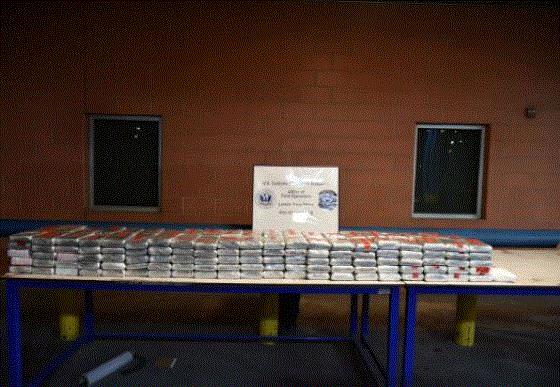
February 10, 2026 CBP officers at World Trade Bridge seized over $6.8 million in cocaine.
On February 10, U.S Customs and Border officers and their canine unit found an unexpected surprise with a rose shipment at the Laredo, Texas, port of entry. Officers confiscated 516 pounds of cocaine hidden in the rose boxes with a street value of 6.8 million dollars.
“This substantial cocaine seizure at the World Trade Bridge highlights the steadfast dedication of our officers in safeguarding our borders and communities from the threat of illicit drug trafficking,” said Port Director Alberto Flores, Laredo Port of Entry. “The discovery within a shipment of roses demonstrates the vigilance and expertise of our officers. Their commitment to the mission reflects the high standards of service CBP upholds, and their actions continue to make a meaningful impact in protecting our nation.”
Could you imagine the surprise getting some of these mixed up with your rose shipment? Another reason to buy local flowers!
Stay Warm!
Lindsay Daschner (and Tater)
Editor-at-Large—Bloom Beat
Owner—Forget-Me-Not Farms
This email was received by 6,199 of your fellow fresh-cut flower growers!
If you're interested in advertising in Bloom Beat, contact Kim Brown and she will hook you up!