Still impressive, regardless of size
Greetings from Essen, Germany, where once again, like clockwork, I'm sharing the highlights of last week’s IPM Essen trade fair, the biggest European event for the horticulture market, and hence the one I choose to cover. It’s got a bit of everything—garden plants, potted plants, cuts, equipment and automation, crop inputs like pots and media and pest control, service companies … you need it, it’s probably here. And even a bit of cannabis seed and one stand selling watches, costume jewelry and scarves. Plus, enough coffee vendors to keep you motoring through the nine big halls of the Messe Essen (not counting Hall 1A, which is underground and houses a big showroom for the German auction Landgard).
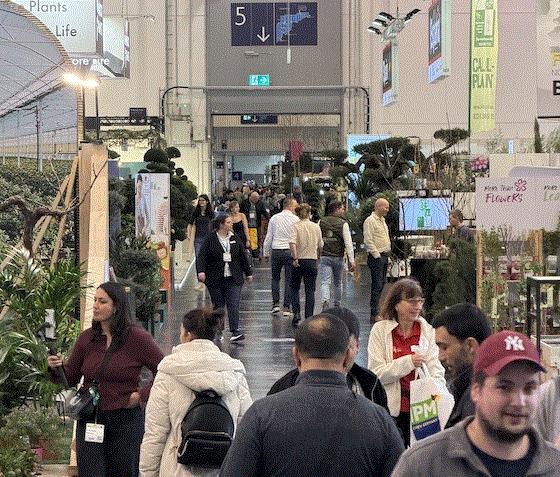
Last year, the organizers reported “well over 40,000 trade fair guests” and 1,434 exhibitors. This year, the figures are “almost 40,000 trade visitors” and a slight increase to 1,476 exhibitors. With about 40% of attendees coming from outside of Germany, it’s truly an international event. That’s evident in the trade show halls, where you see the big signs over the blocks of exhibitors from Holland, France, Spain, Belgium, Poland, the UK, Turkey and elsewhere. Even the U.S. has a group representation: SUSTA—the Southern United States Trade Association, which has been participating in IPM for years.
Despite the increased number of exhibitors, the footprint of the show has been shrinking; they've moved all of floristry and research exhibits from the lower level to Hall 5 upstairs, which used to be full of Danish exhibitors, who now occupy just a small section of Hall 6. So, obviously, the show has downsized, perhaps with fewer large booths.
But regardless of show size, it’s still one of the most impressive and important events on the horticulture calendar, which is why Ball Publishing attends every year. Of course, with more than 1,400 exhibitors, I can’t write about more than maybe 1% of them. It’s why I always say you should put IPM Essen on your bucket list. But since you weren’t there, and I was, here’s a bit of what caught my eye in tools, plants and generally interesting … well, stuff, starting with greenhouse technology.

New livery for TTA-ISO
I reported last year on the merger of high-end machinery makers TTA and ISO Group into TTA-ISO and told you they’d be focused first on sales and marketing. Now they’re more visibly combining the two firms, with new livery on their equipment. It’s a good, clean look. In fact, the new robotic tissue culture planter they showed was even sleeker—almost hermetically sealed, since it has to maintain a much cleaner environment than a typical greenhouse machine. I was told the next step—which is happening now—is combining the forces of their R&D talent. For instance, developing one vision system to control their machines (right now they have three, I’m told).
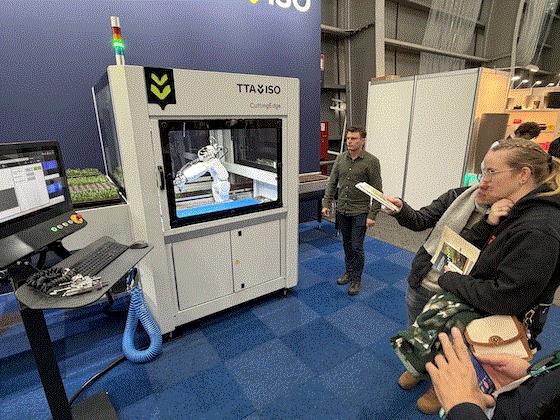
As for the question of which machine or technology will win out? There are still hundreds of both TTA and ISO transplanters in the field working beautifully and TTA-ISO will continue to take care of those customers—including providing new machines to expand their production lines, if asked.
Javo goes orange
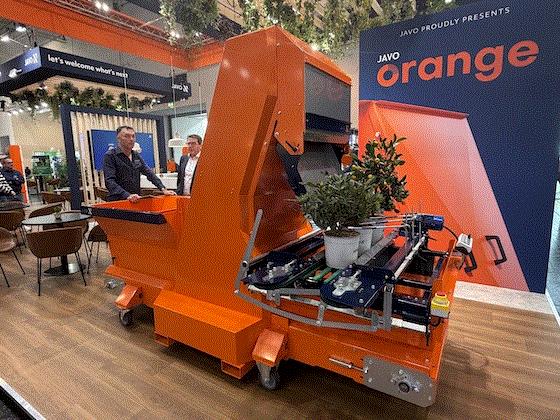
More new livery, this time for Javo, which has had the same sort of burnt orange paint scheme for years (and before that, sort of a gray-green). Now they’re bright orange to reflect their Dutch origin, they told me, but the name “Javo Orange” indicates a new modular system they’ve instituted that allows you to select individual standardized components—base, function and options—to create your desired machine configuration. They say it'll make maintenance, service and upgrades fast and efficient.
Degramec’s Rollo conveyor
Degramec's Rollo is a space-saving way to deploy conveyors in your greenhouse: you roll it out like a hose, then roll it back up to move or store.
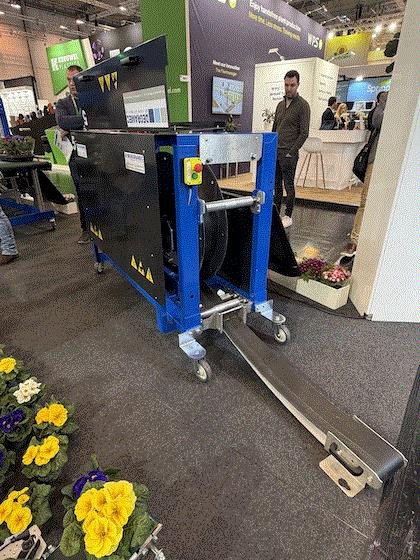
It’s not quite that simple, of course, but Belgium’s Degramec has designed a conveyor belt that unrolls from a powered reel. You place rollers along its path, plus an end roller. On a smooth surface, the belt can lay right on the ground. It can even feed onto a perpendicular main conveyor to carry plants into your headhouse. Rollo comes in varying widths, with length up to 75 meters (about 250 ft.).
Lommers' trimmers
When I heard that Monrovia owns a bunch of their machines and had ordered four more, I had to take a closer look at the nursery trimming equipment offered by Lommers Tuinbouwmachines (tuinbouw meaning horticulture), a Dutch company founded in 2020. (Also, I met the owner and his son at dinner the night before and that formed a bond).
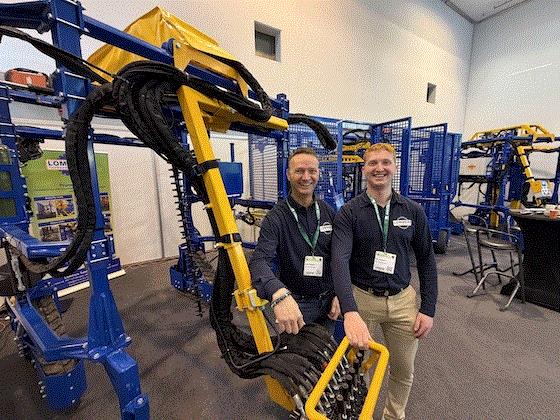
Toine Lommers and son, Tim.
These are big automated trimming machines used to shape woody ornamentals—top them, trim the sides straight or at an angle, form balls … they can do just about anything except spirals (which are still left to the “horticultural craftsmen”). Even though they’re solid machines meant to endure field use, you can still see the Dutch attention to detail in the quality of the razor-sharp cutting heads (of which they offer four styles).
Logiqs’ Vertical Air Flow benches
Horizontal air flow (HAF) happens up high in the greenhouse. Internal transport experts Logiqs has introduced the concept of vertical air flow (VAF) down at crop level to create the “perfect climate near the plants.”
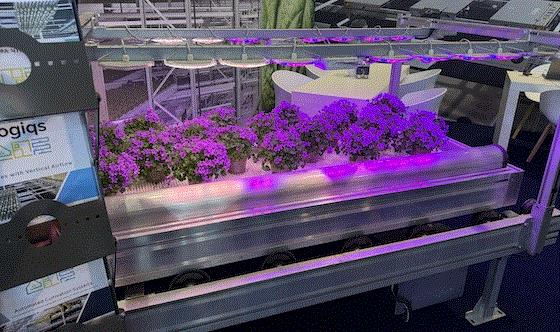
The silver tube on the benches houses the blower mechanism. It only takes up about 1% of a standard table's space.
The technology pumps tempered air (with the desired temperature and humidity) up through holes in the bottom of their benches and into the plant canopy, which they say keeps the plants' stomata open, improving CO2 uptake and boosting photosynthesis. And you can still utilize the bench’s ebb-and-flow system. It’s been tested at a bromeliad nursery and also a vegetable young plant propagator with good results.
GreenProducts’ Green Plugs
The GreenProducts stand caught my attention because there was a Ball Seed sign on it. Turns out, Ball Seed is the exclusive North American distributor of the product they make called GreenPlugs. A GreenPlug looks on the surface like the rolled paper pots so widely used in propagation. But these, I'm told, are made on actual tobacco-rolling machines using carefully selected potting medium.
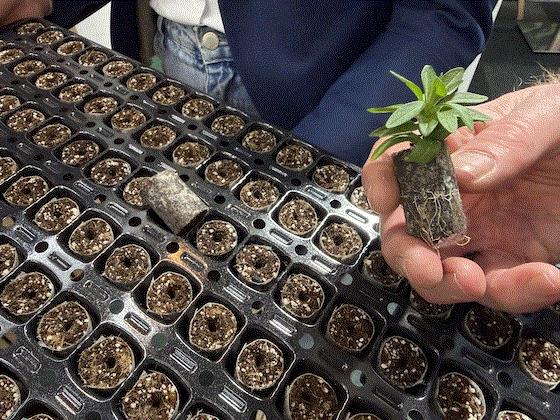
The tobacco in a cigarette or cigar has to be packed extremely uniformly to ensure even burning, right? You can’t have it burn slowly, then fast or unevenly. They reasoned that the same uniformity could be applied to a growing plug to ensure uniform water- and air-holding capacity. That, they say, is what makes GreenPlugs better. They’re easier to water in and keep property watered. They suggest you test them on your most difficult-to-root varieties and you’ll see the difference. GreenPlugs come premade in 102-, 72- and 50-cell sizes.
Now, this is not new technology; in fact, I was told they've been making them since 1991! But the Ball Seed relationship is brand new.

Selecta One’s RCS 2.0 official launch
Another propagation story is the official launch of Selecta One’s RCS (rooted cutting system) 2.0, which was shown quietly last year. RCS 2.0 utilizes organic Ellepot paper as the sole rooting medium. It’s a strip of the paper, folded in half and embossed with little pockets, into which workers in Kenya stick cuttings. They’re rooted, then shipped north to Europe for planting. The benefit? Three thousand rooted cuttings can fit in a carton that would normally only hold about 200 rooted liners. There’s less waste, less packaging material and it’s substrate-free—important in Europe where peat is slowly but surely being outlawed.
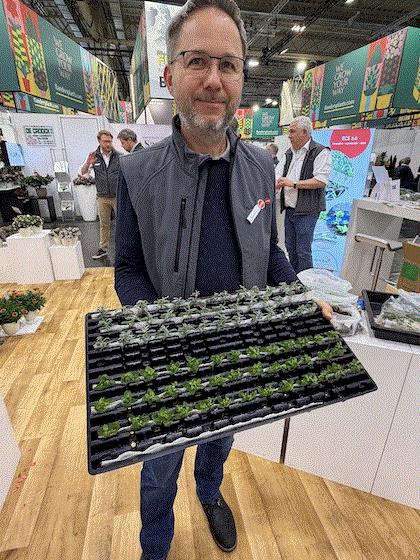
Selecta One's Stefan Reiner with samples of the RCS 2.0 strips.
The downsides: The system still needs technology for automatic planting, which Selecta is working on. And while Europe allows them to be imported from Africa, we can't yet bring them in the U.S. from offshore cutting farms because the USDA hasn't signed off on it as an approved way to bring rooted cuttings into the country. Approval is 12 to 18 months off, Selecta tells me, with fingers crossed. In the interim, Ball is diligently testing the RCS 2.0 to make sure it'll work for their North American customers.
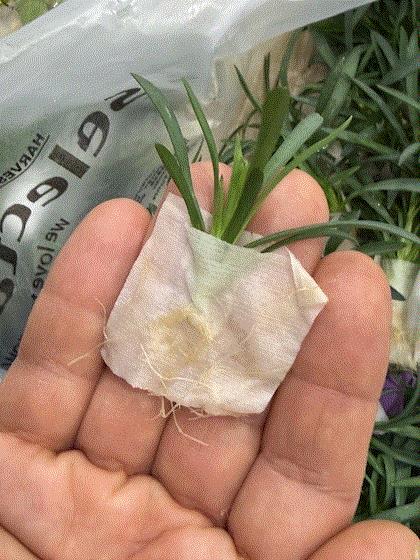
Look, ma—root, but no substrate, just paper!
One other possible use: Some onshore rooting stations have expressed interest in the technology as a way to more efficiently produce rooted cuttings for shipping long distances—again, because of the number that will fit in a box.

Dramm: Something old, something new
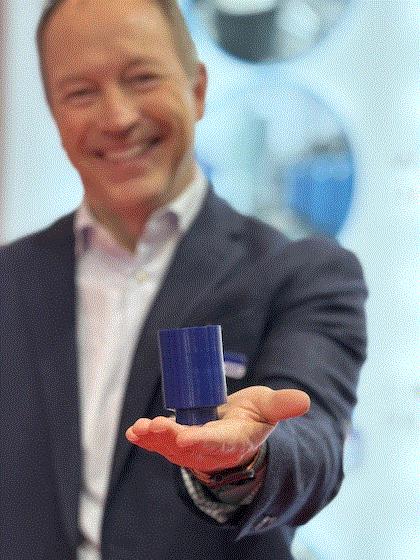
Dramm is a long-time IPM exhibitor and a friendly American face in Hall 3, so when I found myself needing a rest and a beverage, I stopped in to enjoy a bit of their hospitality before striking out again.
At the table, I noticed a strangely elongated blue plastic water breaker with small holes in the back of the body and a fine mesh screen where the water comes out. Studying it, I asked Kurt Becker what it was.
“That’s our Screen-Aire 350PL,” he said.
“Is it new?” I asked.
“It’s been around for at least 15 to 20 years,” he replied.
Hey, it’s new to me, so perhaps it’s new to you, too.
The Screen-Aire is designed for putting out a lot of water (20 gal. a minute), but doing so very gently so you can quickly water plants without disturbing the soil or washing away your slow-release fertilizer. It does that by aerating the water—like a kitchen faucet. Kurt said it’s perfect for large plants or for quick watering right before shipping. They’re about $40, but Dramm’s Louie Damm (who owns a nursery) said it'll pay for itself in about four hours. Now that’s ROI!
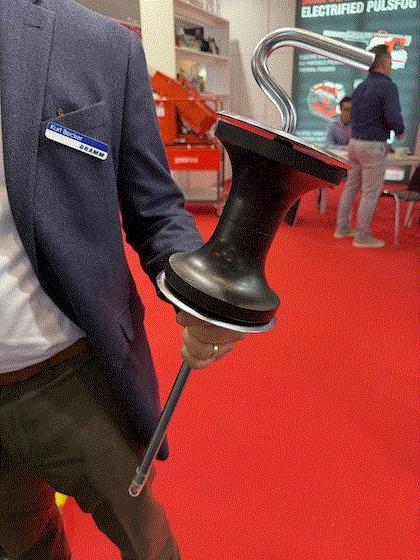
Oh, and to guide your hoses as you quickly water with your new Screen-Aire 350? Try Dramm’s Heavy Duty Hose Guides—which work great with sprayer hoses, too!

Figurines amaryllis from AgroFloral
I’ve been following the waxed amaryllis trends since it started, what, maybe 10 years ago? You know—you dip an amaryllis in wax, flatten the bottom and maybe add a wire ring, and it needs no container to bloom and be enjoyed! They started in just a few wax colors, then added some glitter and paint, and most recently somebody dressed them up with sweaters. The latest? Molded wax holiday shapes like pumpkins, ghosts, Christmas trees, bunnies, chicks and more.
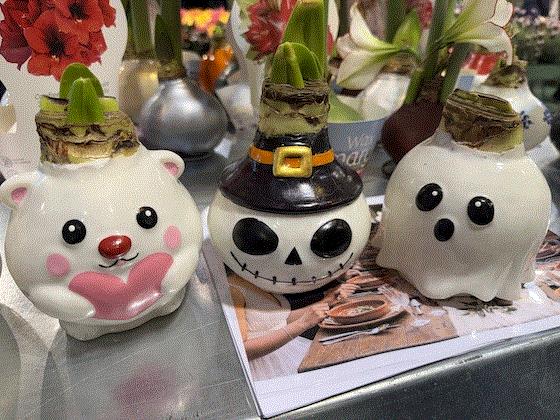
AgroFloral from Peru grows the bulbs and created the Figurines' molding process. They told me it came from demand by Chinese customers who didn’t like the uneven shape of a regular waxed bulb—they wanted something more perfect. The molded and hand-painted Figurines are an offshoot from that.
Three display ideas
Anthura's Vintura orchid collection
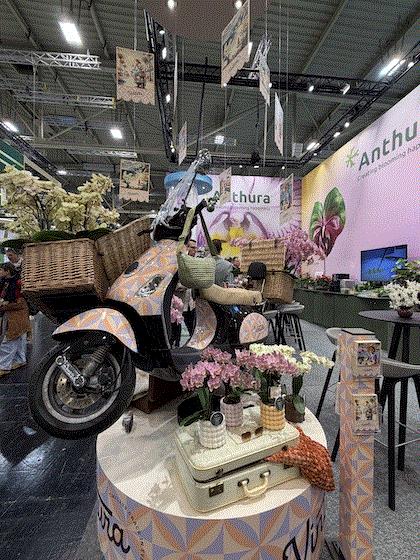
Looking for cool display ideas I could steal for you, I spotted this colorful Italian scooter with travel-inspired décor, including the suitcase and some vintage postcards, in the Anthura stand. I asked how this “Vintura” brand was designed to sell orchids.
Anthura told me these pastel orchids, while loved by the ladies, aren't equally appreciated by the male buyers Anthura often has to sell to. So they designed a branding theme they feel will show the guys these pastel pink and yellow orchids in a new, trendy light.
Landgard’s Funky Leaves concept
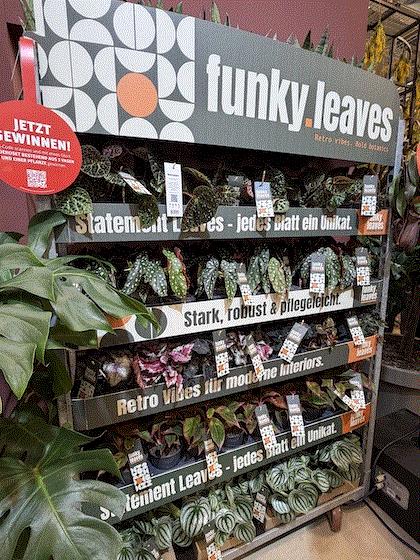
Spotted in the Landgard auction stand, “Funky Leaves” features the interesting foliage of aglaonema, peperomia and begonia.
Trendy display tables
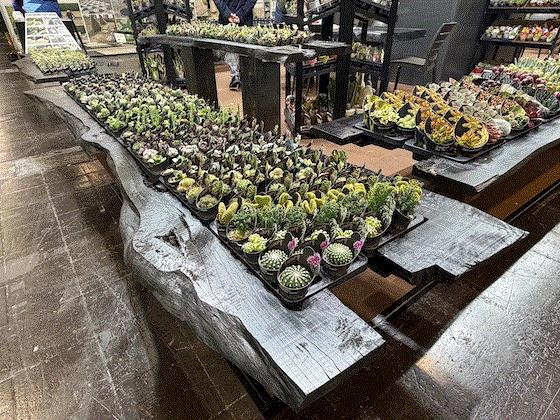
I spotted these organic-looking display tables in the booth of Italian company Giromagi, which specializes in succulents. Two live-edge slabs are cut out to accommodate trays (which sit on 1x lumber attached from below), then given a rich black Japanese shou sugi ban flame treatment (or you could just paint them). Giromagi made them in various lengths and heights.

International Grower of the Year is from the UK
It’s the first time I haven’t attended an International Grower of the Year Award since 2016 when I first was invited to be Master of Ceremonies for the stellar event, but I still want to share the news about who won, even if a day late. The winner is …
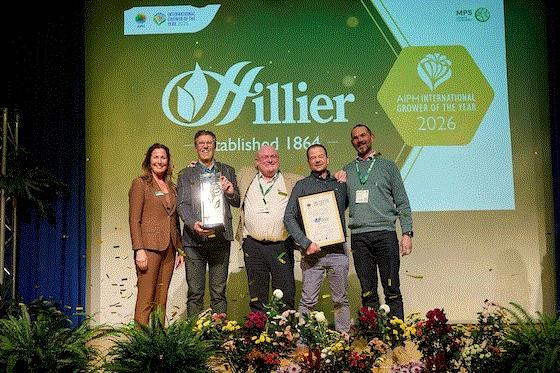
Hillier Nurseries LTD! Hillier is a UK-based producer of shrubs and trees, and they've been awarded the title of International Grower of the Year 2026 by the International Association of Horticultural Producers (AIPH). They were presented with the “Gold Rose” trophy by Linda Hoogendoorn-Veelenturf, CEO of MPS Group, the Headline Sponsor of the awards, which took place January 27 at IPM Essen in Germany. The judges liked that Hillier combines traditional plant craftsmanship with scientific precision.
In addition to the Gold Rose Award, Hillier also won the Finished Plants and Trees category and the Sustainability category.
Other winners include:
Young International Grower of the Year
Henil Vashi, Horticultural Advisor, Robin Tacchi Plants, UK
Young Plants
Longchi Mudan Industrial Co., LTD, China
Cut Flowers and Bulbs
Yunnan Holyflora Horticulture Co., LTD, China
Two other businesses, Beijing Green Garden Group Co., LTD, China, and Kisima Farm LTD, Kenya, earned Certificates of Merit
Come on, you American growers! Sign up for 2027 because we haven’t had a winner since Metrolina in 2022 and Costa Farms in 2016. Note that it’s not about size—it’s about quality of your business model. Learn more HERE.

Finally …
Post-show, I got a press release from Marco van de Koppel, owner of a Dutch consultancy called Horti Experience, which specializes in marketing for the hort sector. Horti Expience is involved in IPM as an organizer of a group of Dutch exhibitors, so Marco is familiar with what goes on behind the scenes.
In the release, Marco outlined some observations and opportunities he saw for IPM. As a veteran of the show, I thought his views were right on, so I thought I’d add them to my coverage. They include:
- “IPM undeniably remains a leading European trade fair, with international appeal, relevance and potential.”
- “Familiar exhibitors were absent, while on the other hand new participants clearly found their way onto this international stage.”
- Participation is no longer self-evident for everyone. Whereas visitor numbers prior to COVID-19 exceeded 50,000 trade visitors, they have stabilized in recent years at around 40,000.”
- “However, it is important not to focus solely on visitor numbers. The quality of visitors during the first three days of this year’s edition was generally good. This underlines that quality over quantity should be a conscious and defensible choice for the future of IPM.”
- “There is growing concern about the combination of rising participation costs (space rental, stand construction, travel and accommodation), limited and insufficiently constructive communication, and inadequate room for substantive input from exhibitors. This has a discouraging effect on both existing and potential participants.”
Those are the challenges that Marco sees. As for the opportunities, he suggests:
- Rewarding loyal (five years or more) exhibitors with more favorable rates and stand locations
- Creating a dedicated exhibition area for new exhibitors
- Re-organizing the trade show halls into more targeted horticultural categories, such as indoor, living and terrace; outdoor, gardening and landscape design; technology; new exhibitors; and others not directly affiliated with horticulture
- Strengthen knowledge exchange on the trade show floor with short, interactive sessions
And, lastly, they suggest making the trade show three days long instead of four, reserving the fourth day for a big networking breakfast and keynote speaker.
I like those ideas! But will the organizers? Said Marco:
“I wrote my reflection primarily with the aim of initiating a constructive discussion, one that an international trade fair like IPM Essen can use over the coming years to work toward recovery and, hopefully, even growth.”


Feel free to email me at beytes@growertalks.com if you have ideas, comments or questions.
See you next time!

Chris Beytes
Editor-in-Chief
GrowerTalks & Green Profit
This e-mail received by 31,270 loyal readers!
Thanks to my loyal sponsors, who help me reach the 29,728 readers of Acres Online in more than 60 countries. Want to be one of them (a sponsor, that is)? Give Kim Brown a shout and she will tell you about our many advertising opportunities.