Ljusgarda’s New Crop
Swedish indoor vertical farm
Ljusgårda has announced a bold pivot away from the indoor farming staple of lettuce and toward nutraceuticals, pharmaceuticals and plant-based ingredients. This shift comes as the economic reality of lettuce production in vertical farming continues to fall short of profitability. Even with high yields and efficient production, the size and pricing of the lettuce market have left Ljusgårda facing a path where profitability appeared increasingly out of reach, prompting the company to consider an entirely different market.
So what exactly are nutraceuticals? Broadly speaking, they are plant-derived products that provide health benefits but are neither conventional foods nor prescription pharmaceuticals. Think herbal supplements and functional ingredients. If you shop at a crunchy natural grocery store (as I often do), you’re probably familiar with shelves of ginseng, echinacea and other extracts tucked somewhere between the vitamins and the toothpaste aisle.
Ljusgårda’s move into these crops opens several compelling opportunities. First, it unlocks international markets. Unlike leafy greens, which are measured in days or weeks of shelf life, many plant-derived ingredients and extracts remain stable for months. That durability makes global shipping not only possible, but practical. Second, this shift truly leverages the strengths of indoor agriculture. We often talk about producing more intense flavors or eye-catching colors through precise environmental control, but the economic payoff for redder lettuce or spicier arugula can feel intangible. With nutraceuticals and pharmaceuticals, those secondary metabolites are the product. If controlled environments allow growers to increase compound concentrations tenfold, the revenue potential scales right alongside them.
Whether growing medicinal and nutraceutical plants represents the future of vertical farming, a temporary stopgap until leafy greens become profitable or a dead end remains to be seen. What is clear is that Ljusgårda is pushing innovation not only within vertical farming, but also into the expanding market for nutraceuticals and plant-derived products.

Little Leaf Jobs
Somehow, I keep finding myself writing about McAdoo, Pennsylvania. Maybe it’s the name, maybe it’s the steady stream of CEA-related updates, or maybe there really is something special happening in this former coal town. At times, McAdoo feels like a small harbinger of what the future of greenhouse farming in the U.S. could look like.
As mentioned in previous articles, Little Leaf Farms has recently completed construction on a new greenhouse range at its Pennsylvania facility. With the range now operational, the company has shifted its focus to staffing and is currently hiring for multiple positions.
Open roles include both Head Grower and Grower positions. Whether you’re looking for a senior leadership role or an entry-level opportunity to get started with a rapidly expanding greenhouse company, there are
several openings available.
It’s also worth noting that the major flower bulb producer van Hoekelen is located nearby. Seeing Appalachian coal country emerge as a hub for high-end produce and ornamental greenhouse operations feels like a win on multiple levels, and a compelling signal of where controlled environment agriculture may continue to expand next.

Bayer Strawberry
Bayer has launched a new strawberry variety, Baya Solara, now available to growers in the UK, Germany, Belgium, the Netherlands and Luxembourg. Baya Solara is a June-bearing variety noted for resistance to diseases such as Phytophthora, while also producing fruit with strong postharvest performance and desirable culinary qualities.
Bayer’s strawberry breeding program stems from its 2023 acquisition of the British company NIAB, which is well known for varieties like Malling Ace, an everbearing strawberry that has been gaining popularity in recent years.
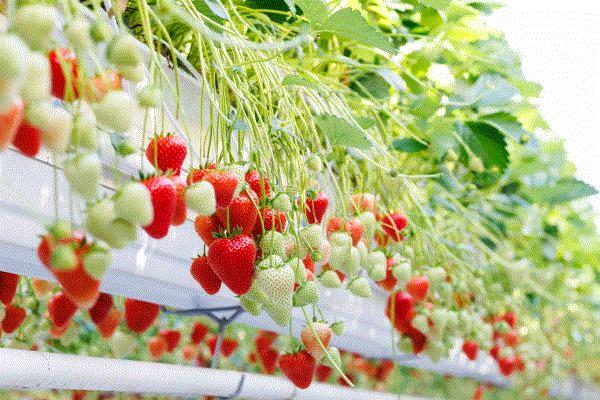 Bayer's new Baya Solara Strawberry
For indoor growers, everbearing strawberries are often the default choice, as they provide relatively consistent (though sometimes flushy) production over extended periods. That said, many growers also utilize June-bearing strawberries, which are short-day plants, similar to poinsettias, to target winter production. Using a combination of June-bearing and everbearing cultivars can help stabilize yields in greenhouse systems and maintain year-round supply. This approach aligns well with common greenhouse production cycles, where strawberry crops are often grown for six to nine months before turnover, allowing flexibility in flowering physiology based on season and climate.
As Bayer continues to expand its strawberry breeding efforts, it will be interesting to see how these varieties perform under controlled environment conditions. With Bayer’s own marketing imagery highlighting greenhouse production, there is reason for optimism that breeders will continue delivering strawberry cultivars better suited to indoor systems, improving both reliability and profitability for this still-emerging greenhouse crop.

AERGC Annual Meeting Date and Location Released
The Association of Education and Research Greenhouse Curators (AERGC) has announced its annual meeting for 2026. The conference will take place August 3–6 in St. Louis, Missouri.
If you’re involved in managing a botanical garden, growing atypical or specialty crops, or training the next generation of growers, AERGC is a group worth knowing. Membership fees are extremely low (only $25 a year) and provide access to a broad network of experts, covering everything from greenhouse operations to germinating rare and unusual plant species.
For those interested in attending but needing support, AERGC offers travel grants of up to $1,500 for selected qualified recipients.
While the location and dates have been announced, registration details are still forthcoming. Keep an eye on the
AERGC website for updates and registration information as this annual event approaches.
Biome Delta and Quantified Sensor Tech
Biome Delta has announced a distribution partnership with Quantified Sensor Technology to bring high-performance greenhouse sensors to North American growers. Through this partnership, Biome will supply growers with the FireFly node and a suite of sensors developed by Quantified specifically to monitor vine crop health.
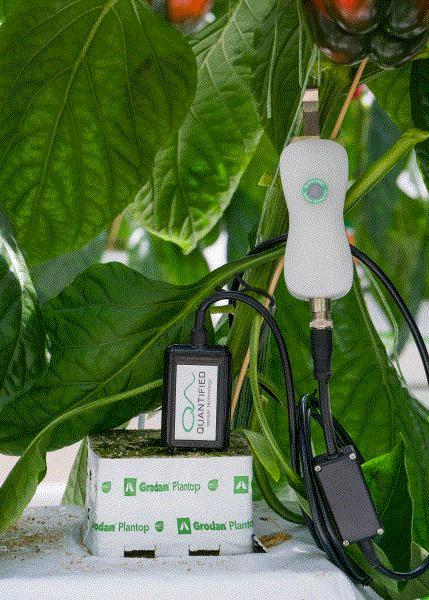 Quantified's moisture and EC probe with a FireFly.
Quantified Sensor Technology’s product lineup adds a level of granularity that goes well beyond standard greenhouse sensing. Their system focuses on climate, irrigation, water use and plant growth. At the center is the FireFly hub, which wirelessly collects temperature, relative humidity and light intensity within the greenhouse. FireFly communicates with a central access point to send data to the cloud while also serving as a bridge for Quantified’s additional sensors, which is where the system really starts to shine.
Those sensors include a Moisture and EC probe, a Smart Gutter and a Crop Weight Monitor. Together, these tools can trigger irrigation based on substrate moisture, measure drainage volume and EC, and track real-time changes in crop weight on the vine. The result is a detailed picture of how much water plants are actually using, how closely irrigation strategies match crop demand, and when crops may be approaching harvest readiness.
Viewed through the lens of the Plant Empowerment growing philosophy, this sensor suite feels almost like a cheat code. One of the three core pillars of Plant Empowerment is water balance, which goes beyond simply supplying water to fine-tuning water status within the plant and managing fruit load as a reservoir. Quantified’s sensors provide direct, quantitative insight into nearly every component of water control for vine crops.
The next question on my mind is how do I do even less? Quantified’s platform includes a robust API powered by InSight, enabling integration with control systems such as Priva, Source.ag and IIVO. With just a few crop cycles of data, these tools could support powerful monitoring and automation strategies aimed at improving yields while reducing water use and labor inputs.
Click here to learn more about
Biome Delta and
Quantified Sensor Technology.

February Indoor Ag Science Café
The next installment of the OptimIA Indoor Ag Science Café will take place at 11:00 a.m. Eastern Time on Tuesday, February 3. This session will feature Ian Justus of Greenlogic, who will discuss raspberry and blackberry production in controlled environment agriculture. These bramble crops are among the newest berry types entering CEA systems and require a distinct set of management strategies that differ significantly from those used for leafy greens or traditional vine crops. You can find the Zoom registration link
here.
This event marks the 80th installment of OptimIA’s Indoor Ag Science Café series. If you’re interested in catching up on past sessions covering topics such as emerging crops, lighting and photovoltaics, recordings of previous webinars are available
here.
Seminarios Virtuales para Empleados Agrícolas de Invernaderos y Viveros
UConn Extension will host an upcoming four-part webinar series designed specifically for the Spanish-speaking green industry workforce. The webinars will be offered entirely in Spanish and will take place every Friday at Noon Eastern Time, from February 6 through February 27.
The series will cover a range of topics including integrated pest management (IPM), pest and disease monitoring and occupational health. The program is free of charge but does require registration, which can be found
here.
Please share this amazing opportunity for a great webinar series!

Dr. Jake Holley
Editor-at-Large
Inside Grower
This email received by 36,281 loyal readers!
Interested in advertising in Inside Grower? Contact Paul Black or Kim Brown and they'll show you how easy, effective and affordable it is.