Handbook of Borers Published
Let’s start with a little shameless self-promotion this week, shall we?
The "Handbook of Wood-Boring Insects of Ornamental Trees and Shrubs in the Eastern United States," edited by yours truly, is finally available for pre-sale. I said finally because my faithful colleagues and I started this project 13 years ago. It's become a joke at my professional organization and the publisher of this handbook, the Entomological Society of America (ESA), was wondering whether we’ll continue to put an expense line for printing the handbook in the annual budget. You know what’s even more embarrassing? I sat on the Finance Committee, which discusses and approves the budget! The discussion often goes like this, “So, erm, JC, this line item on printing the handbook … do we keep it for another year?”
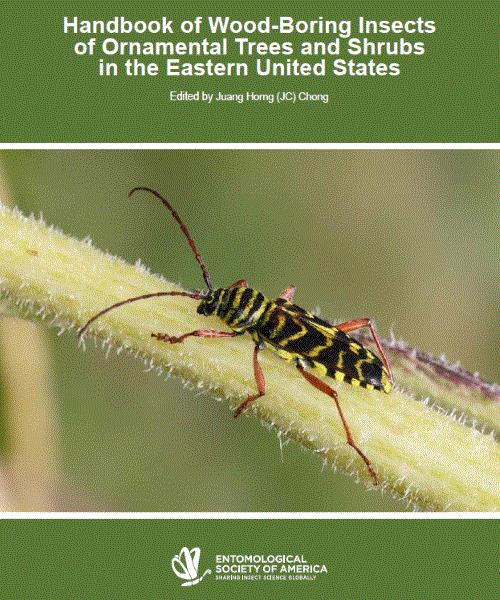
It was a fun and, I hope, impactful project. But have you ever had the feeling of a sword over your head? I did throughout the past 13 years. Like Damocles, I gladly placed this project behind me. Unlike Damocles, no great wealth or power was experienced during that time or will be experienced after the handbook’s publication.
This handbook is meant to be a one-stop-shop for information on the identification, biology and management of common wood-boring insects in the eastern U.S. The target audience of this handbook are plant producers, extension personnel, arborists, pest managers, and horticulturists or managers of conifers and deciduous trees and shrubs. So, it’s y’all!
It nominally covers 56 genera or species, but actually more than that because some profiles include two or more species. For example, I wrote a profile describing 29 ambrosia and bark beetle species you're likely to catch in a trap baited with ethanol and alpha-pinene, but aren’t described in the other profiles.
Similar profiles are prepared for clearwing borer and caterpillar borer species. Plus, there are five chapters on borer ecology and general management considerations, and a management chapter for each borer group—ambrosia and bark beetles, flatheaded borers, roundheaded borers, clearwing borers, caterpillars, weevils and wood wasps.
Of course, there are more than 100 species of borers out there. If I’d included all borer species, this handbook would cease to be a handbook (already more than 260 pages) that you can put on the dashboard of your car.
Also, I can only limit my focus to the eastern U.S. Not wanting to edit a huge text is one reason. Another reason is that the native borer species in the eastern and western U.S. are different. Except for a few species, the Great Plains is an interesting geo-ecological feature that effectively separates the two groups until long-distance transportation of plants and goods was made possible. Hopefully, the handbook can help folks out west and those outside of this country prepare for eastern borer species that may come their way.
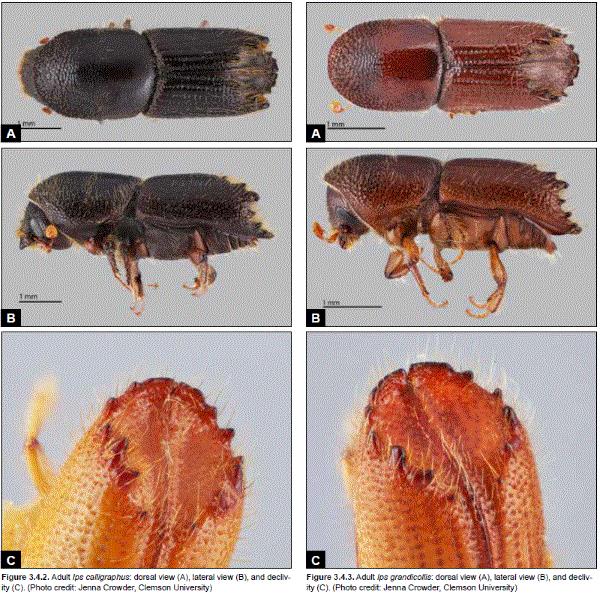
I’m super proud of the efforts we put into writing it, which is as plain as a bunch of professors could do so that anyone can understand the descriptions without searching for the jargon online. I think the colored pictures of distinguishing features will help folks identify the species that we’re looking at.
A printed copy of this handbook will set back a typical ESA member $60 and a non-member $70. But you’re special! You can order the handbook now (or at any time, really), with a 10% discount on the non-member price (the discounted price is $63) or the member price (now at $54). Why? Because you opened your email and read this newsletter. This is your award for being my faithful readers. Use the promotion code “PESTTALKS” when you check out and get the discount. You should receive the handbook in March or April.
Go HERE to find out more about the "Handbook of Wood-Boring Insects of Ornamental Trees and Shrubs in the Eastern United States" and place a pre-sale order. More information to come on ordering an e-book via Amazon, Apple Books, etc.

West Virginia Under BTM Quarantine
I informed y’all in June 2025 that box tree moth (BTM) had been found in West Virginia. At that time, we didn’t know if a quarantine would be imposed on Berkeley and Morgan County where BTM had been found.
USDA-APHIS announced on December 8, 2025, that BTM quarantine had been imposed on the entire state of West Virginia. Boxwood materials—including plant parts, pieces, cuttings, debris, etc.—will now be regulated. Growers who intend to move boxwood plants out of West Virginia will have to enter into a compliance agreement with USDA or the West Virginia Department of Agriculture.
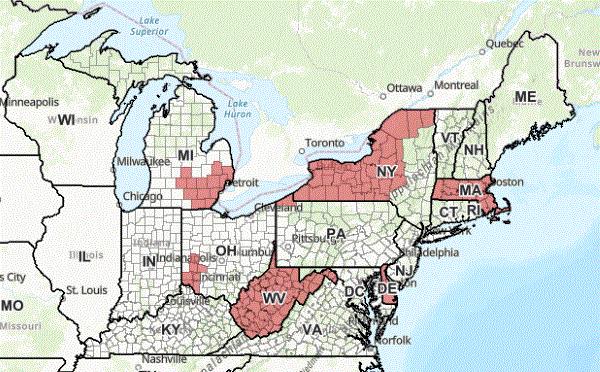
The highlighted counties are currently under federal quarantine against the box tree moth. (Map: USDA-APHIS.)
An example of a compliance agreement for BTM is available HERE. The compliance agreement includes requirements on trapping, scouting, inspection, certification, treatment, etc. It also has a list of insecticides for treatment of boxwood plants for BTM, including Bt, bifenthrin, chlorantraniliprole, cyantraniliprole, lambda-cyhalothrin, methoxyfenozide, permethrin and spinosad. There are separate lists for insecticides used in pre-shipment treatment and in production area. Growers in West Virginia should check with their state agriculture department officials for a compliance agreement that’s specific for West Virginia.

Insecticide Efficacy Against BTM
The lists of insecticides on the BTM compliance agreement seem short—those are products that had been tested in 2022 and 2023. What about other active ingredients for BTM management? There are quite a few active ingredients that are registered for managing caterpillars (in general) in nurseries and greenhouses. The inclusion of these active ingredients will need data to support their efficacy.
A laboratory test by Matthew Havers and his colleagues at Rutgers University and USDA-APHIS published in the journal Arthropod Management Tests in 2025 has provided some information on the efficacy of five insecticides against BTM.
These insecticides are acetamiprid (TriStar 8.5 SL at 8.5 and 16.5 fl. oz. per 100 gal.), bifenthrin (Talstar P at 5.4 and 10.8 fl. oz. per 100 gal.), chlorantraniliprole (Acelepryn at 2 and 16 fl. oz. per 100 gal.), spinosad (Conserve at 22 fl. oz. per 100 gal.) and tolfenpyrad (Hachi-Hachi SC at 21 and 32 fl. oz. per 100 gal.). The researchers treated boxwood plants with these insecticides then offered the treated leaves to first-instar caterpillars at zero (fresh residue), one, two and three weeks after treatment, so the trial looked at the residual toxicity of these insecticides.
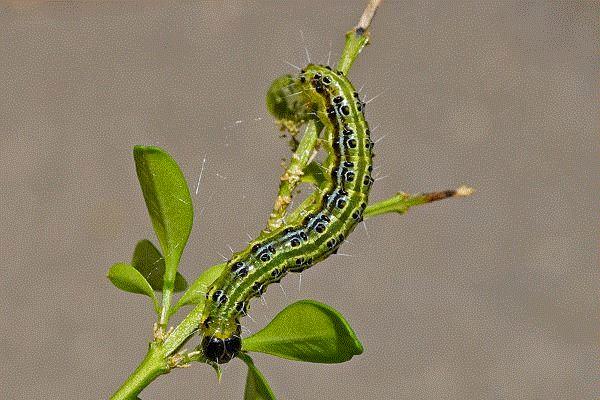
A box tree moth caterpillar is quite distinctive and easy to identify. (Photo: Joe Boggs, OSU Extension.)
Fresh residue of all insecticides killed at or more than 70% of the larvae, except for Acelepryn at 2 fl. oz. and Hachi-Hachi SC at 21 fl. oz. Mortality of larvae for most insecticides declined quite quickly when the residue was one-week-old. One exception is Acelepryn at 16 fl. oz., which remained effective for at least three weeks.
This trial provided support that some insecticides not listed in the BTM compliance agreement (TriStar and Hachi-Hachi) can be effective for quick knockdown of caterpillar populations (good for pre-shipment treatment). Their inclusion will need to be approved. Also, except for Acelepryn, weekly application of insecticides will be needed if the risk of continuous caterpillar invasion is expected (for treatment during production).

2026-2027 Perennials PGR Guide Published
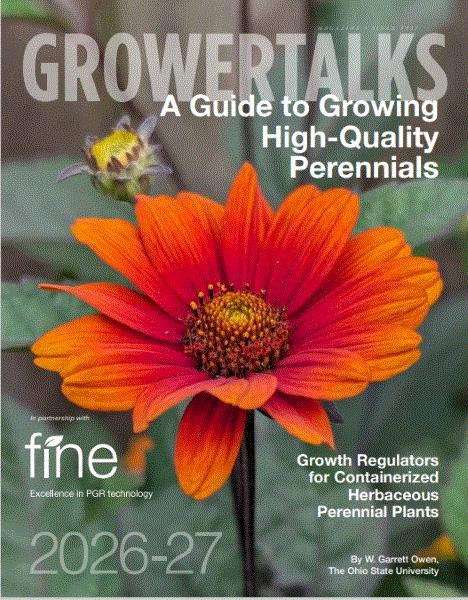
Here’s another useful resource that's been published recently.
The 2026-2027 guide on Growth Regulators for Containerized Herbaceous Perennial Plants is now available. Edited by Dr. Garrett Owen of The Ohio State University, this perennials plant growth regulator (PGR) guide has been updated from its 2024 version. This guide is sponsored by Fine Americas, Inc.
I’m new to the PGR world, so I refer to this guide (as well as the Annuals PGR Guide) on a regular basis. What’s particularly informative to me as a beginner is a table comparing the attributes of various PGRs. A major part of this guide is the pages and pages of recommendations on rates, frequencies and application methods for various containerized herbaceous perennial species.
Go HERE to download a copy of the Perennials PGR Guide.
Erm … How Much PGR Did You Actually Drench?
That’s probably not a great question to be asked by your boss after a block of plants you’d treated a month ago with a PGR still haven’t done much growing.
I didn’t have a whole lot of appreciation for the intricacies that are involved in PGR application before I learned more about Topflor, A-Rest and other PGRs in my current job. Unlike most insecticides and fungicides, on which overdosing may mean wasting money, misapplication of PGRs (whether it’s over- or under-dosing) can mean having a sellable crop or not at the end of a growing season.
We know that applying the right amount of an insecticide or fungicide depends on properly calibrating the spray or drench equipment. The same principle applies to PGRs, as well. But I feel that many growers aren’t particularly keen on calibration when making PGR applications, particularly when drenching by hand (including from a wand). I say that because the response is often, “Oh, I filled it to the rim of the pot,” when I asked about how PGR drenches were done. Drenching a 6-in. pot with 4 fl. oz. of a PGR solution at 10 ppm will get a very different result when drenching the same pot at the same concentration, but at 6 fl. oz.
So I want to introduce to y’all an instructional video from Ball Seed featuring Josh Henry, Technical Specialist at Ball Seed, on determining the right PGR drench volume.
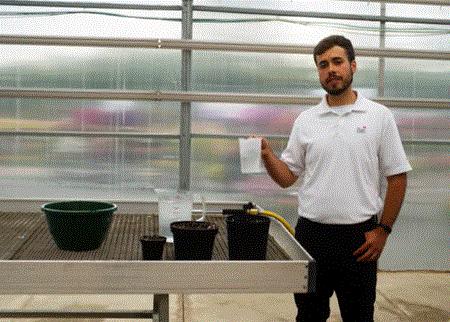
Josh starts by explaining why the general rule of 1 fl. oz. solution for each inch diameter of pot size may not apply as the containers get larger. If you drench by wand, you need to time yourself (by using clean water from the same equipment you’ll use to apply) to determine the volume that comes out for each unit of time, whether it’s minutes or seconds. You can also do the same to figure out how much time you need to put out a certain volume of solution. That way you can approximate the volume drenched by timing each application.
Josh also talked about capturing solutions dripped from an emitter to determine the volume that’s applied over a set duration. The same principles Josh discussed are also applicable to drenching insecticides and fungicides.
This four-minute video is well worth your time. Go HERE to watch it.


See y'all later!
JC Chong
Editor-at-Large
PestTalks
This e-mail received by 27,847 subscribers like you!
If you're interested in advertising on PestTalks contact Kim Brown ASAP!