Mid-January Farm Update
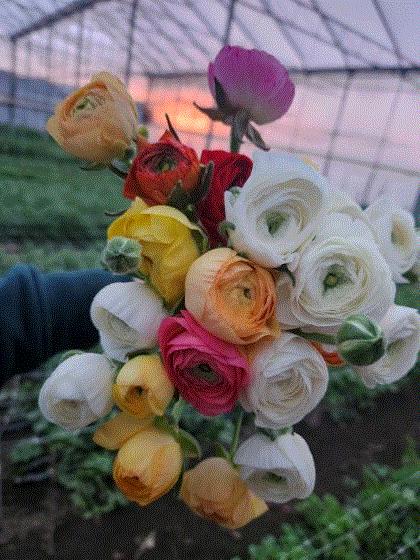
A sneak peek at some of the fluffy ranunculus we cut this week. Tater and I have high hopes for V'Day this year!
Tater and Team Forget Me Not are gearing up for the longest cold spell in the Midwest in almost a decade! Two high-pressure cold fronts are expected to stall over most of Michigan, bringing frigid temperatures. Meteorologists predict that our area will be below freezing the rest of January and possibly the beginning of February. Windchills today and tomorrow are expected to be well below -10F.
With weather like that, it’s not a question of if things will break, it’s a matter of what, and when. Granted, we’re resilient in Michigan. We’ve dealt with conditions like this before, but usually its only five to seven days. Two weeks is a long time (over 300 hours, to be exact) so Tater and I need to be on our A-game with preventative maintenance and late-night farm checks, all while trying to keep morale high and our employees (and flowers) safe.
The plus side to Arctic high-pressure systems is they usually give us more sun—something we desperately need for our Valentine’s Day flowers. And based on our preorders this season, we’re going to need every stem possible! It’s a blessing and a curse, but nonetheless a challenge Tater and I embrace each winter.
In this edition of Bloom Beat, we’re talking about goal planning, Colombia’s minimum wage increase, financial dashboards and more. With all that being said, let’s talk shop!
My Annual Goal-Setting PSA
What are your goals for this upcoming season (production, staffing, efficiency or something else)? If you need a jump start on how to organize your big dreams, below are some tips on planning goals following the SMART goal formula:
Specific. When trying to make specific goals, think about answering the five “W” questions: What do I want to accomplish? Why is this goal important? Who is involved or influenced? Where is it located? Which resources do I need to mobilize to make it happen?
Measurable. How will you document progress of your goals? In order for goals to be measurable they should answer the following questions: How much? How many? There needs to be a metric for measuring success. That could be as simple as setting a gross dollar goal for your farm. Or can be crop-specific, such as, "I want to harvest and sell X number of sunflowers a week."
Achievable. Remember how I encouraged you to dream big for 2023? This is the part where we break down the big goal into smaller bite-sized pieces. Achievable goals usually answer the How question. How can I accomplish this? Once again, you don’t want to set the bar so low you can step over it effortlessly. Your goals should encourage you to grow and step outside your comfort zone. But you also want to be practical in your goal-setting.
Relevant. Does this goal matter to you and does it align with other goals you have? This is your rally point. Goals are designed to propel your forward, but you also have to be in the driver's seat. You need to be in control of your goals. Relevant goals should answer the following questions: Is this worthwhile? Is this the right time? Does this goal align with my long-term goals and aspirations?
Time-Bound. Last, but certainly one of the most important aspects of goal setting. What is the deadline for accomplishing this goal? When are going to sit down and take stock of your progress? Deadlines create urgency, which in turn will inspire you to make daily strides to accomplish it. Goals shouldn’t be nebulous concepts. Time-bound goals should answer the following: When? What can I do today to work towards this goal? What progress have I made over the last month to accomplish this?

Financial Dashboard Planning
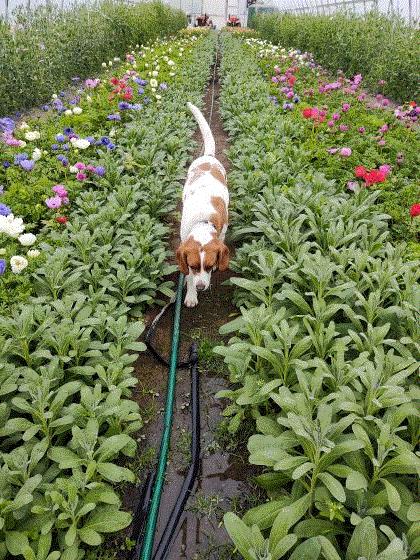
Financial dashboards give you a sense of direction and set a tone of
intentionality—just like Tater on her morning farm patrol.
Tater and I have a new challenge for your 2026 goals. Have you ever crafted a financial dashboard for your farm? When you drive your car and look at the dashboard, there is lots of data about your vehicle at your fingertips—your speedometer, tachometer, fuel level, oil pressure and water temperature (just to name a few). All of this data works together to allow you to get to your destination safely and without incident. It also allows you to perform maintenance and correct problems before a catastrophic mechanical failure.
Don’t you think we should treat our farm finances in a similar fashion?
Tater and I would like to introduce you to the concept of a financial dashboard. Google defines financial dashboards as a “visual, centralized tool that consolidates key financial metrics and key performance indicators to provide a quick overview of financial health, track performance and support faster, data-driven decisions.” In layman’s terms, a financial dashboard allows you to intentionally track meaningful financial data and helps you identify problems before your farms “check engine” light comes on ... or worse, the engine explodes and your farming operation ceases to exist!
There are many kinds of financial dashboards, and you can go down a deep rabbit hole on this, but I encourage you to make it simple and meaningful to you. What do you need to visualize to ensure financial clarity that allows you to focus on proactive (not reactive) management? What will help you make better investment decisions, understand cash flow and plan for growth?
Bear in mind, you want your financial dashboard to be a tool you are actually going to use, so craft it in a way that is user-friendly and intuitive for you. Tater recommends using the five-second rule: If it takes you more than five seconds to look at your financial dashboard to remember the numbers and interpret results, then it’s too complicated! If it’s your first season drilling down on your numbers, you can still craft a financial dashboard, but it may only track a small set of core metrics (such as revenue per month, or farmers' markets). I wish I did this more when I first started farming! But you can learn from my mistakes and start your farming journey well-informed and with copious amounts of intention.
Profitability KPIs
- Gross Margin: Revenue-cost of goods sold. Helps assess how profitable your production is.
- Net Profit Margin: Net Income as a percentage of total revenue. Helps assess overall financial efficiency.
- Return on Assets: How effectively is your farm using its assets to generate profit? High ROA means better use of resources.
Liquidity KPIs
- Current Ratio: Current assets divided by current liabilities. Can you cover your immediate expenses?
- Working Capital: current assets minus current liabilities. Positive means you have a cushion to operate through seasonal fluctuations.
Solvency KPIs
- Debt to Equity Ratio: Total liabilities divided by equity. Lower ratio indicates less risk and more financial flexibility.
- Equity to Asset Ratio: Equity divided by total assets. Shows you how much of the business you really own.
Efficiency KPIs
- Asset Turnover Ratio: Total revenue divided by total assets. Higher ratio suggests efficient use of assets to drive sales.
- Labor Efficiency: Output (or income) divided by number of employees. How efficient is your labor at generating revenue on flowers? The higher the value, the more efficient.
If you are looking for a place to start crafting your own financial dashboard, you can find the Farm Finance Scorecard template
HERE (Go Green!).
If this terminology seems a touch nebulous, it’s worth reaching out to your state’s land grant university. Many have farm business extension specialists that can help you understand and calculate these ratios. While they aren't as exciting as seed catalogs, KPI’s are important for understanding the financial health of your farm and give you the tools you need to make informed decisions.
There is nothing worse than getting to the end of the season and wondering where are your money went and why you didn’t meet your goals. Your financial dashboard puts you in the driver’s seat of your farm’s financial health. Tater and I firmly believe if you plan your farm's finances with as much zeal as you plan your crops, 2026 will be a great year for you. It’s time to balance beauty with economics!

Colombia’s Minimum Wage Increase
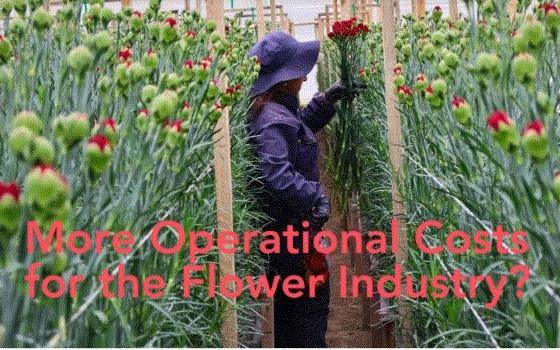 Photo by Thursd.com
Colombia’s President Gustavo Petro recently announced the highest minimum wage increase in Colombia in decades.
Each year the Colombian government, private industry and labor unions meet to establish the nation’s minimum wage. This year, the private sector proposed a 7.2% wage increase, while labor unions lobbied for 16%. The parties did not reach an agreement in the middle of December and as a result, Colombia’s president Gustavo Petro decided the minimum wage increase would be 23.7%.
According to Augusto Solano, President of Asocoflores (the country's cut flower association), the wage increase is strictly a political ploy on the part of the Colombian government to secure reelection in late 2026. Solano further claims that inflation in Colombia is close to 5% and labor productivity is at less than 1%, making a 23.7% wage increase hard to justify any other way.
According to Solano, “For flower growers, the effect is especially significant, as labor represents between 50%–60% of total production costs. Such a sharp and unexpected adjustment introduces additional pressure on operations while the industry continues to meet high standards in quality, sustainability, and social responsibility for international markets."
You can read the full press release on the Asocoflores
WEBSITE.
Tater and I read a handful of
ARTICLES about the direct and indirect impacts of this on the cut flower business. It’s a lot more sophisticated than just passing the increased costs down to the consumer. In addition to the increase production costs, the strength of the Colombian peso plays a role in the ripple effect of government-mandated wage increases.
According to
Bloomberg, Colombian flowers are sold in US dollars but the cost of production is in Colombian pesos. This creates a unique challenge. When the peso is “weak” (meaning more pesos per dollar), this is a positive for Colombian growers because each dollar earned converts to more pesos. This means growers can pay more input costs for each dollar earned. This can also help growers absorb subtle costs of production increases without passing these costs to the U.S. market.
However, the Colombian peso is trending “stronger” (meaning fewer pesos to dollars). Which in theory sounds positive ... but listen closely (it took me a few reads to wrap my head around this): When the dollar converts to fewer Colombian pesos, it reduces profit margin, and it takes more dollars to pay for inputs (which are paid in pesos). This will likely lead to increased export prices and less profit for Colombian growers. With the increased minimum wage, inflation driving up costs of inputs, and a stronger Colombian peso, this all presents unique challenges for Colombian growers.
Imported cuts are a cut-throat market, with Kenya and Ecuador being direct competitors to Colombian growers. This may change the landscape for rose and carnation sourcing if Colombian growers and distributors can’t update supply contracts.
Cut flowers are big business in
Colombia. Colombia is the largest supplier of cut flowers to the USA. Colombia exported 65,000 tons of flowers to the U.S. for Valentine’s Day last year and a total of $1.68 billion worth of flowers to the U.S. in 2025.
With this announcement so close to Valentine’s Day, I am curious to see how much roses and carnations prices increase (if at all). Some of our florists expressed concerns about the price validity of their Valentine’s Day preorders and Colombian floral products in the future. I think if asked, most florists and floral suppliers agree with a higher standard of living and wages for floriculture workers.
I don’t intend to paint this change in a negative light, but I do want to highlight the effects on sourcing and economic effects on the floral industry. The challenge is if the industry can’t pivot and accommodate these financial changes efficiency, the ripple effect on the international floriculture industry may be dramatic. Short-term changes may include reducing hours for Colombian farm workers (or reducing the number of staff), increase investments in technology/mechanization, and reducing crop diversity and/or production. Time will only tell how these changes will take hold.
If you want to learn more, American Floral Endowment is hosting a webinar featuring Solano today (Monday) at 2 p.m. EST. If you can’t attend the webinar live,
REGISTER anyway and our friends at AFE will send you the recording. It just makes sense to stay informed about global floriculture affairs. What are your preliminary thoughts on this? Tater and I would love to hear from you. Drop us a line
HERE.

My Word for the Year is ...
Tater and I are looking forward to 2026 and have high hopes for you, too!
Those of you who have been following this newsletter for a while know that I am not a New Years resolution person. Not that I’m afraid of goals—I embrace them! But over the years I have found that I need something quick and tangible to anchor myself throughout my day. And my Word for the Year does just that. As a result, over the past three years, Tater and I pick a word that expresses our intent for the new year: 2026 is going to be the year of recalibration.
My goal this year is to reimagine, refine and fine-tune my role on the farm. My goal is to make measured changes on the farm, not emotional ones. It’s taken a lot of blood, sweat and tears to get to this point, and I don’t regret investing any of those things ... but over time it becomes unsustainable. Building Forget Me Not has been the ride of a lifetime and it’s a path I want to walk for the rest of my life.
Energy, money and time are all limited. This year I am asking myself, “How can I create a sustainable lifestyle that supports my personal and professional SMART goals?” (see how these concepts all tie together?) Last year was a year of harsh lessons, heartbreak and painful growth—personally and professionally. I wouldn’t trade 2025 for anything, but I also wouldn’t want to go through that again. Enter recalibration.
This will be my ninth year of farming and I’m past the “experiment with everything” phase. Now is the time to drill down and focus on what moves the needle and how can I best serve my employees, customers and family. Granted, I don’t have all the answers, but I think setting the stage by asking the right questions is a great first step. Thank you for following along on our humble flower farming journey. It means more than you know!
Do you have a Word for the Year? If you need ideas, check out this article from
TIME to get a jumpstart. Once again, Tater and I would love to hear from you. Drop us a line
HERE.


Stay Warm!
Lindsay Daschner (and Tater)
Editor-at-Large—Bloom Beat
Owner—Forget-Me-Not Farms
This email was received by 6,214 of your fellow fresh-cut flower growers!
If you're interested in advertising in Bloom Beat, contact Kim Brown and she will hook you up!