Jose Smith Jr. named president of Costa Farms
Congratulations to Jose “Joche” Smith Jr., son of Jose and Maria Smith, co-owners and co-builders of Costa Farms of Miami. He's just been named president of the business as part of the leadership transition process.

This fourth-generation Costa is more than qualified for the big job, having grown up in and around the family business, serving since 2017 as Director of Sales, Replenishment & Analytics, and also VP of Sales & Merchandising. But behind the nursery and greenhouse chops lies a degree in mechanical engineering from MIT (my dad’s alma mater and field). And to top that off, he earned an MBA from Harvard Business School. Did I mention he’s smart? You need that to manage 1,500 varieties on 5,200 acres in several states and countries.
Meanwhile, after three decades as CEO and president, Joche Sr. (also an engineer with an MBA) will step away from the president’s role and stay as CEO and a member of the Board, providing strategic oversight. He'll also continue to lead the legal and human resources functions, allowing him to continue shaping company culture.
“Joche Jr. has an innate understanding of our customers and our mission to bring plants to every home. He’s ready to lead us forward with clarity and purpose,” said Joche Sr. of his son’s new role.
Taking over Joche Jr.’s seat as Senior Vice President of Sales and Commercial Operations is Juan Rodriguez, formerly Director of Sales for Lowe’s.

22-acre greenhouse collapses in the Netherlands
If you CLICK HERE, you can watch a frightening security camera video of the moment a giant Dutch glass tomato range collapsed like a house of cards, pushed by strong winds and weakened by workers who’d removed some structural members to make room for a new curtain system.
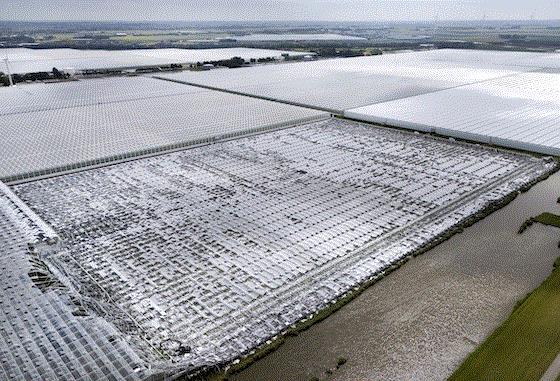
Photo courtesy Olaf Kraak.
The 9-hectare (900,000-sq. ft.) greenhouse fell over in just moments on Friday, June 27. Thankfully, nobody was inside at the time (even though it was 4:30 in the afternoon), so there were no injuries.
Bas Eilander, the site director, told the Dutch news service NOS that 65 employees had been working in the facility earlier in the day. Tomato seedlings in the greenhouse were only three weeks old. The loss of the greenhouse and equipment, however, is estimated at 20 million euros ($23.5 million).
The range, located in Middenmeer in the north of Holland, belongs to Agro Care, one of the largest tomato producers in Europe, with 261 hectares of production at seven sites in three countries, so this loss took less than 10% of their production capacity. Middenmeer is only about 10 miles from the North Sea and it’s a windy part of the country. In the news video I linked to above, you can see a wind turbine turning at a pretty good clip.
The cause of the collapse of the 10-year-old greenhouse was an error during renovation work, said Agro Care after an investigation. Workers were installing a new energy curtain inside and to do so they had to remove support beams. They were supposed to be removed one at a time and then replaced, but to save time workers removed a series of them simultaneously, weakening the structure. Said Agro Care, “A slight increase in wind was enough to undermine the stability.”
Agro Care said that it will work on a plan to rebuild the greenhouse and expects it to be back in production early next year.
Talk about a cautionary tale, eh? Tell your crews that the braces in the greenhouse are there for a reason!

Spring 2025, on a scale of 1 to 10
The numbers are in and crunched, and I can now tell you, unequivocally and without fear of contradiction, what you already know: It was an okay spring. Not great, not bad. Some of you broke records, while others of you felt the crappy weather was like a broken record.
But in the end, the U.S. averaged 7.4 for the whole season, while Canada lagged behind at 6.9. Compare that to 2024, when the tables were flipped, with the U.S. at 7.1 and Canada at 7.4. The 13-year average for the whole season is 7.2/7.2.
Here’s the map:
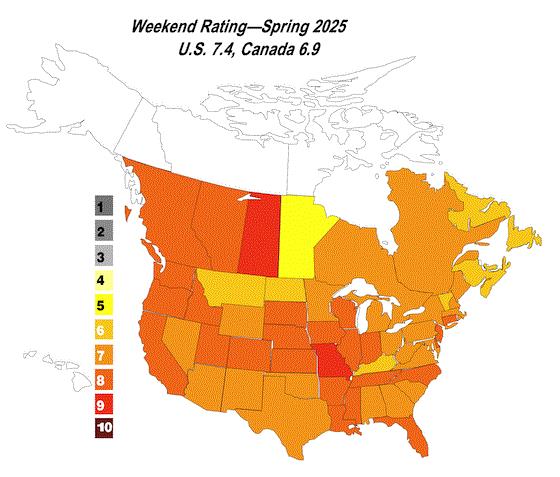 That’s based on 1,251 scores sent in by you over 13 weekends from March 29-30 to June 21-22. The only states not represented by a single score over that time were Alaska and Hawaii. In Canada, it was the territories—Northwest, Nunavut and Yukon. (I was really hoping to hear from Canadian Tire in Yellowknife).
Where did you want to be doing business?
Interestingly, not a single state or regions stood out as distinctly better than the rest. I mean, take a look at the regional season-long averages:
Plains 7.9
Northwest 7.8
East 7.4
Midwest 7.4
Mountain 7.3
South 7.3
West 7.3
New England 7.1
I guess a 0.8 point split between best and worst could be significant, but to check, I looked back at previous year’s data.
Last year, 2024, the Northwest and West were tops at 7.5, with the East on the bottom at 6.7 (a 0.8 differential). In 2023, the spread was 1.8 points between the West at 8.3 and the Plains at 6.6. 2022 was similar: 8.0 in New England vs. 6.6 in the Mountains (1.4 differential). I could go back further in time, but I suspect it’s pretty unusual to see such a tight spread from best to worst region.
But more important, no region this year fell into the 6s—everybody was in the 7s. Looking back, I see that, while most regions fall into the 7s, there’s always one or two in the 8s and one or two in the 6s. Like 2018, when the West averaged 8.0 and the Plains were fully two points down, at 6.0. No, it seems this year everybody got to celebrate some and also suffer some—the rain, cold and heat were pretty equally distributed.
It also means no one state stood out as THE place to be doing business. First, I rule out those states that get just one or two scores each week. Of the remaining states that get multiple (three or more) scores per week, l see average results. Like Illinois (7.6), Michigan (7.5), Wisconsin (7.7), Virginia (7.4) and New York (7.4).

Month by month and Canada
April gets things warmed up and sets the stage. May is the main event. And June is gravy time. Here’s what the months looked like this year:
April May June
U.S. 7.0 7.8 7.3
Canada 5.2 7.6 7.8
11-year average
U.S 6.9 7.9 7.2
Canada 6.2 8.1 7.6
Last year, the U.S. was 7.2/7.4/6.8 for April/May/June, so a slightly stronger start, but then below average for May and a sad decline at the end. Compare that to 2023 (6.7/8.2/7.7)—you started slightly soft, got extra-strong for May, then kept the momentum going to the end. As you already know, a strong May and a June that tapers gradually is what makes for a good season.
Canada’s May and June got flipped this year. The weather just remained sketchy across the provinces, even in mild BC, and while you recovered in June, it wasn’t enough to necessarily make up for the losses (but you’ll see from the “gut scores” section below that some Canadians feel really good about their season!).
I don’t expect great scores from Canada in April, although BC can get lucky with early nice weather. But 5.2 is extra low. Here are previous Aprils in Canada (tossing out the pandemic years of 2020-2022):
April
2024 7.0
2023 6.7
2019 6.0
2018 5.0
Ah! So a really bad April can happen! But in 2018, Canada followed up that dismal 5.0 with a super-strong 8.7 for May … and then dwindled with 6.6 for June and a 6.7 overall. But, anyway, we know those early sales up north are just that—a tentative taste of spring. May and June are where the action is. And this year, Canada, you kept building in June—well done! If May had been warmer and dryer … but what do they say, “If ifs and buts were candy and nuts, we’d all have a merry Christmas.”
Province-wise, I’ll list them from high to low:
Saskatchewan 8.4
British Columbia 8.3
Alberta 7.7
Quebec 7.1
Ontario 7.0
Atlantic/
Newfoundland/
Labrador 5.7
A big spread—almost 3 points—but because I get so few scores from all but Ontario, Quebec and BC, we have to take it all with a grain of salt and look at the country as a whole, I think.

Your “gut” scores: Higher, as usual
Except when there’s a pandemic on and the first dozen emails I open contain scores of perfect 10, I think the most fun I have is getting your season-long “gut scores.” It brings a smile to my face to see how optimistic you are about the quality of the season compared to the actual numbers you sent in every week.
This year? Your gut (or your formula) tells you it was 8.0 in the U.S. and 7.8 in Canada.
Here's the map:
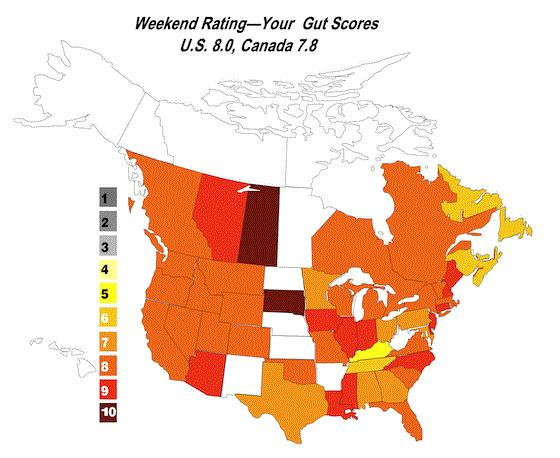
That’s based on 113 scores from 42 states and eight provinces.
Remember, the actual score was 7.4 in the U.S. and 6.9 in Canada. But it felt 0.6 better to you Americans and 0.9 better to you Canadians. Optimists, one and all! I like that about you.
Last year, your gut called it 7.4/7.8, whereas the actual was 7.1/7.4— a bit closer. Here are some other comparisons between your gut scores and the actual scores (U.S./CAN):
Gut Actual
2023 8.3/8.5 7.5/7.6
2022 7.8/7.5 7.3/6.6
2021 9.2/9.3 8.2/8.1
2020 9.4/10 8.1/8.2
2019 8.2/9.0 7.3/7.2
2018 7.9/8.4 6.7/6.7
Interesting, eh? The closest you’ve ever gotten to the actual score is 2022. Otherwise, you’re generally a full point or more happier about the season as a whole than you were when sending in your weekly scores.
I could perhaps dig a bit more to see if there’s a difference when June is good or bad because perhaps it’s like golf, where when you finish the last few holes well, you feel better about your round than when you blow it on 16, 17 and 18.
Ten of you (9%) gave it a perfect 10. Last year, only 3% of you were so bold as to call it perfect. Those 10s came from Connecticut, Illinois, Iowa, Maine, New Hampshire (twice), New York, Ohio, Vermont and Saskatchewan. Another 24 (21%) scored it a 9.
The Plains states scored the highest on the gut scale, at 9.4, while the South, at 7.5, brought up the bottom.

Your comments on the season
Your last chance to let fly on how much you enjoyed—or endured—spring 2025. What’s that they say in baseball ...? “There’s always next year!” But some of you looked beyond sales results and based your rating on the big picture. Like Kate, Kim and Tim:
Iowa (10). “This was a fun one to score. I was going to say 9, but then considered the following: We had an early April, decent Easter, record Mother’s Day, few frost threats, ample rain without any rainouts, and we were able to find enough and good employees. Plants we grew looked phenomenal and product we brought in was good quality with few shipping issues. Our biggest struggle (besides ‘Burnin’ Down the (Green) House’) was with distributors keeping us supplied with hardgoods and some quality issues with our pot supplier. Overall, going into summer we are looking at a few tweaks in our growing program, tightening on inventory a little bit, worrying about tariffs and, of course, our ‘phoenix rising from the ashes’—building another 12,000 sq. ft. greenhouse.”—Kate Terrell, Wallace’s Garden Center
Ohio (10). “Sales were up, many new customers based on word-of-mouth recommendations, product availability was better than last year, we kept up with the workload better … a good season all the way around.”—Kim Grant, Strait Gate Greenhouses
South Dakota (9.5). “Great season! Small increase over last year and the bottom line is looking good. A couple of hiccups with weather, but didn’t deter the buying. Been doing this for over 50 years and I feel lucky to be in an industry where people find so much enjoyment and relaxation in their flowers, vegetable gardening and landscaping. It’s a win-win if we do our job well.”—Tim Sime, Jolly Lane Greenhouse
Iowa (9 ... “I considered a 9.5”). “Weather drives sales and our area of the Midwest had consecutive weekends of nearly perfect gardening weather. Per our records, best Mother’s Day stretch in over a decade. From early April and on, no risk of frost and freezing; meanwhile, temps even into June have been moderate, thus allowing for strong late sales. Sell-out season for greenhouses and retailers alike. Positive momentum heading into the summer and fall production cycle.”—Mike Gooder, Plantpeddler
North Carolina (9). “Ran head-to-head with Spring 2024, actually 1% up. We will take it. The weather was good to us on the weekends when we needed it to be.”—Jake Scott, Piedmont Feed & Garden Center
Indiana (9). “We are up 1% for the year. We call that a win. Cold April started slow, May was up and down, but ended very strong, and June has been good except for the last week being very hot. Overall, a very good year. Time to start reloading and planning for next year.”—Ed Clayton, Clayton Garden Center
Michigan (9). “Weather was not good. Never [spent] so many days in long johns and two sweatshirts in May. Composted more hanging baskets than I would have liked because they were a later planting and just did not want to grow. It was a tough growing season with little sun. Overall, I am happy with my numbers. June more than made up for May once the weather warmed up.”—Karen Brohl, Brohl’s Flower Garden
Montana (8.5). “I think we’d give it an 8.5. It started out a little sluggish and then took off. Overall, a very good season in our little world.”—David Lorenzo, Clinton Farms Greenhouse
Illinois (8.5). “Cold start, great time in the middle and a hot ending of the season. We had a good production schedule, great quality, lowered our cost and had more sales than the last few years. Got a few days where we had a feeling that COVID was back again, so not a bad season at all. Now on to fall and Christmas and trying to make the second half as good as the first half. Sometimes you get the feeling that the only thing that matters is the weather—which is pretty scary, since we have no control over that.”—JP, Countryside Flower Shop, Nursery & Garden Center
Wyoming (8). “Overall, very good. I’d be happy to have this every year. YTD sales down 4% over the past five-year average. Many other financial marks are as good or better than last year. EOM June is one of my financial markers, along with year-end. Fairly happy with this, although always looking for a little bit more.”—Jeff Jones, Great Gardens
Ontario (8). “Both plant sales and transactions are up over the last two years. Not by a huge amount, but very acceptable. Plus, there is only a nice amount left for the summer traffic—but not so much that we need to do deep discounts from now on.”—Joanna Steckle, Steckle’s Produce & Flowers
Washington (8). “Gut-wrenching notes. What a season. Lots of UPS. Lots of DOWNS. The mood of people. The weather. The product availability. And, of course, sales. Gut versus real. Gut says season down at least 12%. And while we did have days and weeks that were down, some significantly, for the period March through June 30, we are actually UP 8.7% in sales. Profits, not so. Down 1.1% However, overall, it’s been a good, solid year. Inventory, with the exception of veggies, is where we would expect it to be. Veggies were DOWN a whopping 42%, and while we didn’t lose money, we didn’t make any either. Huge end-of-season push next week and we will see where that puts us. And now we have to figure out what in the Sam Hill happened in veggie land.”—Kathy Wheaton, Kathy’s Corner

Comments (continued)
New Hampshire (8). “Good season with lots of new customers (after 54 years of being in business!). Weather and a tighter economy kept it from being a 9 or 10.”—Matt McElroy, Newton Greenhouse
Ontario (8). “Overall, a challenging spring with steep fluctuations in weather conditions in May, which ended flat. June was strong, though, with a 40% increase over last June.”—Rob Gemmell, Gemmell’s Garden Centre
Pennsylvania (7.5). “Annual growers were up a little bit. Perennial and nursery growers were about the same as last year. Very wet and rainy, cold and record-breaking rainfall in Pennsylvania for May—at least for southeast PA. So we prove we can handle tremendous volumes of rain spread out through the month, but then we had sunny days in between and that’s when the nurseries and the retail establishments were very busy.”—Dave Dagen, Briggs and Sidhu Nurseries
Montana (7.5). “The season was up and down. Although not exactly terrible, it could’ve been way better or worse. It just seemed as though something was missing this year. Folks were buying, but the enthusiasm was off. By the latter part of June, customer traffic just dropped off a cliff. But working on cleaning things up, booking orders and looking forward to ’26.”—Ed Hebbe, Circle H Growers
Nevada (7 … or 8?). “Gut says 7, better than a year ago, but nothing special; the numbers (actual performance) would argue for an 8, especially when compared to what we hear from other retailers.”—Bruce Gescheider, Moana Nursery
Virginia (7). “Overall, a good spring! While we are down 1.3% for the year, I largely blame that on a cool, wet spell in late May. Certainly, we’d like to see the major increases of the last several years continue, but looking at the big picture we have no complaints—business is good and we are blessed!”—Gary Garner III, Gary’s Garden Center
Alabama (7). “It ended up being a great year—up 5% overall. We had fewer customers, but the average sale was higher. Honestly, it started off really slow, and I was a little worried in February and March. But then we had our best April ever in terms of dollars and May even beat last year. The weather definitely helped. It was a bit dry in April, but overall, it cooperated. I think people are being more cautious in early spring—holding off on buying too early because they don’t want cold snaps to ruin their plants. So we saw more buyers later in the season as the weather warmed up, even more than in previous years."—John David Boone, Dothan Nurseries
New York (6). “When over 50% of sales occur on weekends, and EVERY weekend has at least one rainy day and additional rainy days during the week, it is very difficult to get ahead. Add the 'coldest May in history’ to that and you have all the ingredients for a lousy spring.”—Sig Feile, Atlantic Nursery
Minnesota (6). “Overall, I would say I’m disappointed in 2025, but I also feel it was slightly better than 2024. A score of 6 seems appropriate given those two sentiments." —Derek Lynde, Lynde Greenhouse
Ohio (6). “Record Mother’s Day Weekend was soured by cold (38F) Memorial Day and wet subsequent weekends. I’m planting mums and poinsettias now. I’m over spring.”—Betsy Kollman Bresky, Kollman’s Greenhouse
Vermont (5). “Rained literally every weekend. Plus, none of our Canadian customers showed up this year (who can blame them?!). Lots of product left …”—Dick Chase, West Shore Farm

“Nuances in the season” from Abe
Regular contributor and former GrowerTalks columnist Abe VanWingerden of Metrolina Greenhouses in North Carolina puts a lot of thought into his weekly scores for 14 eastern states and I appreciate him for it! He scores each state based on what percent up or down it is from the previous year.
His “gut” score was based on overall sales for each state in 2025 compared to 2024. New York was +15.2%, earning it his only 10 for the season, while Alabama was -4.7%, earning it a 5. It all averaged out to 7.5.
Abe considered dropping the season-long score to 7, but opted for 7.5 because he finished with positive sales—“Solid, not spectacular,” is how he described it.
“I really think the industry was down a bit overall due to tough conditions in other markets, but we squeezed out a good spring,” he said in his notes.
Abe offered three “shifts” that Metrolina has noticed this spring:
1. Bring back lower-priced items. Consumers looking for value in pots and hanging baskets want items in the $10 to $20 range. Said Abe, “This is due to three to five years of increasing retail [prices] and sizes on most all containers and hanging baskets, and consumers are screaming at us to, ‘COME BACK.’”
2. Shade combos and shade items. A trend started by the re-emergence of premium begonia, plus coleus, lysimachia and so on. “Again, something consumers are asking for and we as an industry have been slow on the response due to great calibrachoa/verbena/petunia combos making us feel good about our combo game.” In other words, we haven’t been growing what they’ve been wanting.
3. Seven-day ready. Abe said the trend of shopping for the garden any day of the week that started during COVID has remained and seems to be permanent. “Friday, Saturday and Sunday continue to be the biggest days,” he said. “But Monday has increased a ton in importance, as well as Thursday.” What’s that leave for resting and restocking? Wednesday.
Thanks for the insights, Abe!
Anyone else notice any similar or additional trends this spring? Share them HERE.

High school teachers attend hort school
This next piece was penned by editor Jen Zurko, who was a guest for Seed Your Future’s visit to Ball’s world headquarters in West Chicago, Illinois. As you know, Seed Your Future introduces school-age kids to careers in the green industry:
A few weeks ago, Ball Horticultural Company was one of the host sites for 30 teachers from around the country for the second annual Seed to STEM Teacher Immersive Program coordinated by Seed Your Future.
Seed to STEM is a professional development program that immerses high school educators in hands-on experiences, site visits and direct engagement with horticulture professionals. The program equips teachers with industry insights, classroom-ready resources and real-world connections to help students explore different career pathways in the plant and horticulture sciences.
Other industries like beef suppliers have taken advantage of the program (called On The Farm STEM), and Jazmin Albarran, executive director of Seed Your Future, thought it would be a perfect way for teachers across all concentrations to learn about the horticulture industry. After discussions with the program organizers, she collaborated with them to develop what became Seed to STEM.
During the inaugural event last year, 25 high school science teachers visited multiple hort businesses, including Corteva Agriscience and Heartland Growers in Indiana. This year, the event was held in Chicagoland with stops that included Midwest Groundcovers, Kennicott Brothers Wholesale Florist and Ball. This time, instead of only science teachers, there were about 30 teachers of Math, Art, English and Business in attendance.
“It’s been very eye-opening for the teachers,” said Jazmin. “When we were walking through Heartland Growers they were just amazed. They never realized all the jobs that it took to get those plants into the stores or into their front lawns. They saw how much people love what they were doing in the industry and wanted to really bring that into the classroom.”
The teachers spent all day at Ball, touring the Seed Distribution Center to see the new automated Perfect Pick system, visiting the R&D labs at Ball Helix and strolling the 7-acre gardens. They also heard from multiple Ball employees about their jobs and the career path they took to get here. I was one of the employees asked to talk about my professional journey and how I ended up at the oldest (and bestest) horticulture magazine in the industry.
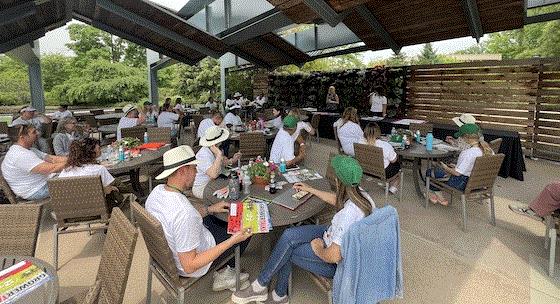 Here, the teachers are learning about horticultural marketing from Katie Rotella and Sarah Makiejus.
It was great talking to them about what I thought I was going to be when I grew up and where I ended up. I told them I didn’t know a thing about business-to-business publications or that it was even an option for me as a way to develop what I learned in journalism school. They asked a lot of great questions, including what advice I would give to high schoolers who are interested in pursuing a career in journalism. (Write for your college newspaper or intern at a local paper [if you still have one]—the hands-on experience you get is invaluable!)

Seed to STEM (continued)
One of the outcomes is the hope that these teachers take what they’ve learned back to their classrooms so that more students become interested in a horticultural career path. But each one is also expected to come up with a formal lesson plan that can then be shared with teachers from around the country on the Seed Your Future website (the current lessons have been downloaded almost 800 individual times). Combined with last year’s teachers, Jazmin said they’ll have about 50 lesson plans that incorporate horticulture not just in science classes, but other subjects, too. It offers a chance for those non-science teachers to be creative with their curriculum, especially in classes like art.
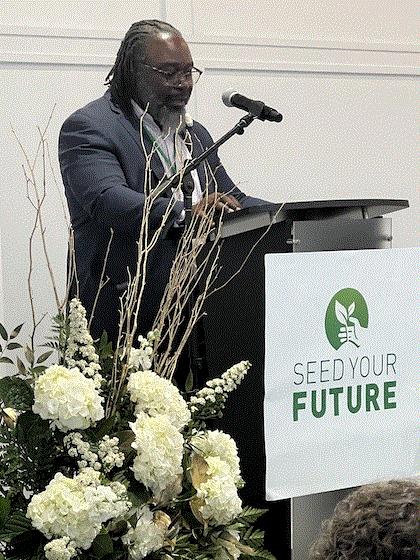
One of the educators who spoke at the gala was Dr. Shawn Hearn, a teacher at the Savannah High School of Liberal Studies in Savannah, Georgia. He told me he’s built a school garden for the students to learn about plants, and it’s especially helped kids who’ve experienced trauma. They’ve recently incorporated more vegetables because maintenance and harvest time is during the summer—the timing helps keep the kids occupied and decreases the chance of them getting into trouble when they’re not in school.
“We wanted these teachers that didn’t know before to understand this industry,” said Jazmin. “And now they get to walk away with very practical examples of how their subjects can lead to finding something their students are interested in.”
And now that these formal lesson plans have been developed, Seed Your Future can take advantage of other ways to engage with teachers through specific educator conferences.
Next year’s Seed to STEM Immersive Program is scheduled to be in the Philadelphia area, where they’ll visit Longwood Gardens and other local horticulture businesses. Eventually, Jazmin would like to have multiple regional immersive events just for teachers in that area that’s focused on local businesses and local job opportunities.
All of this vital outreach takes money, and as a non-profit, Seed Your Future counts on donations and grants to fund all of their efforts. Jazmin said she just hired a grant writer whose expertise is finding ways to secure grant money from different sources. Since their usual federal grant funding has been frozen this year, they will be applying for state funding to offset the shortfall. Jazmin said that Seed Your Future has three main corporate donors, but they’d like it to be spread out over a wider pool.
“If 300 of the nurseries and greenhouses in the industry gave us $1,000, we would be set,” she said. “The future is building awareness and, luckily, we have some testimonials from students who found horticulture in high school because of Seed Your Future. And educators are starting to realize that there are many career paths in horticulture that their students can take regardless of what their passion or interest is.”
To learn more about what Seed Your Future is doing and to donate, GO HERE.

Finally …
Any Californians have greenhouse space to spare?
I received an interesting query from my friend and former colleague/boss Diane Blazek, the executive director of All-America Selections and the National Garden Bureau. NGB helps with California Spring Trials registrations, and Diane said she’s recently been asked about exhibiting at CAST and finding greenhouse space in which to do so. Specifically, between Oxnard/Ventura at the south end of the trials and Gilroy in the north. She said the current CAST participants tell her they're maxed out.
Is there a greenhouse, garden center or other venue owner anywhere along that 285-mile stretch of the central coast who'd be interested in leasing some space to a CAST participant? If so, let me know HERE and I’ll pass your name along to Diane.
I think it’s great that new companies are looking to join the fun of CAST. Let’s help Diane find them a home out there!
Feel free to email me at beytes@growertalks.com if you have ideas, comments or questions.
See you next time!

Chris Beytes
Editor-in-Chief
GrowerTalks and Green Profit
This e-mail received by 29,752 loyal readers!
Thanks to my loyal sponsors, who help me reach the 29,752 readers of Acres Online in more than 60 countries. Want to be one of them (a sponsor, that is)? Give Kim Brown a shout and she will tell you about our many advertising opportunities.