How was spring? Pretty average ...
I always feel a bit silly at this time in the season telling you how YOUR season went. Ridiculous—you lived it! You know exactly how it went.
However, that was your season. What about your neighbors across town, across the state, across North America? Was theirs the same? Better? Worse? And how does it all average out?
After 13 weekends of gathering your scores, including four holidays (Easter, Mother’s Day, Memorial Day and Victoria Day in Canada), I have the results, and they reflect what you’ve been telling me the last couple of weeks: It was an average season at best.
The final tally? 7.1 in the U.S. and 7.4 in Canada.
Here’s the map:
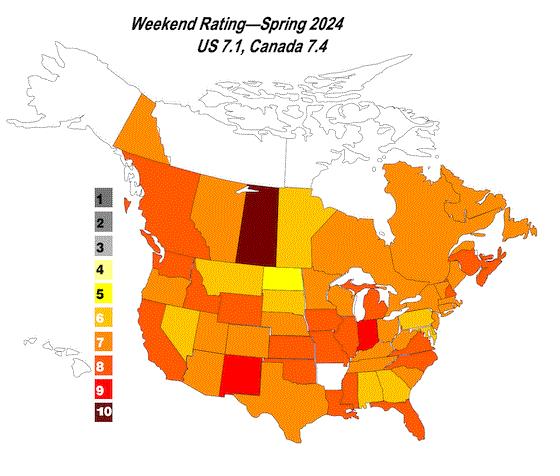
That’s based on 1,317 scores over 13 weeks/weekends from every state in the union except Hawaii, Alaska and Arkansas, and every province except the Northwest and Nunavut territories.
This year’s results are well down from last year’s 7.5/7.6, but pretty close to the 12-year averages of 7.3/7.2. Nothing will likely top the pandemic years of 2020 (8.1/8.2) and 2021 (8.2/8.1). In fact, if we toss those years out, the average drops to 7.1/7.2.

Regionally speaking
Were there bright spots, regionally speaking? Only slightly bright, as you can see:
Year Apr May June
Northwest 7.5 8.5 7.0 7.0
West 7.5 7.9 7.9 6.7
Midwest 7.4 7.7 8.3 6.4
South 7.2 8.4 7.2 6.2
New England 7.0 5.8 7.5 7.8
Plains 6.9 7.2 7.7 6.0
Mountain 6.8 6.0 7.3 7.1
East 6.7 5.5 6.9 7.7
I don't think any spot had a great season throughout. Every place had good times and bad stretches. The Northwest and South started strong, but dragged in May and June. The Midwest also got off to a strong start, and had a great May, but weakened at the end. New England took a while to build up momentum. And the East really never got going until the very end.
What state would I have wanted to be doing business in this year? (I’ll pick one that had multiple scores each week to make it fair.) Illinois managed 8.0 for the season, with a super-strong 8.8 for April, 8.2 for May and an unfortunate 6.9 for June when the heat dome hit.
California did well at 8.2 for the season: 7.9 in April; 9.0 in May and 7.5 in June.
Kansas (8.0) was another state that did great for two of the three months: 8.8 in April, 8.0 in May and 7.1 in June.
That seemed to be the story most places: some of spring was excellent … just not enough of it.
Where would I have NOT wanted to be plying the plant trade? A skim down the list shows North Dakota at 5.0, Maryland at 5.9 and Delaware at 6.0. Really, it was one of those seasons where I'm glad to be writing about it, not actually doing it—you guys and gals work HARD!

Meanwhile, up in Canada …
Here’s the regional story north of the border:
Year Apr May June
Saskatchewan 9.5 * 9.8 9.3
British Columbia 8.5 9.0 8.3 8.2
Atlantic 7.5 5.7 8.8 8.0
Quebec 7.2 8.2 6.8 6.8
Ontario 7.1 6.1 7.9 7.3
Yukon 7.0 (based on one score)
Alberta 6.9 8.0 6.9 5.9
Manitoba 5.0 2.0 5.8 7.2
BC and Quebec really took off in April, with Alberta also performing well. BC did okay in May and June, but not what they could have done. Ontario had a fair May, but also never really got going. And Quebec collapsed in the peak months.
Weather, people! I tell you, that’s what matters most. That and having good product and making the effort to draw in customers. I can’t tell you how many times I’d see a 5 and a 9 from the same state for the same weekend, and the 9 was based on an event or sale or some other enticement that got the customers in the door.
Mother’s Day was the highlight
If there was a peak of the season, it might have been Mother’s Day for many of you. Here’s how I reported on your Mother’s Day results:
This is the oddest weekend report I’ve ever written.
The first 10 scores I received from you were 9, 9.5, 9, 10, 10, 10, 10, 10, 9 and 10.
Wow!
“This is going to be the best—or one of the best—Mother’s Day reports I’ve ever given!” I thought to myself as I began populating my spreadsheet with the data.
As I tallied your scores and read your accompanying notes, I only grew more confident.
“Out of the ballpark” was how John Langendoen of Willowbrook Nurseries in Ontario scored it.
“It was COVID crazy all weekend long,” said Tracy Droessler of Stockmens Greenhouse in Minnesota.
“This was about as 10/10 as it gets! Absolutely bonkers all over the PNW,” wrote Tom Van Wingerden of Van Wingerden Greenhouses in Washington. Tom added, “Most are reporting record-breaking sales this past weekend.”
And Tom was right. I counted 18 respondents out of 134 who told me they’d set new sales records at their businesses (their comments are below). I was sure this Mother’s Day would finish in the top five of all time (well, since this survey began in 2012).
So imagine my dismay to find that the national average score was just 8.3 in the U.S. and 9.1 in Canada—high scores, to be sure, but compare that to last year: 9.1 and 9.8. Or 2018’s 8.8 and 9.5.
Hmmmm. Looking back, 8.3 and 9.1 were pretty good compared to how the season finished up. We’d have loved to see more of those scores in May and June, eh? In other words, don’t look a gift weekend in the mouth … or something like that.

Your gut scores
Now for the fun: How do you rate your entire season and how do those “gut” scores compare to the real scores? Historically, you tend to remember the season more optimistically than your week-to-week scores reflect and 2024 is no exception: You rated it 7.4 in the U.S. and 7.8 in Canada—just slightly better than it actually was (7.1/7.4). Based on my recollections, this is closer than usual—sometimes you’re a full point higher.
Here’s the “gut score” map:
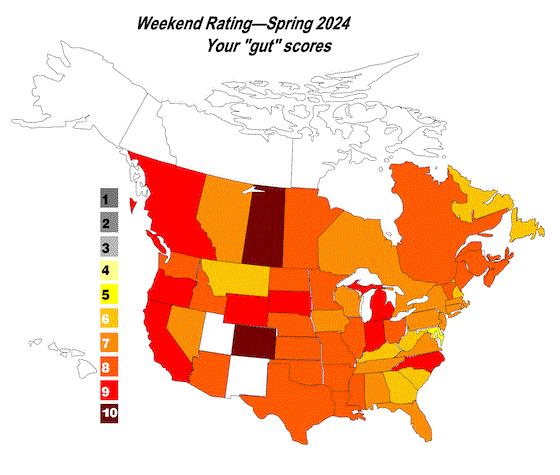 That’s based on 119 scores from 46 states (including Arkansas, finally!) and nine provinces. Four of you rated your season as a perfect 10—from Colorado, Michigan, Ohio and Saskatchewan.
The gut regional scores are interesting:
Northwest 8.4
Mountain 8.3
Midwest 8.0
Plains 7.9
West 7.8
South 7.3
New England 7.1
East 6.0
As a reminder, here are the actual regional scores, from high to low:
Northwest 7.5
West 7.5
Midwest 7.4
South 7.2
New England 7.0
Plains 6.9
Mountain 6.8
East 6.7
Note above that the Northwest and East placed their positions correctly—best and worst. Yet the Northwest gut score was almost a full point higher than the actual, while the East’s gut score was nearly as much (0.7) lower than the actual. Interesting! Like, if it was good, it felt extra good. But if it was bad, it felt worse than it was.
Regular contributor Abe VanWingerden of Metrolina Greenhouses in North Carolina sends 16 scores each week plus some analysis. It’s useful intel from a major big-box player. Here’s a bit about what he said about Metrolina’s season—which he rated a 6 overall:
Per your ask on the overall year: Slightly below average to somewhat tough year overall, so I give it a 6. Nothing catastrophic, but nothing we would want to repeat.
The good news is, the supply chain is more stable and we can get back to building our business plans based on demand vs. based on supply as we roll into Fall/Winter 2024 and 2025.
For the year, a great start of the year in Midwest and South, but North never got going, and from Mother’s Day to July 4, it was soft overall due to weather in all markets (combination of rain in May and heat in June). The South and Midwest finished with +0.0% to 1.0% growth, but the North was down (-5.0%).
Then Abe wrote something I’d not seen before—how the number of weekends with good weather impact your overall season:
In basic terms, we need six of the 10 core spring weekends to be dry and temperatures between 65F to 85F for those weekends. That would give us an average to good year. But in 2022 and 2024, we only saw two in 2022 and only four in 2024 (and only two in the Northeast). Sandwiched in between was a strong 2023 where we had seven of the 10 core weekends with good weather.
Interesting!
Abe concluded with something that should make us all feel positive about being in the horticulture industry today:
Net, our consumer is still there and we feel we have kept most of the 20 million new consumers that came during COVID. They still want to engage, they enjoy this new hobby, and if we get some [good] weather and we give them some compelling offers both in value and innovation, we will continue to grow this business.
We have to work harder now to win than we did during COVID, but that is the nature of this business, and we accept that challenge willingly and happily.
Thanks for sharing that with us, Abe!
Got your own thoughts about the season? Comments on Abe’s analysis? Let me know HERE.

“Billboards for our industry”
Last time, I mentioned that a couple of you credited landscape customers with keeping cash flowing late in the season. I asked for more thoughts on the topic and Sue Adams, VP of Mark Adams Greenhouses in Poughkeepsie, New York, offered up this:
I sell a lot of plants to colleges in our area. When large numbers of plants need to be ordered, I start working with those accounts by February. In the summer I’ll do site visits so that I can take notes for the following year. Those campuses are billboards for our industry. Our future customers walk by the beautiful displays every day as they go to classes.
Same goes for landscapers. They’re planting our billboards. One of the things we should be doing is making sure they understand the plants and pick those flowers that will work best (low maintenance, will hold up in heat and drought, for example). A landscaper who plants huge containers of petunias at a shopping center knows all about slow-release fertilizer and iron supplement later in the season. And those containers are gorgeous!”

Don’t say the season is over!
A reader (who asked to remain anonymous) mentioned to me that perhaps we as an industry are doing a disservice to ourselves and our customer when we talk about “the season” and especially saying, “The season is over.” He clarified that he wasn’t specifically calling me out … but was focused on buyers who tend to think in terms of the “season” being April and May … or maybe March through Mother’s Day in the south … and deciding to stop buying just because of a calendar date instead of taking regional weather into consideration. That’s especially important in places like New England or the Pacific Northwest that can stay mild all summer long.
What’s your take? Do your customers (or buyers) operate by an arbitrary calendar? Or do they keep buying beyond “the season” when the weather makes it possible? Let me know HERE.
As for me, I’ll try to tone down my “The season is over” rhetoric lest a buyer take me too seriously and stop placing orders with you.
Selecta acquires Whetman Plants
In recent acquisition news, German flower breeder Selecta One is taking on Whetman Plants International of Exeter, United Kingdom. Whetman is known for breeding dianthis, and seeing how Selecta One has been making a concerted effort in dianthus recently—especially in North America, recently—it makes the acquisition quite logical.
Says the July 2 press release, “Selecta will gradually integrate Whetman into the Selecta Group, building on existing relationships and continuing to deliver high-quality plants to the Whetman customer base. The aim is to have a seamless transition with regards to the supply chain.”
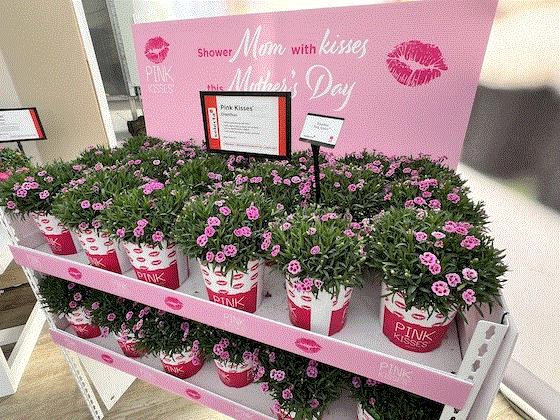
Selecta One has been all in on dianthus lately. This display is from their California Spring Trials.
Fiona and Ed Marley, owners of Whetman, stated, “We are delighted to see the Whetman genetics and pipeline benefit from Selecta One’s significant resources and global reach. We have been impressed by the professional approach of their leadership team and we look forward to watching the innovation continue.”
Fiona Marley will remain as WPI Managing Director. Ed Marley will continue to lead Pinnacle Plants International (worldwide young plant sales, UK finished pot production and breeder’s agent) and Valin Genetics (breeding).
Per Klemm, owner and CEO of Selecta, said, “We are very happy to welcome Whetman, another successful and well-known company, into our family. This strengthens our claim to be the number one in dianthus worldwide. The Whetman range, with its particular strengths in perennial dianthus, complements our successful portfolio in all the right places.”

Zurko heads south—again
GrowerTalks editor Jen Zurko has been traveling and writing a lot this spring. In June, she did two of the three Southern Plant Tour stops and she filed this report:
Apparently, I can’t get enough of the south! This time, I visited a couple of operations that are stops on the Southern Plant Tour in early June. Officially started over 10 years ago, the Southern Plant Tour is similar to other regional field trials events around North America in that it’s grown organically with promotion typically being word of mouth, although they’ve developed a more “formal” campaign during the last year or two to help spread the word.
It’s a three-day event to three different places: Young’s Plant Farm in Auburn, Alabama; the University of Georgia in Athens, Georgia; and Metrolina Greenhouses in Huntersville, North Carolina. It’s a bit of driving—since, technically, you’re visiting or driving through four different states in three days—but good music and entertaining podcasts help pass the time.
This is the twelfth year that Young’s has opened up their trials area in early June to local growers, breeders, students and academics. Built to help them collect their own data and aid in the decision-making process on what to add to their product lineup, their field trials aren’t divided by breeding company. Instead, they put all of the same crops together to get a true side-by-side comparison of how they perform in the Alabama heat and humidity.
“This allows us to be able to make the best decisions for production and the home gardener,” said Penny Merritt-Price, Product Development Manager for Young’s. “And it gives us a seat at the table with the different retailers and breeders.”
Young’s Plant Farm’s field trials area is 26,000 sq. ft. with more than 800 varieties in raised beds, plus 220 combos and 58 hanging baskets. They had the most attendees this year with more than 225 people, which can be attributed to ramping up promotion of the event.

Three generations of Youngs. From left: Greg, Cale and Brandon Young.
Along with trials of new annuals (sun and shade), there are also some landscape beds that focus on trends. This year, there was a focus on plants for pollinators, native plants, and plants that match Pantone’s Color of the Year, Peach Fuzz.
“Our goal is to be the regional expert, and this enables us to do that,” explained Bryan Young, one of the third generation of Young’s to be part of the business. “And it’s a good way to end the spring season.”

Continuous expansion
Because there’s a lot of distance between all of the stops, I didn’t have time to go to UGA. Instead, I was kindly invited to pay a visit to Metrolina’s perennial operation in York, South Carolina, which the VanWingerdens acquired more than 10 years ago when it was Stacy’s Nursery. Totaling 450 acres, a majority of the crops grown here are perennials in outdoor production. They also grow mums and finish Christmas greens here.
And they continue to get bigger. Currently, they’re in the process of adding 3 acres of cold-frame greenhouses and have plans to add another 3 acres in 2026.
And that’s not even the most impressive part: When I was there, construction crews were busy finishing up 88 additional acres of outdoor production. COO for Metrolina’s York location Chris Copeland said the plan is to have mums on this new area in a few weeks.
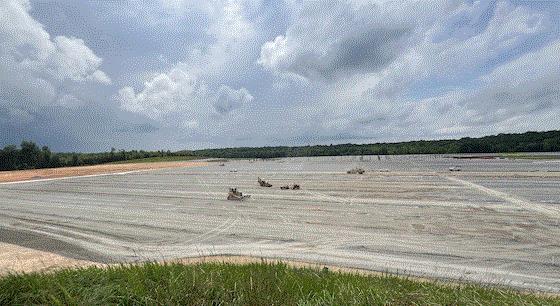
Metrolina was just finishing up an 88-acre outdoor addition that will be filled with fall mums very soon!
Evolving trials
Metrolina holds their trials open house at their main location in Huntersville, North Carolina, and it’s been an ever-evolving space and event since 2010. I was here shortly after they first installed a few raised beds to conduct their own trials and it has grown … a lot!
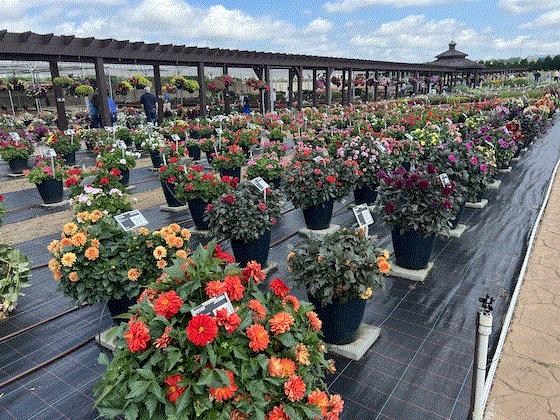
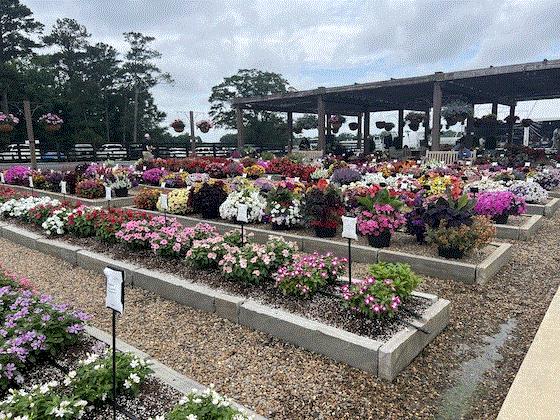
The container trials. Basket trials are hanging from the pergola.
Laura Drotleff, manager of marketing communications, said there are over 2,000 varieties in the trials from 40 different breeders of sun and shade annuals, perennials (first- and second-year), container trials for dahlias, geraniums and osteospermum, and dozens of hanging baskets and combination planters. And it’s a “real-world trial,” she said—they don’t do any extra “babying” of the plants besides keeping them watered.
On the Friday after, Metrolina holds a focus group of 130 consumers. They’ve done this for a few years, now, and they get support from companies in the industry—live and hardgoods—to help guide the questions asked. Along with their own trials, Metrolina uses the data they gather from the focus group to help gauge their decisions on what products to pitch to their big-box customers for the coming seasons.

Two Penn State programs
Krystal Snyder, Commercial Horticulture Educator for Northampton County, asked if I’d promote a couple of educational opportunities they’re offering this month. Of course I will!
First up, a webinar on thrips. Guest speaker Dr. Sarah Jandricic from Ontario’s Ministry of Agriculture, Food and Rural Affairs will share information on identifying and managing several thrips species causing problems in greenhouses, including the new invasive species, Thrips parvispinus. The webinar is scheduled for July 12 at 1:00 p.m. Eastern/Noon Central.
Sign up HERE.
It’s free ... unless you want Pennsylvania pesticide credits, in which case it’s just $10.
Next up, the annual Penn State Flower Trial Field Day, which is July 25 from 9:00 a.m. to 3:00 p.m. at Penn State’s Southeast Agricultural Research and Extension Center in Manheim. There you can see close to 1,000 annual and perennial plant samples submitted by 30 companies from around the world.
Attendees will be able to network with industry representatives and connect with customers while gaining some education! Sessions include new varieties of annuals and perennials; cutting-edge information from breeders; disease management; and pesticide safety.
Organizers ask that participants register by July 19, but walk-ins are welcome. The registration fee is $65 and covers morning refreshments and a buffet lunch.
Hey, while in town, you can visit Green Leaf Plants’ Open House, too!

Finally …
This Friday, I’ll be one of those 40 zillion Fourth-of-July travelers clogging up the system. Laurie and I are flying to Chicago to drop in at our old neighborhood to conduct the World-Famous Spring River Ridge Report. She’ll drive, I’ll jot down the data and we’ll wave at a few neighbors. Stay tuned for that in a special edition of Acres Online, brought to you by Sun Gro Horticulture.
The only thing I’ve heard about my old ’hood since I abandoned it for Orlando is that the guy who bought my house isn’t doing near the job of keeping up with the landscape as I did.
Well, of course not. I set a pretty high bar!
Feel free to email me at beytes@growertalks.com if you have ideas, comments or questions.
See you next time!

Chris Beytes
Editor-in-Chief
GrowerTalks and Green Profit
This e-mail received by 28,856 loyal readers!
Thanks to my loyal sponsors, who help me reach the 28,856 readers of Acres Online in more than 60 countries. Want to be one of them (a sponsor, that is)? Give Kim Brown a shout and she will tell you about our many advertising opportunities.