From Room 403 of the Atlantic Congress Hotel
Hallo (that’s hello in German) and greetings from Essen, where I’m covering the four-day IPM Essen trade fair. IPM does not stand for integrated pest management—it stands for Internationale Pflanzenmesse, or the International Trade Fair for Plants, and it’s the biggest horticulture industry show in the world: 40,000 visitors from 46 countries to see 1,330 exhibitors. This is the 40th year of the event.
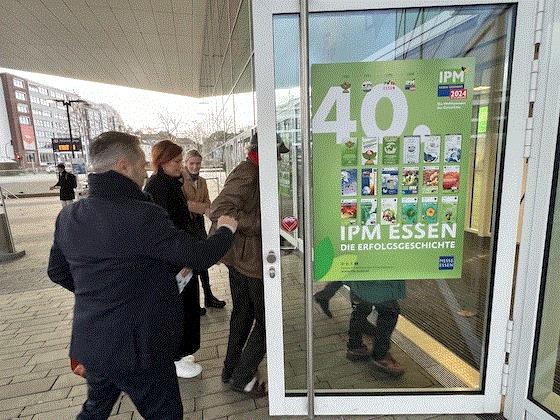
It's not the biggest IPM ever, even with those numbers. I think we’ve seen more than 55,000 visitors in previous years. And some large exhibitors are noticeably absent from the eight exhibit halls (due, I am told, to the rising cost of participating, both in booth space and staff travel).
Still, that didn’t stifle the energy and enthusiasm animating the folks I spoke with. Exhibitors and attendees alike are energized for Spring 2024. As for conditions in the European market, I’m told the chaos has settled down, things like fuel prices and the war in Ukraine are no longer making headlines, and businesses are back to worrying about the weather and the changing demographics of our customers.
Before I got to Essen, I popped into Intratuin Duiven, which has become an annual pre-IPM stop for me because it’s right off the A12, about halfway between Amsterdam and Essen, convenient for a post-flight cup of coffee and clean restroom. When you see IKEA, get off at the next exit, go through a couple of roundabouts and there you are.

At Intratuin Duiven
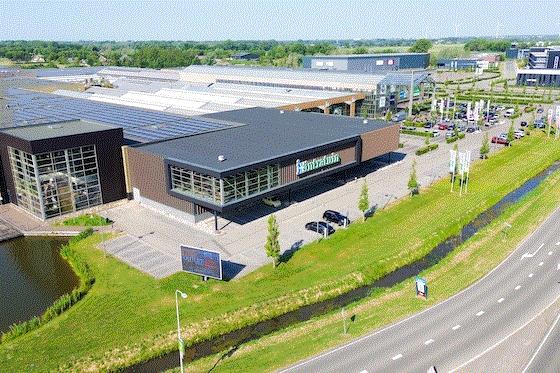
The store is massive! I looked it up: 30,000 sq. ft. (322,000 sq. ft.), the largest in the 67-store Intratuin chain. You’ll want to take a photo at the impressive entrance like I always do. You’ll notice some other business names, including hardware chain Gamma. Intratuin leases space to several other retailers, so you can shop for more than just plants if you feel so inclined. (“Baby Dump”? No, thanks.)
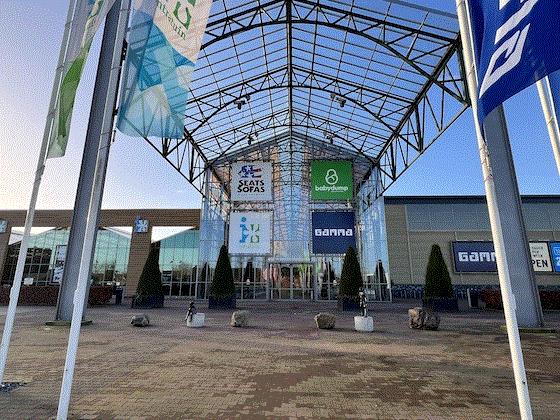
Inside, you’ll marvel at the giant old olive trees planted in the soaring foyer. And be distracted by the floral and fresh produce kiosks. But keep going to the very back and you’ll find the entrance to the garden center yourself.
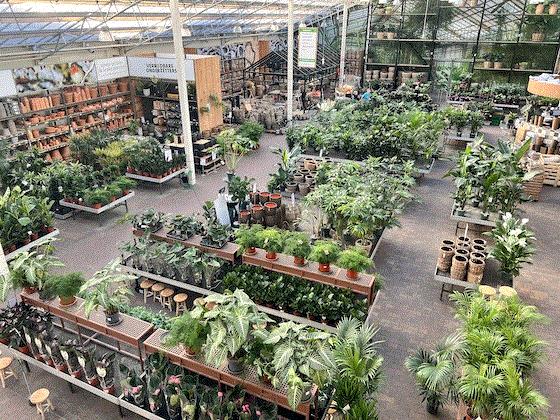
If you come in January as I did, you’ll first encounter their “Kamerplanten (houseplant) Pop-up,” a giant foliage sale featuring every cultivar under the sun in pot sizes from small to XXL. Talk about an impressive selection! It’s a good thing Laurie wasn’t with me—she’d insist we move from Orlando to Duiven just so she could shop! Whether you’re a grower or retailer, you’ll marvel at the quality, consistency and reasonable prices. This photo shows just a small section of the pop-up!
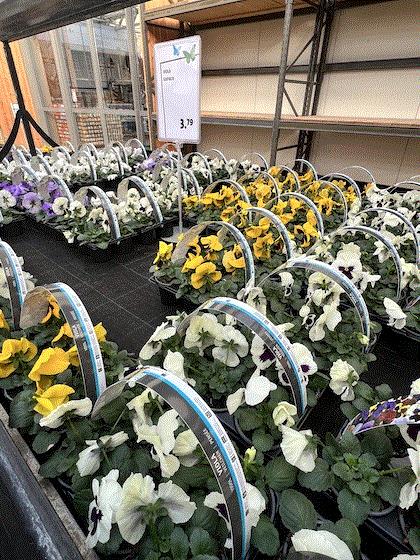
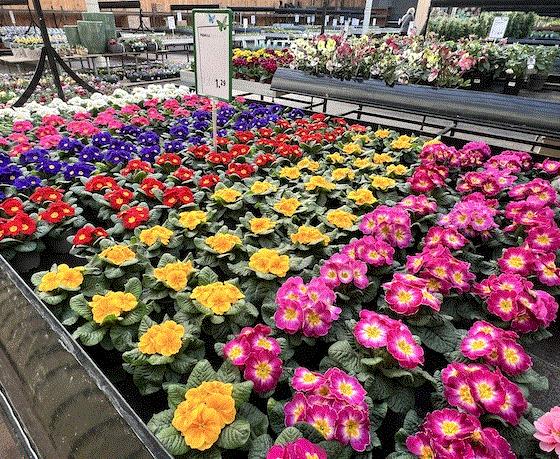
Another thing I like to see is what they offer for midwinter gardeners. The pansies and other spring annuals were fabulous, clean, with big flowers, and priced reasonably. These big 6-packs were about $4.10 U.S. Primula are always spectacular and beautifully merchandised. And at $1.40, I should have bought a few for my hotel room.
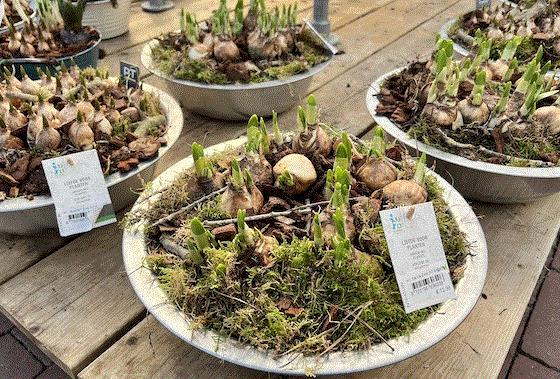
I also like what they do with bulb gardens, like these, which makes one think of a forest floor.
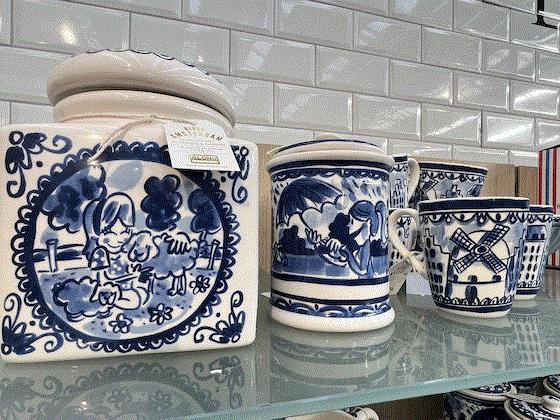
Inside, there are a million things to look at as you wind through the 7-acre store. But what caught my eye was this modern take on classic Delft pottery. Fun!
As for what’s trending? Maybe colored glass: they had an entire room devoted to nothing but bottles.
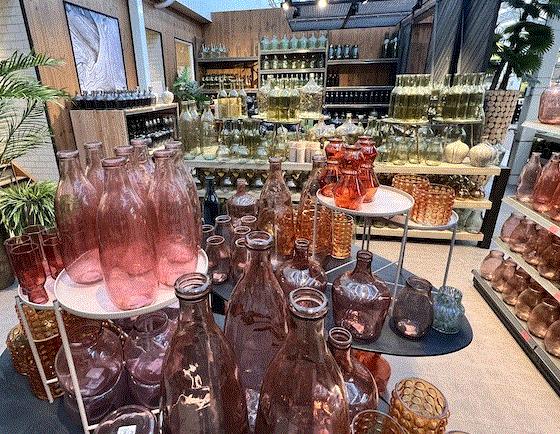
I could have written an entire newsletter on Intratuin Duiven; you’ll just have to put it on your bucket list. Now let’s head up the road to Essen, shall we?

At IPM
You can just about do this giant trade show in a day if you dash through, focused, and keep the conversations to a minimum. Two days lets you be more thorough, but still, you gotta know what you’re looking for. Give it three days and you can really have a good time. I’m almost going to be bored staying for a fourth day, but I’ll spend it taking more photos, seeking hidden gems, having a few last conversations, and seeing if I can buy those 100th anniversary Lowe secateurs I spotted in Hall 3, with the leather holster, in the original-style box. Very cool!
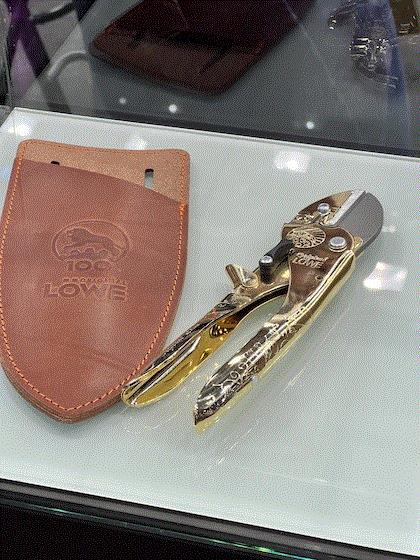
Lowe also had a contest to win these—the last pair out of just 100 gold-plated 100th anniversary pruners. I should be so lucky!
Shrub ideas
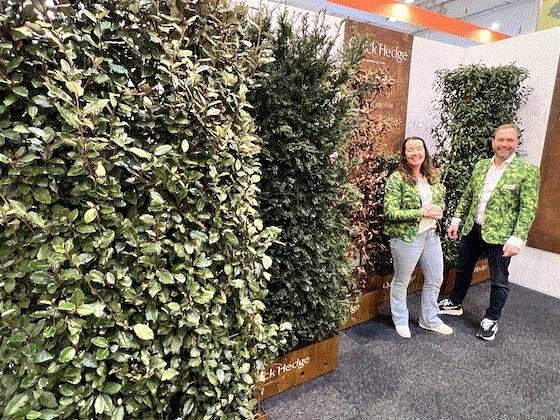
Starting backwards—in Hall 8, the one with all the Dutch trees and shrubs—I look for packaging ideas. The “InstantHedge” isn’t new (I think it launched in 2009), but it’s on trend: instant gratification! And so far, only one grower in the U.S. has picked up on the idea—Brent Markus, who discovered InstantHedge in 2012. I thought it was worth mentioning because we need more plants that give consumers what they crave.
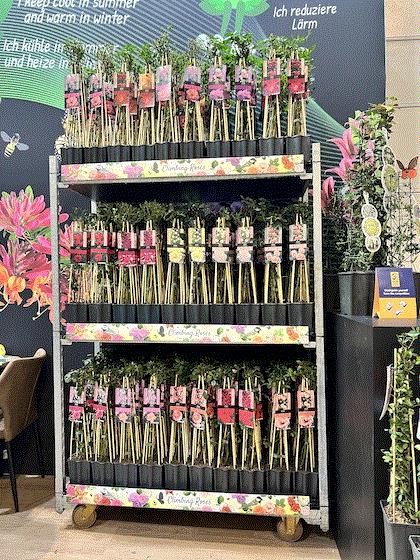
In the woodies hall I also look for POP, and Van Der Starre delivered some great tagging for their fruits and vines. Look at this concept: an entire rack of climbing roses, 180 plants in 15 varieties, ready to roll into your garden center.
Greener plants and pots
I expect to see green and sustainable and compostable and biodegradable options here, and I do … not necessarily as many as you’d expect, but they're coming. Here are a few:
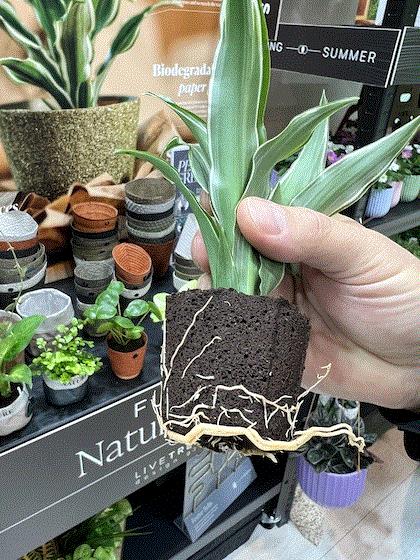
LiveTrends Europe is ahead of LiveTrends USA in one way: the use of peat-free potting media, since the use of peat is being discouraged and even discontinued in some countries (the UK has a partial ban now and a complete ban by 2030). LiveTrends is using a peat-free mix for about a dozen of their Danish-grown foliage plants.
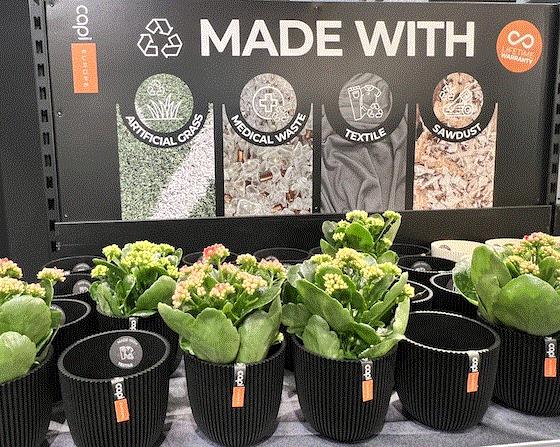
Capri Pots, a certified B Corporation, offers both indoor and outdoor container collections featuring various recycled products. The outdoor pots, made from 98% recycled plastic, utilizes scrap from their old pots, used plastic corks and old fishing nets. The indoor pots get a bit more strange, featuring “medical waste” and artificial turf, along with textile offcuts and sawdust. But, hey, the pots look fine!
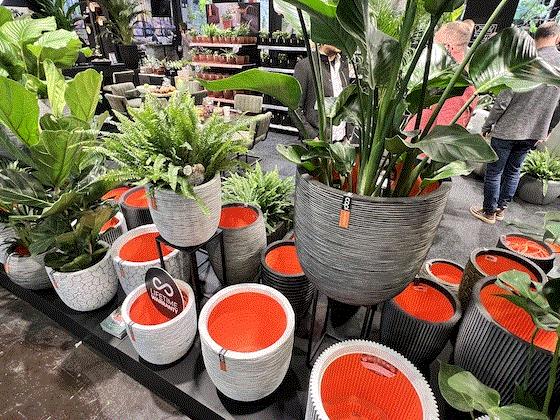
Also note their orange liner—“a little nod to Holland,” they called it with a smile. Like Louboutin heels!
Euro Plant Tray
Trying to help the entire German (and possibly European industry), a group of growers, distributors and retailers has gotten together to create a returnable, reusable shuttle tray for plants. The Euro Plant Tray idea came about when the German Environment Agency called a group of suppliers to point out that some 150 million one-way trays go into landfills each year in Germany and perhaps they’d like to do something about that. Golly!
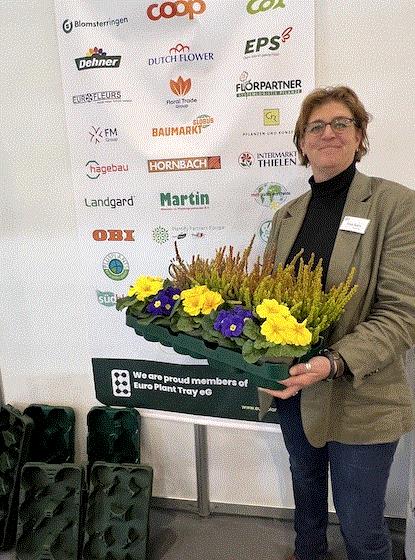
Well, when the government speaks, you act before they act for you, and that brought together a cooperative of stakeholders called Euro Plant Tray eG, an organization bent on developing a standardized solution to the problem. Interestingly, the cooperative does NOT include plastic companies or transport companies—just those who'll be using the trays. In just 18 months, they’ve come up with two designs in standard sizes to fit a variety of 10.5- to 13-cm pots and to fit on a CC rack. They’re expected to last for 20 years or 100 rotations. They’re currently negotiating production contracts, with trays for sale this summer. I believe about six countries are involved, not just Germany.
Click the link above for more details about this interesting project.
By the way, the woman holding the tray? She's Flora Späth. Is that great or what?

Biophilia: Celebrating our need for plants
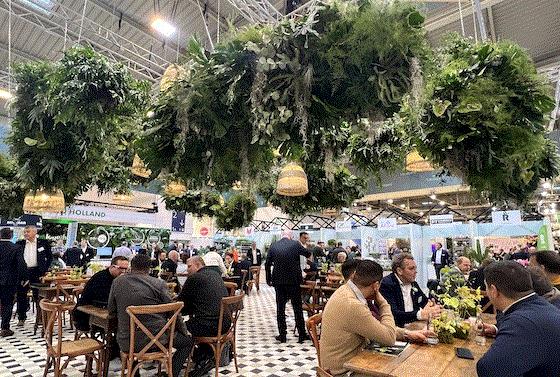
The big German auction, Landgard, had a “biophilia” theme in their stand this year: the natural, innate connection between plants and people that makes us crave nature. Check out the lush green gardens they had hanging overhead:
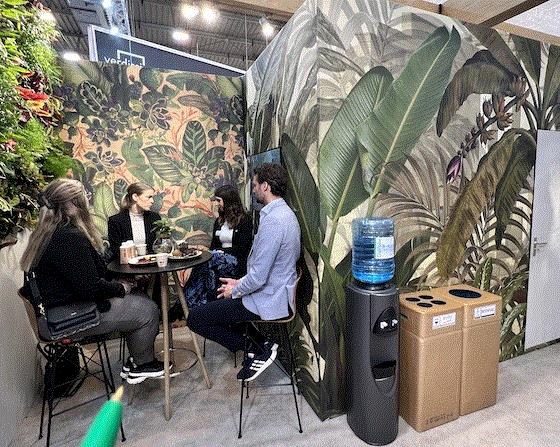
I love the wallpaper backdrop in the Dutch Flower Group stand. Big tropical color like this is on trend.
I saw a similar look in the Ter Steege container company stand:
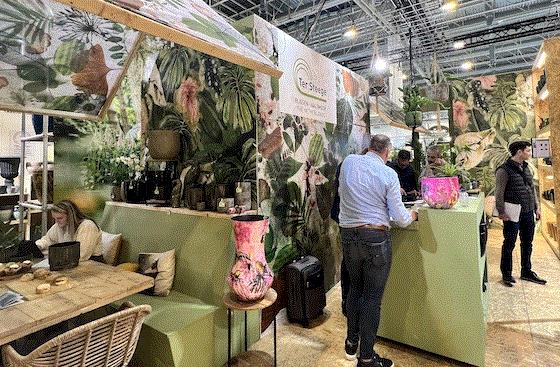
Trends in containers
My favorite beat: Technology
Flowers and plants are wonderful and hard to resist, but I spent all of my first full day looking for tools to help make you more efficient. Here are three cool ones:
I wrote about this just recently: the TTA Cutting Edge cutting sticking robot, a competitor to the well-known ISO Cutting Planter 2500. ISO has a several-year head start, with more than 300 currently in use, but TTA used that to find a way to make a better mousetrap. Did they? That'll be up to you guys to figure out through field-testing.
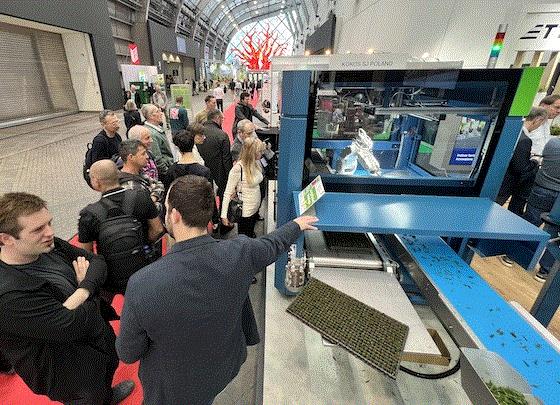
But TTA offers several features that look good. First, the Yaskawa six-axis robot’s head can rotate a full 360 degrees, making it easier to pick up cuttings. The gripper seems to do an elegant and delicate job picking up the cuttings—I never saw a miss—and it also plants them firmly, yet delicately, just like a talented human might. A third nice feature is that input, output and cutting overflow all happens on the same side of the machine, making it easy for one operator to keep an eye on things.
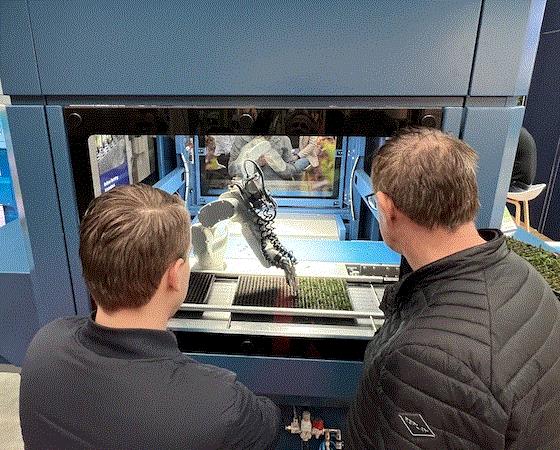
And a detail I wouldn’t have spotted is the chain conveyor, which TTA says makes for precise positioning of the destination tray—especially crucial if sticking in small cells where every millimeter of accuracy counts.
Meanwhile, over at ISO …
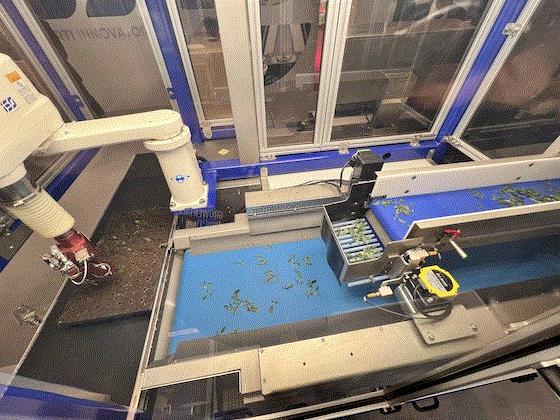
Not resting on their laurels, ISO Horti Innovators continues to upgrade its Cutting Planter 2500. I’ve reported on software updates, which are impossible to see, but the most recent upgrade is easy to spot: a buffer belt that sits above the main belt, feeding cuttings down to it. “Singulation fingers” help separate the cuttings as the fall onto the main belt, reducing the need for worker attention and producing 10% higher throughput, they say.

Meet the two Emmas
Otte Metallbau is a German internal transport company I've never written about. But upon spotting the two Emmas, Emma 3.0 and Emma 2.0, I knew I had an interesting story.
You're familiar with the typical Dutch tray bench systems, which rides upon pipe rails through the greenhouse. You can push them by hand or you can automate the movement, even adding cranes and things to pick up and set down tables. But it’s not easy to mechanize an existing manual table system. Nor would it be cheap!
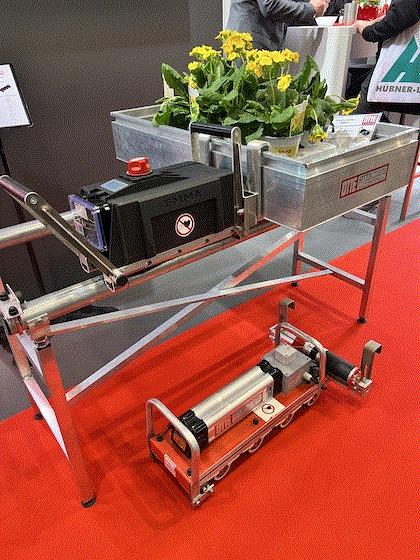
The Emmas are battery powered motors that will push the carts for you, easing the load on the backs of workers. Just set them on the rail, clamp them to the table and use a small remote control to power her forwards or backwards. Emma 3.0 is the smaller of the two; she can push 20 smaller tables. Her big sister can push 20 large tables.
Emma actually stands for something that ends in “automatic” or something like that, but it was lost in translation between me and my German host.

What I heard on the trade show floor
I can’t repeat what I heard at dinner, or anytime I was being plied with strong drink, as I always promise that if there’s alcohol out, it’s off the record (amazing how many people start offering me drinks before noon …), but I did have some excellent conversations in booths and the aisles. And there was a really good keynote before the International Grower of the Year Award.
Overall, the mood was what you might call "normal." The crisis situations in Europe—namely fuel prices and the war—seem to be off the front page. Yes, there's a train strike in Germany and a farmers' strike in France, but these have become ho-hum occurances. I think folks are back to worrying about what really matters to us: the weather.
Also, as one fellow told me, any sort of crisis seems to be good for our industry. Well, except $100 natural gas. That's not good for anyone.
A European garden center owner told me that in his experience, urban consumers, who you would think would be MORE into environmentally conscious products than their more suburban counterparts, are actually not. He opened a store in a major city, with an emphasis on sustainability and a strong environmental message. Customers didn’t respond, he said. When I asked why, he replied that they feel the plants themselves are “green” and environmental enough. The pot it’s grown in, the chemicals used to grow it and the store it comes from—doesn’t really matter.
Interesting!
The IGOTY keynoter, Ynzo van Zanten, once the “chief evangelist” for Dutch candy company Tony’s Chocolonely, told a story about being stuck in traffic in Belgium. When he called a friend to complain, the friend pointed out, “Ynzo, you are not stuck in traffic, you ARE the traffic.” Which made him think about all the things we complain about, like broken systems. Perhaps WE are the systems that we think are the problem. And so we should adjust our mindset, such as with our employees. He raised the statistic that only 13% of workers care about and are engaged in their positions. Is that their fault? Or the empoyers’? Perhaps the term “human resources” is outdated.
The same with “customer service.” He prefers “customer culture.”
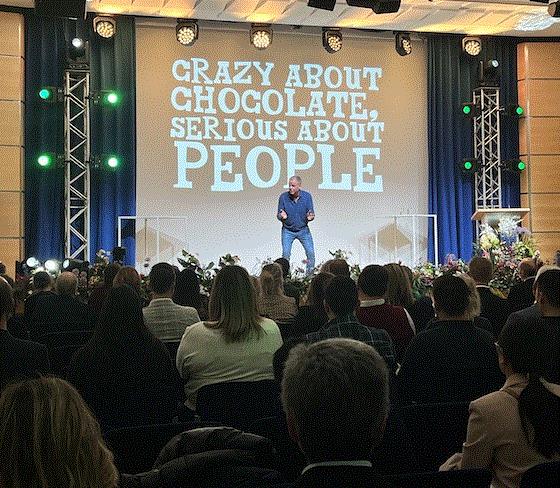
Ynzo in action.
Which recalled to mind something else I heard on the trade show floor while looking at an unusual plant. The seller told me (and I’m paraphrasing), “Ordinary plants have customers. This plant has fans.”

And the winner of the Gold Rose is …
I mentioned the International Grower of the Year Award. I was once again present (even if not on stage) when the winner was announced: Greenwood Plants, a wholesale nursery from the UK. Presenting the award was AIPH President Leonardo Capitanio. Greenwood also won the Finished Trees & Shrubs category and the Sustainability Award.
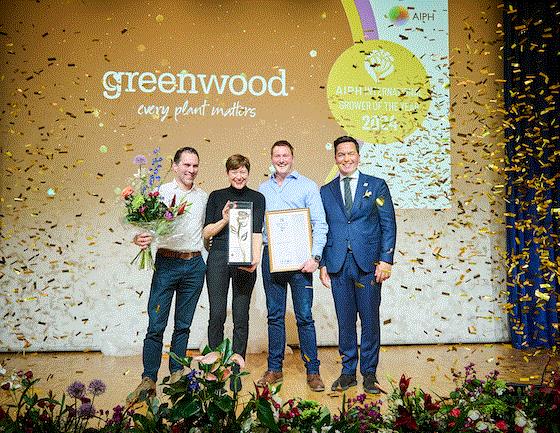
Greenwood is a landscape supply nursery that specializes in the new build property, commercial and infrastructure sectors. With over 100 acres, it produces around 6 million plants a year across its six nursery sites. In 2023, the company was awarded the HTA Peat-free Grower of the Year award due to its commitment to sustainability.
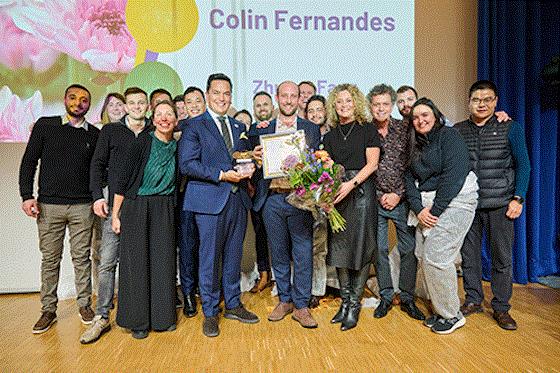
At the same event, the Young International Grower of the Year was announced: Colin Fernandes, Trial Site Coordinator for the cut flower grower Marginpar of Kenya. Colin and the other entrants above were participants in Jungle Talks’ Pro Manager Mastercourse.
By the way, one of those Mastercourse participants was Stephanie Saccomano, the GrowerTalks Young Grower Award winner in 2020 and current GrowerTalks columnist!

Finally …
There’s plenty more to report, including great plant varieties that should be coming our way, so I’ll share them next time, along with my regular weekly news, views and opinions.
Feel free to email me at beytes@growertalks.com if you have ideas, comments or questions.
See you next time!

Chris Beytes
Editor-in-Chief
GrowerTalks and Green Profit
This e-mail received by 27,293 loyal readers!
Thanks to my loyal sponsors, who help me reach the 27,293 readers of Acres Online in more than 60 countries. Want to be one of them (a sponsor, that is)? Give Kim Brown a shout and she will tell you about our many advertising opportunities.