January Farm Update
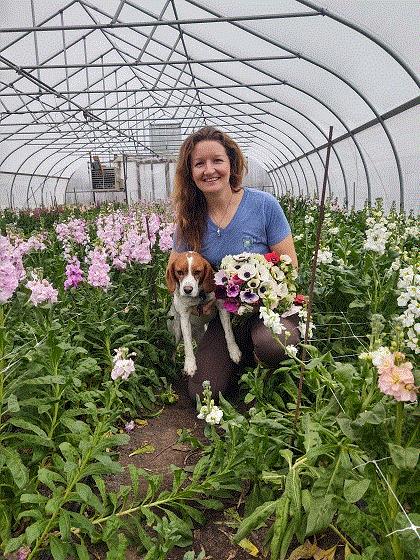
Happy New Year! Tater and I hope you are off to a great start for 2023.
Welcome to 2023! January is the month when Tater and I finalize our summer crop plan. Evenings include pouring over seed catalogs and reading industry magazines and various flower-farming threads on social media. We try to learn everything we can about potential crop additions for the farm. We take the time to research new crops and learn from others’ experiences.
January 2023 is especially exciting for us, since we have flowers blooming! This is a first for us. Usually we start harvesting blooms just before Valentine’s Day. I am hopeful that we will have a reasonable showing for Valentine’s Day this year. The stock, anemone, and snapdragons are a welcomed sight, especially since we have had some wild winter weather in Michigan already. We have some pretty big dreams for this season and I hope you do, too. I sincerely hope this edition of Bloom Beat will help you establish and refine your goals for the season ahead.
With all that being said, let’s talk shop!

What's Blooming Now: Snaps, Stock, Anemone
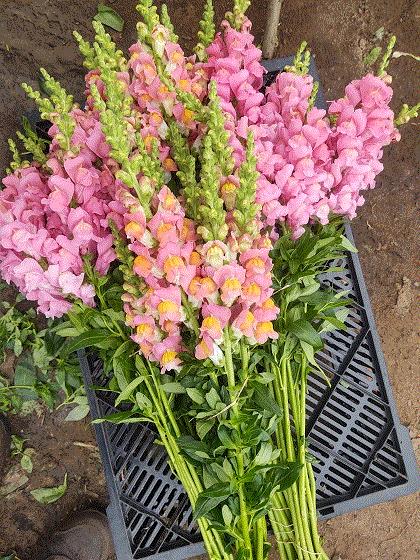
Cool Rose and Cool Orange snapdragons.
Tater and I want to walk you through some of the crops that are flowering at the moment. We are cutting a reasonable amount of stock and snapdragons, and the first anemones are starting to flower. Needless to say, our florist customers are in love!
We started snapdragon and stock seeds at the end of August and are pleasantly surprised to start harvesting them now—not a bad crop turn-around! We want to introduce you to some of these stunners. Maybe you will consider adding them into your early season crop plan. Bear in mind we planted our transplants into the greenhouse the third week of September and heated it to 50F to have blooms right now.
Snapdragon Cool series (PanAmerican Seed). These are a Group 1 snapdragon. When it comes to snapdragons you want to sow a variety in the proper bloom category for the season. Winter is Group 1, early spring and late fall are Groups 2 and 3, and summer is Group 4. Since we were looking for winter blooms we went with a Group 1.
I personally really enjoy the Cool Rose and Cool Orange snapdragons we started cutting this month. Our florists love local snapdragons and were thrilled to have them! Let’s face it, you know how amazing a fresh-cut snapdragon smells. Shipped snapdragons aren’t nearly as vibrant or fragrant as those fresh from the farm. Winter snapdragons are a real treat for florists, and according to my customers in southeast Michigan, quality snapdragons have been hard to come by the last few weeks. They were trilled to have ours. If you are looking to sell to florists, line flowers (single-stem flowers with vertical clusters of blooms along a single stem) like snapdragons are a great way to differentiate yourself.
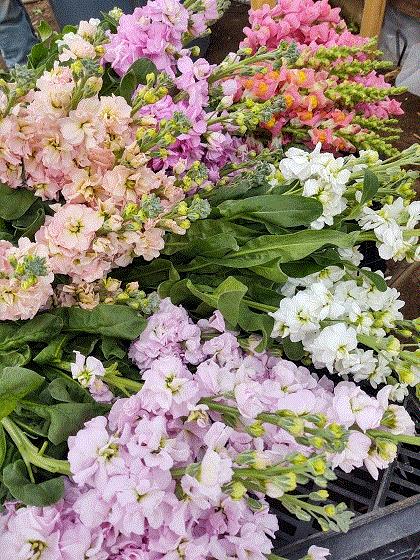
Pictured are stock Iron Cherry, Iron Apricot, Cannetto White and a few Cool snapdragons.
Stock Iron series (Sakata). Stock is another great line flower that florists can’t get enough of. The difference in quality between local stock and shipped-in is dramatic. Not only are the vase life and fragrance second to none, local flower growers can offer the progressive colors of stock that aren’t common on the wholesale market. Tater and I love the Iron series, specifically Iron Apricot, Iron Vintage Brown and Iron Cherry.
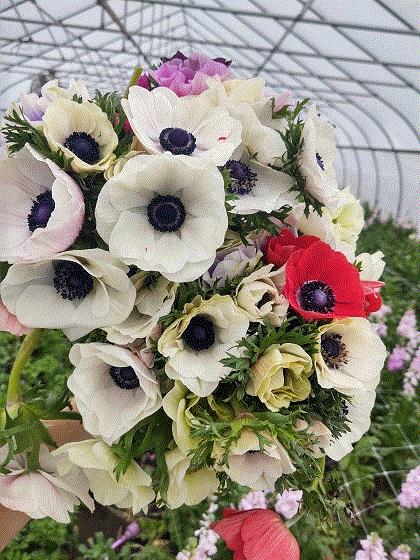
These are Mistral Bianco Centro Nero anemones, along with a few vibrant Carmel series blooms.
Anemone Bianco (Onings Holland). Above are anemone Mistral Bianco Centro Nero from Onings Holland. (There are a few Carmel Pastel Mix and Carmel Red blooms mixed in as well. Carmel is bred by Yodfat Flower Bulbs Nursery in Israel). As you can see from the blooms, Bianco Centro Nero translates as "white with black center." We haven’t cut very many of these beauties yet, but they garner a lot of attention! I am hoping anemone production will ramp up in a few more weeks, because our customers have been clamoring for the few bunches we have.
If you are really looking to get customer excited, early-season anemone, stock and ranunculus are the way to do it. Tater and I are waiting with bated breath for the first ranunculus bunches. We saw a few blooms color up this week!

Dianthus Webinar Alert!
As I mentioned before, Tater and I use the winter months to catch up on relevant industry articles as well as webinars, and the folks at GrowerTalks have a dianthus webinar coming up in February. To be frank, I have a fundamental appreciation for good puns, and the title for this webinar is at the top of my list!
Do or Dianthus Part 1: How to pick the right variety and schedule your best Dianthus crop
Wednesday, February 1
1 p.m. Eastern/Noon Central
Here is their description:
Dianthus offer endless possibilities for growing your program, from indoor holiday pots, to premium annuals, to traditional perennials. But how do you know which varieties are right for your needs?
In Part 1 of this free two-part GrowerTalks webinar series, dianthus expert Gary Vollmer will walk you through the broad variety of genetics available from Selecta One and give you guidance for a successful and profitable program. Topics Gary will cover in Part 1 include:
- The various classes and varieties of dianthus and how they can be used— as indoor holiday pot carnations, premium annuals or traditional perennials
- Choosing varieties based on growing conditions, container sizes, region and desired timing
- Opportunities for dianthus in the marketplace
Part 2 (date and time TBD) will cover all the production details you need, from rooting to finishing, to produce a top-notch dianthus crop.
Dianthus are one of the most versatile crops available, and Selecta One is a world-leader in this class. Don’t miss this opportunity to learn how to add dianthus to your production!
Even if this doesn't mention cut flowers, webinars tailored for container production can be incredibly informative and insightful. You can glean all sorts of relevant information that can be readily applied to cut flower production.
The folks at
GrowerTalks also have an excellent assortment of prerecorded webinars that will help you become a better grower. Look for them
HERE, under the "available now" link.
Happy listening!

ASCFG Tours, Research Grants
The Association of Specialty Cut Flower Growers (ASCFG) just released their 2023 farm tour dates and locations. I mentioned these last season, and fellow farmers have told me that they are incredibly helpful!
Tours are hosted by fellow ASCFG members. These hosts take you on a tour of their farm and give you a glimpse into their marketing, sales, growing and production practices. They are an excellent way to connect with other farmers. I’ve found that the cut flower community is incredibly collaborative and these farm tours are a great way to facilitate farmer-to-farmer knowledge-sharing.
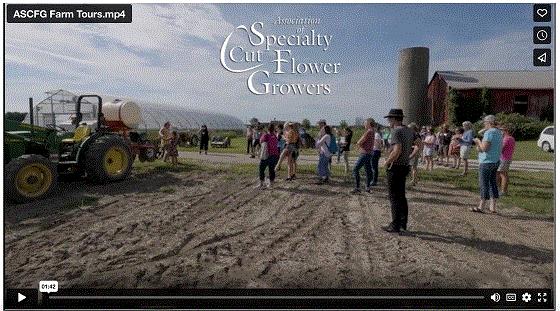
The tours will take place all over the country, from California and Virginia to New York and Quebec, just to name a few! Here is the LINK to the full roster of farm tours. The maximum number of participants varies per farm tour, so if there is one you have your heart set on attending, you may want to register sooner rather than later.
In addition to farm tours for 2023, ASCFG is offering research grants to growers. Current ASCFG members who have been farming for three years of more can apply for $500 to $2,000 of funding to conduct original on-farm research. Matching funds from other organizations are encouraged. Proposals should be for one or year or less in duration but may be apart of multi-year project.
Application deadline is March 1. Submit your application to mail@ascfg.org. You can access the application guide on the
ASCFG website.

Setting S.M.A.R.T. Goals
Every new season is an opportunity to dream big and shoot for the moon. So dream your big dream!—but also make smaller goals that will help you accomplish your big dream.
According to a 2016 study, 41% of Americans set New Year's resolutions. Only 75% of those who make resolutions are still keeping them one week into the New Year. Yikes! By June, only 46% of folks are keeping their resolutions. The statistics become even more discouraging by the end of the year, when just 9% feel they have successfully lived up to their new years resolution.
Why do we fail? The
University of Alabama surveyed individuals who reported that they failed to keep their New Year's resolution, and they learned the following:
-
35% of participants set unrealistic goals
-
33% of participants did not track progress
-
23% of participants forgot about their resolutions
-
10% of respondents said they made too many resolutions
Based on this evidence, how can we make sure that we will keep our farm goals and resolutions for 2023? Welcome to S.M.A.R.T. goal setting!
What does S.M.A.R.T. stand for, you ask?
Specific. When trying to make specific goals, think about answering the five “W” questions: What do I want to accomplish? Why is this goal important? Who is involved or influenced? Where is it located? Which resources do I need to mobilize to make it happen?
Measurable. How will you document progress of your goals? In order for goals to be measurable they should answer the following questions: How much? How many? There needs to be a metric for measuring success. That could be as simple as setting a gross dollar goal for your farml. Or is can be crop-specific, such as, "I want to harvest and sell X number of sunflowers a week."
Achievable. Remember how I encouraged you to dream big for 2023? This is the part where we break down the big goal into smaller bite-sized pieces. Achievable goals usually answer the How question. How can I accomplish this? Once again, you don’t want to set the bar so low you can step over it effortlessly. Your goals should encourage you to grow and step outside your comfort zone. But you also want to be practical in your goal setting.
Relevant. Does this goal matter to you and does it align with other goals you have? This is your rally point. Goals are designed to propel your forward, but you also have to be in the driver's seat. You need to be in control of your goals. Relevant goals should answer the following questions: Is this worthwhile? Is this the right time? Does this goal align with my long-term goals and aspirations?
Time-Bound. Last, but certainly one of the most important aspects of goal setting. What is the deadline for accomplishing this goal? When are going to sit down and take stock of your progress? Deadlines create urgency, which in turn will inspire you to make daily strides to accomplish it. Goals shouldn’t be nebulous concepts. Time-bound goals should answer the following: When? What can I do today to work towards this goal? What progress have I made over the last month to accomplish this?
If you want a more elaborate dive into setting SMART goals, check out
THIS ARTICLE from
Forbes. Happy planning!

In Closing
This is my public service announcement to ensure you work on your succession plan this month!
As I mentioned before, Tater and I love spending quality time with seed catalogs in front of the fireplace during the winter months. Winter is a great time to outline your succession plantings for your summer crops. That way, when you are in the thick of the growing season, you can execute your well-thought-out plan versus flying by the seat of you pants and haphazardly sowing seeds on a whim.
Remember, your farm is a business, and you want to make sure you have product to offer your customers each week. Also, be sure to set S.M.A.R.T. goals that will motivate you and encourage you to put your best foot forward this season. Tater and I are cheering for you!
What new varieties and crops are you excited to try for 2023? We would love to hear from you! Drop Tater and me a line at ldaschner@ballpublishing.com. Or if you would like to talk to Tater directly, you can reach her at tater@ballpublishing.com.
Stay well and we will talk to you soon!

Lindsay Daschner (and Tater)
Editor-at-Large—Bloom Beat
Owner—Forget-Me-Not Farms
This email was received by 6,218 of your fellow fresh-cut flower growers!
If you're interested in advertising in Bloom Beat, contact Kim Brown and she will hook you up!