Express Seed licensing Syngenta’s poinsettia line
During Cultivate’22, Syngenta announced that they would no longer be producing and breeding poinsettias, opening the door for other interested businesses to acquire the license to take over the program. We’ve had our ears to the ground ever since, curious who might take on the poinsettia business, which includes well-known varieties like Orion, Toro, Superba, Marblestar, Alaska, Maren and Cortez Burgundy.
Now we have the answer: Express Seed. Ace investigative reporter Jen Zurko got the scoop from Scott Valentine, Express Seed’s CEO, and Scott Rusch, Business Development Director. Here’s her report:
This week, Express Seed is announcing that they are now the exclusive global licensee of all of Syngenta’s poinsettia products.
Express will be maintaining open distribution with brokers and root ‘n sells in the United States. In Canada, unrooted cuttings will now only be available from Express. Rooted liners will still be sold through existing brokers and young plant producers.
GrowerTalks: Give me the background on how Express came to obtain Syngenta’s poinsettia program.
Scott Valentine: Days before Cultivate, Syngenta sent out a communication letting companies know about the announcement. I and others on the Express team had familiarity on Syngenta poinsettia genetics. We had confidence in the varieties and the production, so we got to thinking, how might we make this work? We’ve seen good success with the multi-breeder collaboration of ThinkPlants in the perennial segment and wanted to explore Syngenta’s poinsettias fully. We didn’t want the program to end and we wanted to make sure that we still had all the Syngenta, Lazzeri and Beekenkamp varieties produced together, to fill boxes, meet minimums and simplify logistics for all growers.
One concern was [Syngenta] wouldn’t be able to find a buyer and the program would end. Or they would find a buyer who would have their own interests that wasn’t part of the original collaboration between them, Beekenkamp and Lazzeri. So we wanted to maintain that partnership on behalf of our growers.
To be clear, this is not an acquisition, it’s an exclusive license with a path to a complete IP transfer in the future. And this is an exclusive license for everything—production, pipeline development, breeding lines, etc.

Syngenta's Matt Blanchard shows off Toro Red to Jen Zurko during the 2021 Heimos poinsettia trial.
GT: Once the news was out, how did the internal discussions at Express go? How did you get buy-in from the rest of your team?
SV: First, this is a strategic interest for us. Me, David [van Wingerden], Estuardo Arriaga and Scott Rusch discussed it. At that point, we didn’t have any numbers or hard information to go on. It was more like, is this a strategic fit? Is this something that we’d be interested in? It was an opportunity that came across our lap, really. And for the reasons I just mentioned, we said yes.
Now, we didn’t see any data [on the program] until just after Cultivate. That was when we saw the first real data and even that wasn’t financial data. It was more of here are the varieties, here’s the concept, here’s what’s in the pipeline.
After Cultivate, that’s when we went back to Syngenta and said we were interested. That’s when we started working on a business plan. We felt it was a strategic and financial fit.
GT: What does the license agreement entail?
SV: We have a global license to all of the current poinsettia lines exclusively for us to market, produce, distribute and sell. We also then have exclusive access to what they have in development, that was planned to launch in the next three years. And in R&D, there are many, many selections to evaluate. That is all for us to develop and commercialize exclusively.
GT: Is Express going to have its own poinsettia breeding program now to continue where Syngenta left off?
SV: One hundred percent yes. Having a line without breeding to maintain varieties and bring innovation to the market is a little risky. We can’t say yet who our breeding partner is, but there is 100% a breeding partner to be named later.
Scott Rusch: There is a team at Express who understands the poinsettia market and what growers need. We have experts in breeding, product development, production and growing. For example, Estuardo understands the poinsettia market backwards and forwards. And like everything at Express, it’s really a collaborative team effort. The whole group of salespeople, product people, technical experts—we’re going to guide this program where it needs to be and leverage as much as we can out of that germplasm. As the exclusive licensee for this program, we want to maximize the potential returns.
(Editor’s note: Longtime poinsettia expert Steve Rinehart will consult for Express with the program’s transition and provide technical assistance for their team and grower customers.)
GT: So this will be Express Seed’s first foray into plant breeding?
SV: Way back when, Express had a minority stake in Kieft Seed. But in the last 10 to 15 years, this will be the first foray into breeding for Express and lines that are exclusively licensed by Express. And we’re very excited about it. It’s a new chapter for us.
GT: Will Syngenta’s poinsettias continue to be produced at the same facilities?
SV: Yes, we’re going to keep production at Vivero [in Mexico]. Express has had a long relationship with Vivero. We feel they’ve done a great job on quality, so we do want to keep the lines there. Lazzeri and Beekenkamp also have their lines there and we want to keep those three lines together. That’s important.
GT: What does this mean for growers who produce Syngenta poinsettias?
SV: In short, it’s business as usual. This means growers that have grown the varieties they know and love will still be able to grow in 2023 and beyond.
Scott mentioned our technical expertise with Estuardo and many of our sales reps and we will increase the focus on quality. It’s not that the varieties didn’t have good quality before, but that will be our No. 1 emphasis—making sure growers get high-quality inputs and are successful. You must have high-quality products and that will be our drive for the future. There will still be innovation coming behind these varieties, but really the next year or two will be focused truly on quality supply of the existing assortment.
GT: Will there be a separate program name for this, like Express has with its cut flower program [InFlora Cut Flowers]?
SV: Good question. I think for now it’s just going to be status quo and we’re keeping the variety names. Everyone knows Mirage, so we’re keeping the name. Do we keep that in the future? I don’t know. Once we have transferred the knowledge and physical assets from Syngenta, we will sit down and discuss if we want to rebrand the name for this. Once our breeding path is final and announced, do we create something new? Potentially.
SR:The main thing we want everybody to know is that the varieties are the same, the names are the same. We’re going to work with our production partners to maintain and improve quality, and we think we can add value there, but everything else is the same. People know the Syngenta poinsettias and we’re not going to complicate that. It’s all about how we continue to improve the supply chain, which is where Express has shined in multiple categories for our grower customers. It’s all about how we make things go smoothly for the growers.

Are poinsettias part of a grand plan?
GT: There seems to be a lot of change and expansion happening at Express. Is it just good timing with all of these opportunities or is this part of a long-term plan?
SV: When I started with Express the Board tasked me with growing the company. Express has traditionally been strong selling annuals and perennials for big box growers. We have put a strategy in place to build upon this solid foundation and grow beyond annuals, perennials and big box growers. That includes expanding our grower customer base, and also includes other segments of our industry outside of annuals and perennials. We have also hired great people—such as folks from Gloeckner, additional sales reps and Mr. Rusch—to lead our business development activities. Scott has been my right hand to help develop and execute our strategy, such as developing our cut flower business.
SR: The existing vendors, breeder relationships, customer service and logistics know-how at Express and our sister company Fresh2U offer support for our grower customers—those services can really be a big help to growers of all categories and all sizes. And that’s where we see growth and opportunity.
GT: Part of this expansion is promoting awareness of Express Seed and its programs, correct?
SV: You have to. We’re in the cut flower segment, but it does us no good if a cut flower grower has no clue who Express is, so we have to build our awareness. Basically, introduce ourselves to those growers. It’s to build awareness in the industry outside of annuals, of who we are and what we do.
SR: This is the 40th anniversary of Express Seed Co. John [van Wingerden] started it in 1982. Our team is growing and we plan to share our capabilities with growers of all sizes and all segments going forward.
GT: Express is going to be getting a lot more attention with these new programs and partnerships.
SV: It’s not for us to pound our chest and say, “Oh, look at Express.” It’s really just to make sure we can connect our services to these growers.
SR: The core of Express is about connecting growers with the products that best meet their needs and then the vendors that can best deliver those products with the highest level of quality. There’s a level of independence here because we are not beholden to any one source of germplasm. We always have that independent eye on selling the best product for the grower.

In memoriam: Kristian Madsen
The Danish greenhouse industry lost one of its beloved members earlier this month when Kristian Madsen, second-generation owner of Gartneriet PKM in Odense, died of pneumonia at age 70. The news didn’t come as a great surprise to me, as Kristian had suffered a life-threatening head injury in a fall in 2014 and had endured health issues ever since.

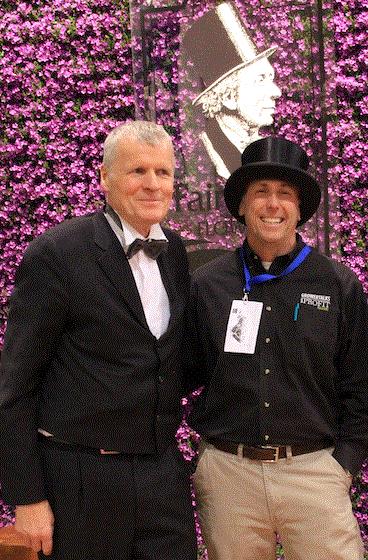
If you ever attended Horti Fair or visited the Danish hall at IPM Essen, you probably saw Kristian in his top hat and tails, which he wore in honor of his country’s famous poet and fairy tale writer Hans Christian Andersen, who became Madsen’s inspiration for Fairytale Flowers. Under this trademark, his company, Gartneriet PKM, currently markets four flagship products: campanula, lavandula, rhipsalidopsis and schlumbergera.
I always enjoyed chatting with Kristian and his wife, Anett, in their impressive booth (below is 2014, when I somehow talked him out of his hat). He truly was one of the nicest people in the industry and an impressive businessman. I also visited their nursery once, in 2015. Since his injury, the business has been run by Anett and son, Poul.
I’d heard the sad news about Kristian from another industry colleague, but had no details. But my friend Ron Van Der Ploeg of FloraCulture International (FCI) was able to fill in the blanks of Kristian’s life.
Kristian was in education at one of the Denmark’s horticultural schools, after which he briefly traveled the world, working at several horticultural companies in Norway, Germany, New Zealand and the United States.
In 1983, he joined the nursery his parents, Poul and Marie Madsen, had founded in 1948. The company changed its name to Poul & Kristian Madsens Gartneri ApS—Gartneriet PKM—and six years later when dad retired, Kristian took over the company’s reins.
Kristian ran the nursery with great energy, ingenuity and enthusiasm, allowing it to grow by leaps and bounds over the years. He created one of the country’s largest and most successful horticultural businesses and many good jobs on Funen, Denmark's central island.
The “Fairytale Grower” was constantly looking for ways to improve the industry. He was unorthodox as a grower and showed incredible courage. To solve industry issues, he thoroughly searched for information and feedback. No one else dug deeper than he did and had a keen eye for product handling and development from an early age. And he was happy to go to any lengths to optimize production methods and products using the latest technology. This led to many unique products that put Danish-grown schlumbergera, campanula and Christmas mini trees on the world map.
In 2011, Dansk Gartneri, the trade association for Danish horticulture, elected Kristian as its president, putting industry issues straightforwardly and relentlessly on the political agenda. Even after his accident, he used all his efforts in the interest of the horticultural sector until September 2015.

Lucas expands yet again
Another report from Jen Zurko, this time from her recent journey to New Jersey to look at garden mums. I’m delighted to see that I trained her to look not just at plants, but at the tools used to grow them!
While I was looking at Lucas’ mum trials and taking a peek at their early poinsettia production, owner George Lucas carted me over to his newest expansion project.
Four additional acres of Prospiant greenhouse was being built with the plan of completion for early 2023. It will allow Lucas to isolate some of its young plant production to maintain their sanitary practices. Lucas will now have a total of 2.2 million square feet of greenhouse space at its Monroeville location.

“It’s not necessarily because of the increase in business, but it’s to help us do a better job of planting and spacing on time,” explained George. “It’s for the future growth of the company and to stay ahead of the curve.”
This addition is part of a five-year plan that will eventually also include tearing down some old, inefficient greenhouses, and adding more space for storage and offices.
George and his wife, Louise, are the first generation of Lucas Greenhouses, with their son and two daughters now involved with the business as the second up-and-coming generation. George said when he was 21 years old, his dream was to have a 1-acre greenhouse. At the time, he said he didn’t dream big enough for the land he had. But now, years later, he’s overseeing another multi-acre expansion.
I asked him if his 21-year-old self would ever have thought he would be running a 35-acre growing operation with 400 employees. "No!" he said with a laugh.

Sustainable innovations up for Dutch award
I won’t be attending the annual Royal FloraHolland Trade Fair Aalsmeer this November 9-11, which is a pity because it’s one of my favorite shows. (HERE and HERE are links to parts 1 and 2 of my last visit, in 2019, for a taste of the event.)
Anyway, one of the things taking place at the Trade Fair is the presentation of the “Greenovation Award,” which recognizes the best sustainable product or concept launch within the horticulture sector. Sustainability is a growing concern all over, but especially in Europe, which is why it's the focus of the award.
There are nine nominees for this year’s award. A panel of expert judges will provide 50% of the final vote; YOU can weigh in on your favorite to make up the other 50%.
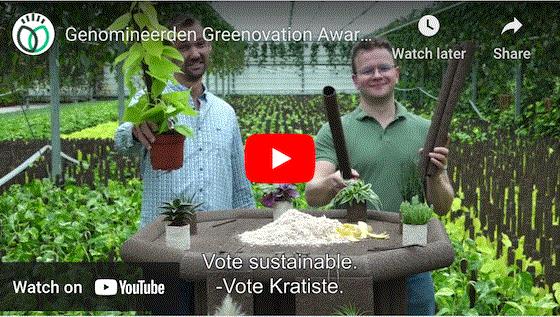
Here are the nine finalists. You can watch this VIDEO for a quick look at each finalist, then place your vote!
Tesselaar Alstroemeria B.V.
Product: Alstroemeria Mistral
A carbon neutrally produced flower. Working in the greenhouse with people at a distance from the labor market.
Modiform
Product: ecoExpert Clampack
Sustainable packaging to safely send plants to consumers. The clampack clamps around the pot and can stay closed while the plant sticks out through the opening.
Paardekooper
Product: Flower bucket returns system
Sustainable solution for the large numbers of buckets that are used every year in the floriculture industry. The returns system offers flower traders a Euro pallet or roll container to collect their used flower buckets.
Hazeu Orchids
Product: Orchid cultivation in a hexagonal pot
The hexagonal nursery pot enables 20% more plants on the same surface area, 20% more plants in transport, and therefore a 20% reduction of energy consumption and a 15% improved carbon footprint.
Plantics BV
Product: DOPA plant-based plant pot
The DOPA brand is the steppingstone for all innovative developments, product ranges and concepts within the entire horticulture industry. From paper plant pots and furniture to paper strawberry containers.
Floral Trade Group
Product: Refleur
This concept was designed to offer clients a commercially viable sustainable proposition. It consists of four components: sustainably grown flowers, sleeves made of floral waste, buckets made of 100% recycled materials and payments to a sustainable charity. Refleur is meant to create awareness among customers and growers.
Chrysal International B.V.
Product: Chrysal Sea Freight Services
A post-harvest treatment to keep flowers looking fresh and beautiful for longer during sea freight and storage. Reduces the carbon footprint by 90% compared to air freight.
Kratiste
Product: Kratiste stake
Innovating the old-fashioned stake along which climbing plants can grow up. Made from potato peels and Dutch elephant grass.
Saidi-Ronen
Product: Environmentally suited crops
This Israeli grower cultivates environmentally friendly crops. Its business concept is holistic and offers a solution that combines environmental responsibility, a contribution to the community and society, and a fair profit for the owners.

J&P to archive rose genetics at LSU
Jackson & Perkins and the LSU AgCenter Botanic Gardens in Baton Rouge, Louisiana, have announced a partnership that will preserve J&P proprietary and historic genetics AND be part of a program to ensure their roses are free of rose mosaic virus (not to be confused with rose rosette disease). The latter will be done under the guidelines of the National Clean Plant Network (NCPN) and with the assistance of Dr. Kevin Ong, director of the Texas Plant Disease Diagnostic Laboratory.
Why LSU’s gardens? One important reason is that its facilities are 300 miles south of any known case of rose rosette disease (RRD), according to Dr. Mark Windham, one of the country’s leading experts on RRD. RRD is a virus that causes roses to grow strangely deformed stems, leaves and flowers. A tiny mite spreads the disease between plants.
J&P has already begun sending their roses to the gardens, where they'll be planted and maintained in a secure area. This exclusive garden will ensure that none of these rose genetics will ever be lost. The LSU AgCenter Botanic Gardens is an ideal partner for this, having a long history of maintaining roses in multiple gardens, having been an All-America Rose Selections (AARS) trial garden, and now a trial garden for American Garden Rose Selections and American Rose Trials for Sustainability. The AgCenter’s also offers horticulture students real-world educational opportunities.
As a bonus for rosarians, these rose genetics go back 100 years or more and many are no longer in commerce. This program will allow J&P to eventually reintroduce many of these historic varieties back to the market ... perhaps a rose like Diamond Jubilee, the AARS winner in 1948, introduced to commemorate J&P’s 75th anniversary.

Jackson & Perkins is part of J&P Park Acquisitions of Edina, Minnesota, which includes Park Seed, Wayside Gardens and Van Dyke’s Restorers.

Dümmen Orange again donates to Yellowstone Forever
Speaking of yellow flowers, if you grew and sold Dümmen Orange’s Yellowstone Petunia, you enabled them to donate $100,000 to Yellowstone Forever, the official nonprofit partner of Yellowstone National Park. This amount raises the overall total to $185,000 that Dümmen Orange has presented to Yellowstone Forever over the past two years.
 Yellowstone Forever focuses on funding the park’s wide-ranging support of the world’s first national park, including sustainability efforts, the historic Yellowstone Wolf Project, Native Fish Restoration, Yellowstone Cougar Project, Bison Conservation and Transfer Program, and the Youth Conservation Corps, among many other park priorities. Donor support helps to fund these important projects and ensure the future of Yellowstone National Park for generations to come.
PanAmerican Seed donates to save sight
If you bought Beacon Impatiens seed (or the plugs or finished plants they produced), you helped PanAmerican Seed raise $81,000 for a pair of worthy charities, Spectrios Institute for Low Vision in Wheaton, Illinois, and The Macular Society in the United Kingdom, that are fighting low-vision issues and macular degeneration, diseases affecting millions of people worldwide.

Low vision is the loss of eyesight and vision capabilities that cannot be corrected through lenses or general surgery. While not blindness, as limited sight remains, low vision can include blind spots, poor night vision and blurriness. It can often leave people unable to do the things so many of us take for granted, such as reading, watching TV, or even recognizing the faces of friends and family. Both Spectrios and The Macular Society support and empower people to optimize their visual capabilities and independence through the use of technology, prescriptive tools and rehabilitative training. This issue was brought to the attention of PanAmerican Seed through one of its own employees living with low vision.
A new charity will be announced soon for the 2023 sales season.

Online classes: Irrigation Water Quality & Treatment
The University of Florida (for full disclosure, my alma mater!) Greenhouse Online Training continues November 14 with its final course for 2022: Irrigation Water Quality & Treatment. This sounds like a great class for any grower who wants to know more about their water and interpreting test results. You'll learn how to:
- Interpret water quality tests for irrigation of greenhouse and nursery crops
- Select appropriate water treatment technologies
- Design a water treatment and monitoring system
Lesson topics include:
- Water quality and conservation
- Chemical water quality
- Plant pathogens
- Sanitizing technologies
- Removing particles
- Ponds and runoff
- Integrated water treatment design
This advanced course is designed for experienced growers or technical managers. Lessons are offered in English and Spanish, and are taught by professors from six universities in the United States, including Paul Fisher and Rosanna Freyre (University of Florida); Bruno Pitton and Loren Oki (UC-Davis); Jennifer Parke (Oregon State); James Owen and David Sample (Virginia Tech); Dan Hitchcock and Sarah White (Clemson); and Damon Abdi and Tom Fernandez (Michigan State).
The online class runs from November 14 to December 16 and costs just $249.
Learn more and sign up at https://hort.ifas.ufl.edu/training.

Sign up for TPIE ’23
There’s no time like the present to get your spot booked for the best tropical plant event on the planet: TPIE! It’s slated for January 18-20 at the Tampa Convention Center in Florida.
The annual Tropical Plant International Expo specializes in tropicals and indoor plants, which remain in high demand. You’ll see North America’s best selection of foliage, potted plants, orchids, bromeliads, exotics—everything you need to keep the Instagrammers excited! Plus, TPIE brings together the world’s resources and experts from all categories of inputs, supplies, tools and equipment you need for your greenhouse or garden center.
A special feature will be the return of Christine Boland, one of the most insightful and relevant trend analysts you'll ever hear. She’s a veteran of TPIE and so knows our products and our customers. TPIE asked her to come back specifically to hear about the post-pandemic world and how our industry fits into it.
Register now at www.tpie.org/2023. And don’t forget to book your hotel accommodations, too, as space is limited.

Finally …
Good news from my fellow National Greenhouse Manufacturing Association (NGMA) Board of Directors members. I was on a call with them earlier this week and I tossed out an informal query about the current state of the greenhouse construction materials supply chain. The news? Positive! Metal prices are coming down. Galvanizers are turning around jobs more quickly. Fan motors are available. About the only negative I heard regarded aluminum extrusions, the suppliers of which are still backed up.
But if you’re thinking of building a new greenhouse or buying some equipment for your existing facility, you might get it sooner AND at a better price.
Feel free to email me at beytes@growertalks.com if you have ideas, comments or questions.
See you next time!

Chris Beytes
Editor
GrowerTalks and Green Profit
This e-mail received by 26,133 loyal readers!
Thanks to my loyal sponsors, who help me reach the 26,132 readers of Acres Online in more than 60 countries. Want to be one of them (a sponsor, that is)? Give Kim Brown a shout and she will tell you about our many advertising opportunities.