Videos of poinsettia pests and diseases
Last week’s issue of this newsletter focused on pest management during the finishing stage of a poinsettia crop. If you want to learn more about how to manage insects and diseases on poinsettias, or just about anything poinsettia, GrowerTalks Tech on Demand’s Bill Calkins has just the videos for that!
Part 30 is on disease control. James Doukas, Jason Twaddell and Gary Vollmer from Ball Seed and Selecta One talked about common diseases of poinsettia, such as Rhizoctonia, Botrytis and Pythium. The speakers also talked about how to manage the diseases with fungicides.
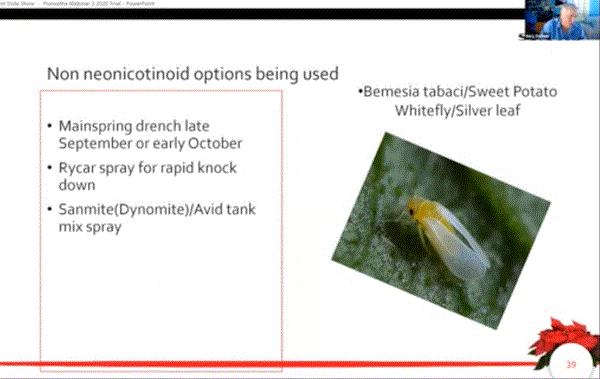
Part 31 is about fungus gnats and whiteflies as pests of poinsettias. James, Jason and Gary also talked about which insecticide to use to manage these insects.
Check out the whole poinsettia video series at Tech On Demand’s YouTube poinsettia playlist by clicking HERE.
Hey, bug man, where's the biological control?
You know what’s missing from all the talks about pest management in the aforementioned videos and this newsletter from last week? Biological controls.
You know who's not going to let me get away with that? The Bug Lady, Suzanne Wainwright-Evans.
Suzanne and I have known each other for years and she has the street cred to point out my omission of biological controls. I listen when she tells me something about them. The omission wasn’t intentional (sorry, Suzanne) and I’ll rectify that this week.
Whitefly management on poinsettias is perhaps the classic success story for biological control. Many growers are very successful in managing whiteflies by releasing Eretmocerus parasitoids and A. swirskii mites regularly, and by applying selective and compatible insecticides to deal with hotspots. The effectiveness of these biological control agents to suppress whitefly (and spider mite) populations could be enhanced with a pre-planting dip of poinsettia cuttings in 0.1% horticultural oil or a mixture of 0.5% M-Pede (insecticidal soap) and BotaniGard 22WP (Beauveria bassiana) at label rate. Learn more about pre-planting dip by clicking HERE.
As for spider mites, there are predatory mites for that. Although many growers are using P. persimilis for twospotted spider mite control, a study on strawberries by Anna Howell and Oleg Daugovish of the University of California Cooperative Extension suggested that N. californicus and A. andersoni may perform better when the mite population is composed entirely of Lewis mite. I’ll have to verify if californicus and andersoni are indeed better for Lewis mite on poinsettias.
Folks have had success managing fungus gnat populations with regular applications of Nemasys and other products containing the nematode Steinernema feltiae, and Gnatrol (the bacterium Bacillus thuringiensis subspecies israelensis). The best approach, I think, is to incorporate regular drenching of the nematodes with releases of hypoaspis mite (a.k.a. Stratiolaelaps scimitus) and the predatory rove beetle. Again, prevention is the best tool, so don’t overwater. Check out Rick Yates’ article on fungus gnat management by clicking HERE.
Suzanne made an excellent selling point for biological control on poinsettias—you don’t have to worry about damage by biological control agents to bracts. It’s pretty nice to have one less thing to worry about.
If you're interested in learning more about biological control in poinsettias, check out Ron Valetin’s article in GrowerTalks by clicking HERE.

Crop safety of Avelyo fungicide
Not including biological control is an oversight on my part. My lovely wife, kids and co-workers are also concerned about my memory and attention span lately. I guess they have good reason because (according to them) I’ve failed to pay attention to or forgotten many things, big and small, in the past few months. According to the dog, however, everything is just fine; she’s getting fed and walked as usual. If something is lacking, she isn’t shy about telling me when I’m not performing up to par.
What got me started with my rambling is the fact that (I don’t know how) I missed the release of the crop safety summary of Avelyo fungicide by IR-4 Environmental Horticulture Program in July. It was only when I went to IR-4’s website to check out the crop safety profiles of several unregistered fungicides and insecticides that I realized the Avelyo crop safety summary has been sitting there for months.
A recap: Avelyo is a new broad-spectrum fungicide introduced by BASF in June of this year. Avelyo contains mefentrifluconazole, which is a brand new DMI fungicide (FRAC Group 3) for the greenhouse and nursery market (but not residential ornamentals). Avelyo can be applied as a spray or drench against a long list of diseases. For more information on Avelyo, click HERE.
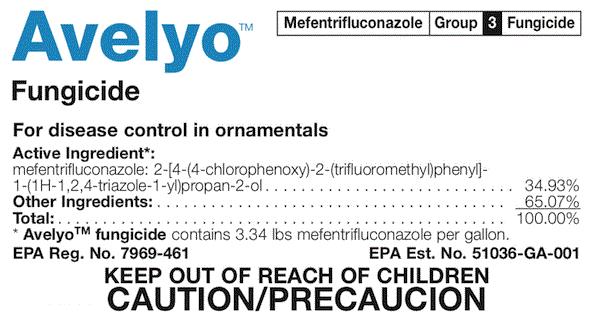
Since Avelyo is still a brand-spanking-new fungicide, the crop safety dataset is relatively limited. IR-4 completed 24 crop safety evaluations on 15 plant species, including coreopsis, camellia, euonymus, juniper, phlox and verbena. Application rates tested were 3, 6 and 12 fl. oz. per 100 gallons for foliar spray, and 7.2, 14.4 and 28.8 fl. oz. per 100 gallons for drench. The current label rates of Avelyo ranged from 3 to 10 fl. oz. per 100 gallons for foliar sprays and 2 to 3 fl. oz. per 100 gallons for drench, depending on the disease.
Avelyo didn’t cause any significant crop injury in these crop safety evaluations. Avelyo’s label also didn’t include any plant species that are reported as sensitive. Although both BASF and IR-4 found Avelyo to be safe to many ornamental plant species, I would suggest doing your own phytotoxicity test before you apply Avelyo (or any new pesticide for that matter) to all crops.
Click HERE for a copy of the Avelyo crop safety summary from the IR-4 Project.

A new resource on biological control
I’ll circle back to biological control for the last piece of news this week ...
Alice Formiga of Oregon State University shared with me a new resource for organic farmers and producers. This is a new bulletin providing an overview of biological control in organic production and it was recently published by Janet Wallace and her colleagues at Dalhousie University in Halifax, Nova Scotia, Canada.
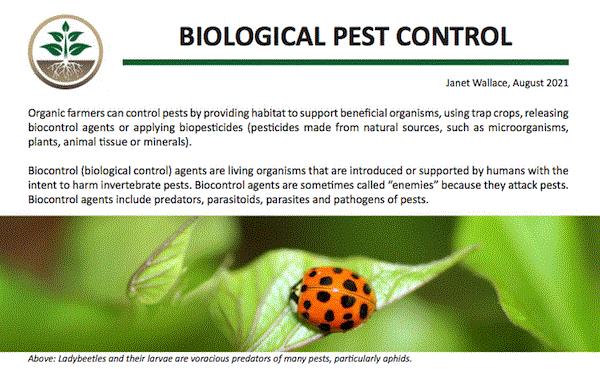
The bulletin focuses on releasing biological control agents, providing habitats for natural enemies and using biopesticides. What I find particularly useful is a long list of natural enemies and beneficial insects, and what plant species may attract them. I think this bulletin would be a good starting point for folks who are interested in learning more about biological control.
Alice is the Director of the eOrganic program. eOrganic is a wonderful clearinghouse of information, training and education on organic production. Lots of webinars and articles on organic production that could keep me busy for days. If you produce organically and don’t know about eOrganic (gasp!), you should definitely check it out by clicking HERE.


See y'all later!
JC Chong
Professor of Entomology at Clemson University
This e-mail received by 26,766 subscribers like you!
If you're interested in advertising on PestTalks contact Kim Brown ASAP!