What the ... ?
Hope everyone had a wonderful 4th of July holiday.
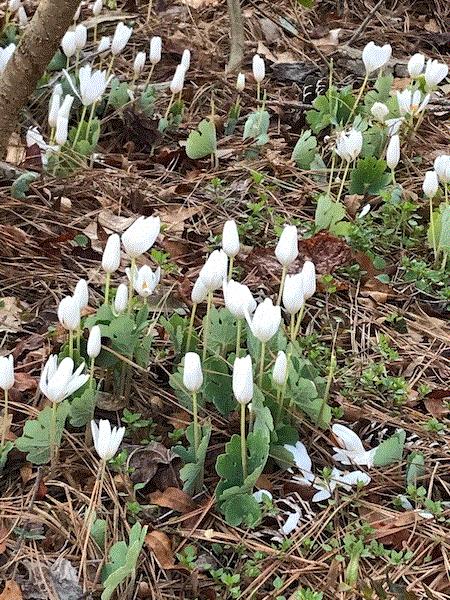
I’d told y’all that I live in a house built by my wife’s granduncle, who, along with his wife, was an avid gardener. I often find unusual plants popping out of the ground, like these bloodroots this spring.
So, now onto our "What the...?"
S. Stewart moved into her 20-year-old house eight years ago. Her garden is full of unusual plants planted by the previous homeowner, who has a degree in horticulture. Look what she dragged out of her garden a couple of weeks ago! S. has been working in her garden during the lockdown and spotted a weird growth in one of the beds in front of her house. Now, talk about weird! It looks like a grotesque mushroom-like plate or bulb, with long, curly, springy and bulb-y tentacles. She didn't want to touch it since she didn't know what it was.
After a couple of garden groups to which S. belongs couldn't identify the weird thing, she sent the pictures to Paul Thompson, a horticulture agent in York County, South Carolina, for identification. Paul shared the picture in one of our weekly Horticulture Team meetings and stumped quite a few of us for a while. Eventually it was identified, first by an entomologist no less. (Good one, Vicky!) I thought it was an interesting mystery and want to share it with you. S. has since found several more in her garden.
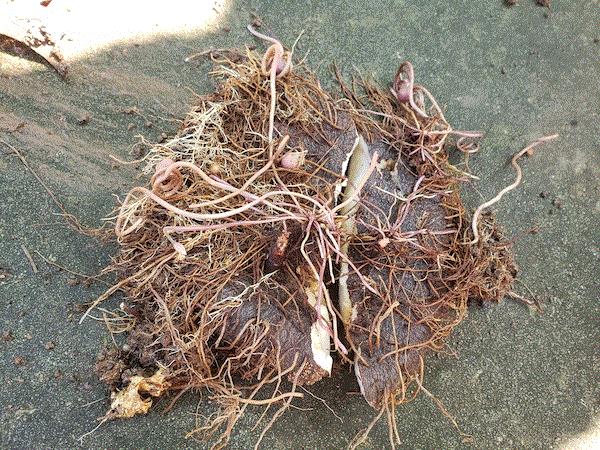
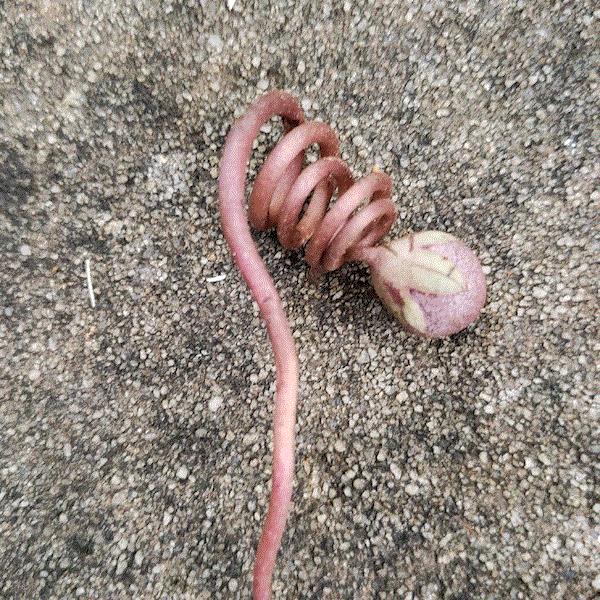
If you know what the weird growth is, send me an email by clicking here. Those who provide the correct identification will be acknowledged in the next issue of this newsletter.

Borers, beetles and grubs efficacy summary
IR-4 Project published its borers, beetles and white grubs efficacy summary in mid-June. Since the summary covers 14 species and it’s difficult to summarize the data species by species, I’m going to discuss the results by feeding guilds (beetle borers, clearwing moths, leaf beetles or grubs).
The efficacy of 53 active ingredients was tested against adult and larval stages of beetles in 2005 to 2019, and 10 active ingredients were tested against clearwing borers in 2008 and 2009. Some species were evaluated in one or two trials, so I’m not going to summarize the efficacy against these species because I don't think the data from one trial is sufficient to draw any conclusions. If you want more detailed information, get a copy of the summary by clicking here.
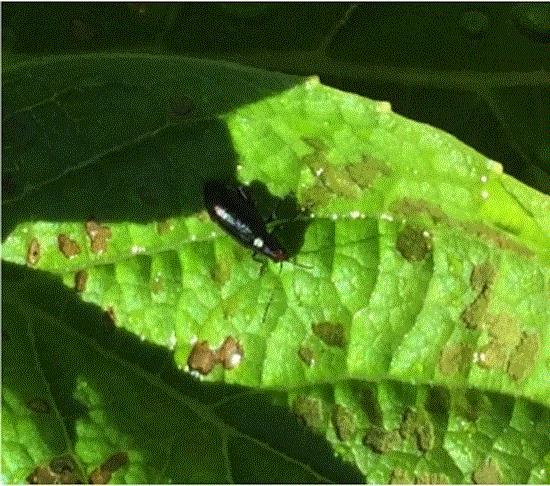
Let’s start with the leaf-feeding beetles. Acelepryn (chlorantraniliprole), Aloft (clothianidin + bifenthrin), Onyx (bifenthrin), Sarisa (cyclaniliprole), Sevin (carbaryl), Talstar (bifenthrin) and TriStar (acetamiprid) applied as foliar spray achieved good to excellent reduction in feeding damage by adult Japanese beetles in multiple trials. Foliar applications of Acelepryn, Conserve (spinosad), Flagship (thiamethoxam), Hachi-Hachi (tolfenpyrad), Merit (imidacloprid), Permethrin (permethrin), Safari (dinotefuran) and TriStar also reduced foliar damage by viburnum beetle, with Safari being the most consistently effective. Most of the insecticides tested, such as Flagship, Hachi-Hachi, Onyx, Safari and TriStar, reduced damage by the redheaded flea beetle to some extent and within a short time after the treatment, with Aloft, Sarisa and TriStar being the most consistent. Other foliage feeding beetle species covered in this summary include adult black vine weevil, European elm flea weevil and Sri Lankan weevil.
For beetle grubs that feed on roots in the medium or soil, products were tested as a drench or medium incorporation. Preventive treatment performed consistently better than curative treatment. Efficacy was also higher when the insecticides were applied against younger grubs. Medium incorporation or drench of Acelepryn, Safari and Talstar provided excellent control of black vine weevil grubs. Acelepryn, Flagship and Safari were effective against newly hatched or second instar oriental beetle grubs, but were ineffective against older grubs. Orthene (acephate) and Talstar were effective against strawberry rootworm larvae. Other grub species covered in this summary were Japanese beetle and May/June beetle.
In multiple trials against granulate ambrosia beetle and black stem borer, only trunk sprays of pyrethroids (bifenthrin, cyfluthrin, esfenvalerate and permethrin) and chlorpyrifos achieved consistently reduction in attacks. There are only two trials against the flatheaded borer (bronze birch borer and flatheaded appletree borer), and two trials against clearwing moth borers (banded ash borer and peachtree borer). Drench and trunk sprays of neonicotinoids (Flagship, Merit and Safari) and diamides (Acelepryn and Mainspring), and trunk sprays with pyrethroids, appeared to reduce attacks by flatheaded and clearwing borers.

Gallery and Pradia crop safety summaries
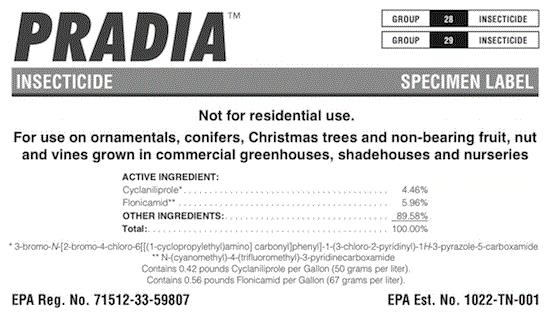
IR-4 Project also published two crop safety summaries last week. One for the herbicide Gallery (isoxaben) and the other for the new insecticide Pradia (cyclaniliprole + flonicamid).
Gallery (WSSA Group 21) is a pre-emergent broadleaf weed control herbicide registered for use in turf, landscape and nursery. IR-4 evaluated the crop safety of Gallery on 98 plant genera or species. In addition to a large number of grass and ornamental plant species already on the label, Gallery 75DF also caused no or minimal injury to southern wood fern, sea lavender and little bluestem, and Gallery SC caused no or minimal injury to soft rush, blue lyme grass, Indiangrass, prairie dropseed, and feather grass. Gallery 75DF caused significant injury at label rate to astilbe, lady fern, buddleia, garden mum, foxglove, purple coneflower, lamb’s ears and thyme. Click here for a copy of the Gallery crop safety summary.

Pradia (IRAC Group 28 + 29) is a new insecticide introduced by OHP this year. This is a combination insecticide with activity against sucking insects, thrips, caterpillars, beetles and other pests in greenhouses and nurseries. IR-4 completed 16 trials in 2019 to evaluate the crop safety of Pradia on nine ornamental plant genera or species. All test plant genera or species didn’t exhibit significant injury even at four times the label rate. However, additional trials may need to be conducted to firmly establish the crop safety of this new insecticide. Click here to get a copy of the Pradia crop safety summary.

Bayer settles glyphosate and dicamba claims
Last week, Bayer reached a massive settlement over glyphosate (Roundup) and dicamba claims. A little background: Bayer has been fighting more than a hundred thousand claims over Roundup’s role in causing non-Hodgkin’s lymphoma. The claims stemmed from a 2015 conclusion by the World Health Organization (WHO) that glyphosate is a probable carcinogen. The United States Environmental Protection Agency (EPA) and other pesticide regulatory agencies in the world have published reviews that counter the WHO’s conclusion. (I wrote about a Canadian review last year; click here to read).
So, the settlement amounts to … wait for it … $10.9 billion. How will the many dollars be divvied up? Up to $9.6 billion will be paid out to settle 95% of the current claims. Another $1.25 billion will be reserved for future claims and to support research into the role of glyphosate in causing cancer.
It’s a reversal from Bayer’s earlier announcement to defend glyphosate litigations. (Read my piece on the earlier decision by clicking here.) I’m not surprised, though, because it’s super-expensive to defend against litigation. It’s cheaper just to pay up and settle all current and future claims once and for all. As Bayer’s Chief Executive, Werner Baumann, said, “The Roundup settlement is the right action at the right time for Bayer to bring a long period of uncertainty to an end.” Furthermore, the settlement doesn’t obligate Bayer to admit liability or wrongdoing. Bayer intends to continue to sell Roundup and associated technologies.
Everyone focuses on the astronomical figure of $10.9 billion. (I can see that the wheels are turning in your head. Yes, $10.9 billion can buy lots of stuff and solve lots of immediate problems.) Like a magic trick, many seem not to notice another part of the settlement concerning another popular herbicide, dicamba.
So, what’s up with dicamba? If y’all haven't heard of it, that’s because this drama involves only row crop farmers.
The popularity of dicamba soared after Monsanto developed dicamba-resistant soybean and cotton varieties. Just like Roundup-Ready crops, farmers can now use dicamba on the dicamba-resistant crops to control other weeds. The major goal of the switch from glyphosate to dicamba is to reduce the use of glyphosate, to which many weed species have developed resistance.
The problem occurs when dicamba spray drifts onto other crops (sometimes a mile away downwind) that aren’t designed to resist the herbicide. Crop damage and yield loss had caused hardship for some farmers, particularly in the Midwest.
On June 3, the Ninth United States Circuit Court of Appeals in San Francisco, California, overturned EPA’s approval of dicamba, citing the EPA’s failure to consider the risks and social costs of dicamba. This decision essentially made dicamba no longer a legally approved herbicide. EPA later clarified that farmers can use dicamba they already purchased until July 31, unless this court decision is overturned.
Part of Bayer’s massive settlement is to provide a $400 million settlement for dicamba drift crop injury claims. A portion of this settlement, about $300 million, will be paid out to non-dicamba resistant soybean farmers who suffered yield losses from 2015 to 2020. Another $100 million will settle claims on other non-soybean crops and associated litigation costs. Farmers who didn't participate in the original litigation can also submit claims if they can provide evidence of damage or yield loss.
The glyphosate and dicamba settlement costs Bayer a huge chunk of cash, and pummeled Bayer’s share price. Bayer inherited much of this legal drama when the chemical giant took over Monsanto at a cost of $46 billion. I wonder what the head honchos at Bayer are feeling about that decision now.


See y'all next time!

JC Chong
Professor of Entomology at Clemson University
This e-mail received by 23,162 subscribers like you!
If you're interested in advertising on PestTalks contact Kim Brown ASAP!