How Was Memorial Day?
A virtual carbon copy (kids, ask an old person to explain what that means) of the previous weekend, May 19-20, with the U.S. again scoring a decent 7.4 and Canada ripping the roof off with 9.3, just a tenth of a point behind their previous weekend score of 9.4 and two-tenths below their all-time high.
Here’s the map:
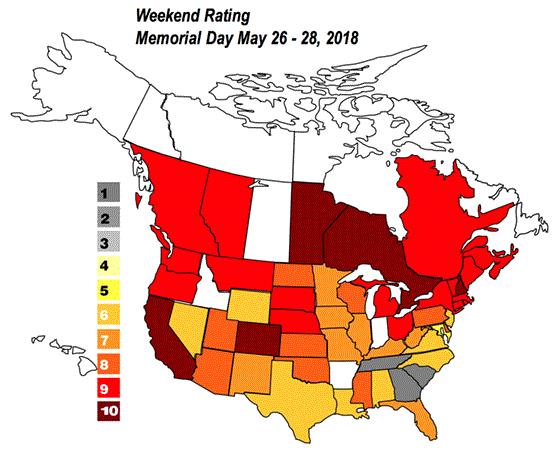
That’s based on 119 scores from 45 states and six provinces.
From 3 to 10 and everything in between
That 7.4 is a reflection of a tremendously broad range of scores, from 10 down to 3. Some of you had killer weekends and some of you had miserable weekends. Twenty-one of you (18%) sent in perfect 10s, whereas 24 of you (20%) sent in scores of 3, 4, 5 or 6.
Curious, I checked to see how many states sent in scores of 9 or 10, indicating great sales. The result: 23 out of 50, or 46%. In other words, half the country was great and half was so-so.
But even that analysis we have to take with a grain of salt, as some states had both high and low scores, reflecting either variable regional weather (Texas and Pennsylvania, for instance, are both prone to being nice at one end and lousy at the other), or else the differences between individual businesses.
For instance, North Carolina sent a 3 and a 9. Florida sent a 5 and a 9. Illinois was 4, 7, 8, 9 and 9. Wyoming sent a 4 and an 8. Alabama was the most variable, with a 3, a 6 and a 9.9 (some folks refuse to send a perfect 10, reasoning that it can always be better).
Many states were uniform in their goodness or badness. New Hampshire was 9, 9.5, 9.5 and 10. Colorado was 9s, 9.5s and 10s. Oregon was all 9s and 10s, with one 7. New Jersey was 6, 6 and 6. Virginia was 5 and 6. Minnesota was 6 and 7.

Heat was the main culprit
Up until now, it has been cold and rain that has dampened sales. Last weekend, we had too much rain across the East and too much unseasonable heat everywhere else. It was 95F in my Chicagoland garden, and folks across the Ohio Valley, Midwest and Upper Midwest all the way into Canada all roasted in the heat. Some reported that customers “shrugged it off” and kept buying, while others said the heat definitely affected traffic.
Thankfully, the forecast shows that it was a temporary heat wave, and conditions should be back to normal for June 2-3 (meaning warm to hot in the south and temperate everywhere else).
Meanwhile, up in Canada ...
What better than a few quotes to illustrate just how good it was up in Canada last weekend?
“Yesss!”
“10/10 and still going strong!”
“May has more than made up for a nonexistent April, and sales have surpassed last year’s. What a spring! Fast and furious, short and sweet.”
“I have never seen so many empty greenhouses so early, including our own. The demand is great and supply weak. Should be an interesting summer, and I bet pansy season will be early this year.”
“Typically, the week leading to our Victoria Day and the two weeks after, which include your Memorial Day, are our three busiest of the year, and so far they have not disappointed.”
“Another best weekend!! The weather was perfect. Let’s hope this continues.”
“Still going strong. Our annual greenhouses are showing grey metal. One of our fastest-moving springs in our 59 years of business.”
Color Spot files Chapter 11
I sent out a “breaking news” email Wednesday about this, but in case you missed it, here’s a recap of the big news of the week … really, of the year (at least so far):
On Tuesday, May 29, Color Spot Holdings filed for Chapter 11 bankruptcy protection in U.S. court in Delaware. Color Spot Holdings includes the four Color Spot divisions: Color Spot West, Hines Growers, Inc., Color Spot Southwest (Lone Star Growers, Inc.) and a merchandising division that provides in-store service to Color Spot’s customers (which include The Home Depot, Lowe’s, Walmart, Kmart, Rite Aid, Orchard Supply and Kroger).
Filings indicate that Color Spot has approximately $117.5 million in bank debt, plus about $20.7 million in unsecured trade debt. Top unsecured creditors include Express Seed, Ball Horticultural Company, Nursery Supplies, Inc., Summit Plastics, The HC Companies, Inc. and Container Centralen. The first four are owed more than $1 million each.
In the filing, Color Spot reports having less than $50,000 in assets, and $100 million to $500 million in liabilities, on sales of about $268 million in 2016 and $248 million in 2017.
Raymond James & Associates was hired in February to attempt to sell the company, with some 37 parties executing non-disclosure agreements and three expressing interest in purchasing all or part of the company. Color Spot is hoping to sell the business to pay off most of its debt, and has asked the court to set July 16 as a bid deadline.

Events leading to Chapter 11
Paul W. Russo, a former VP of tool manufacturer The Stanley Works, was appointed CEO of Color Spot in March 2017 after serving as COO in 2014 and on the Board of Directors for seven years. He stated in the court filing that Color Spot had suffered from declining market share and revenues since 2014. He blamed the six-year drought and accompanying water restrictions in California and adverse weather events in Texas.
Most telling, however, is the statement, “[Color Spot’s] focus on customer service waned as [the company] grew in size, which translated into losses of certain markets with key customers.”
According to the filing, after his appointment as CEO, Mr. Russo began implementing a restructuring plan, which included:
- Negotiating an amendment and restatement of the existing revolving credit facility with Wells Fargo
- Soliciting customer support by meeting with the leadership of key customers to identify and address problem areas
- Right-sizing production capacity to match revenues, including closing four of 13 nurseries in the first nine months of his tenure
- Simplifying the product mix to improve production efficiency and increasing inventory investment in best sellers, eliminating production of 40% of the genera grown, which were contributing less than 10% of sales
- Eliminating layers of management to improve responsiveness, which, along with facility closures, generated a 30% reduction in employee headcount in nine months
Apparently, those efforts weren’t enough to prevent the bankruptcy filing.
Founded in 1983 by Michael Vukelich and Jerry Halamuda, Color Spot grew organically and through acquisition to six nurseries in California, two in Texas and one in Oregon, comprising 11 million sq. ft. of greenhouse, 6 million sq. ft. of shadehouse and 83 million sq. ft. of outdoor production, with 1,600 full-time employees. Michael passed away in 2011; Jerry retired as CEO and President in 2017. He could not be immediately reached for comment.

Your thoughts on the bankruptcy
I won’t go into my thoughts here; you can read them in the original email HERE. But many of you sent your own thoughts, 100% of which are in accord with my own … which doesn’t prove that I’m smart, only proves that I’m good at stating the obvious. If you’ve got views, feel free to click the email link in the original piece to share.
Here are a few sample comments from readers:
“In my opinion, it goes to show that this is a very, very hands-on industry—you NEED to have your finger on the pulse of everything, from employee happiness to customer wow factor and the thousands of things in between. Our industry does not do well when owned by investor groups or teacher’s pension plan funds.”
“Chris—GREAT assessment of the Color Spot situation. Your two paragraphs – calling out customer service and simplifying the product line are 'spot on' and apply to more than just nurseries and greenhouses.”
“Chris—pretty much on the money with your comments. One additional point: I met with a horticulture banker two years ago and his comment on our industry is even profitable nurseries don’t have much left for internal investment. In short, there is a sigh of relief if a nursery made money, but not much left for evolution or innovation. Large growers have large customers. And those large customers, as we have said for years, do not reward innovation with pricing advantages. Thus, the cycle continues. One positive: There are large chain stores that will pay premium for specialty products (at least in some of their regions in the U.S.).”
“I am, of course, saddened to hear that Color Spot has filed for bankruptcy again. I was with the organization from 1988 to 1998 and it was during this time that Color Spot went on a buying spree in the early 1990s. If my memory serves me, it was like 13 nurseries in 18 months. I can’t speak for how Color Spot has operated since I left … but I believe the statement about losing sight of their customers may very well have been accurate. When a nursery gets too big to care, when they don’t listen to their customers and then back it up with best-in-service, it may take time, but at some point they are bound to fail. As a young man in the industry and moving into a management role I looked to Mike Vukelich and Jerry Halamuda for guidance and mentoring. I learned from them the art of customer service and negotiations. I learned my numbers and these are the lessons I try teach to my staff today. What mattered then still maters to me today: Great quality, great selection and the best customer service. What a ride it was when I was with the organization. I will be sad to see it go.”

Finally … weekdays vs. weekends
A couple weeks ago, I asked if you’d noticed any changes to your retail sales traffic away from weekends and toward weekdays. Barbara Pondelick has; she reports the following from northern Illinois:
I have to agree that nice weekday sales can outnumber a cold or wet weekend’s sales. I’ve had several weekdays in which the sales were the same or greater than a weekend day.
As far as which weekday is the slowest, [that] again depends on the weather. So far in May, I’ve had a Friday, a Wednesday and two Mondays. I’ve also had a Monday, a Wednesday, two Thursdays and a Friday blow away a cold and rainy Sunday.
But I have to agree that the weekdays are seeing more traffic and sales, and I’ve had to hire an extra person to help.
I also would like to add that for the last several years, my busiest time of the weekday is between 11 and 3.
See you next time!

Chris Beytes
Editor
GrowerTalks and Green Profit
This e-mail received by 23,046 loyal readers!
Thanks to my loyal sponsors, who help me reach the 23,046 readers of Acres Online in 66 countries. Want to be one of them (a sponsor, that is)? Give Paul Black a shout and he'll hook you up.