End-of-August Farm Update
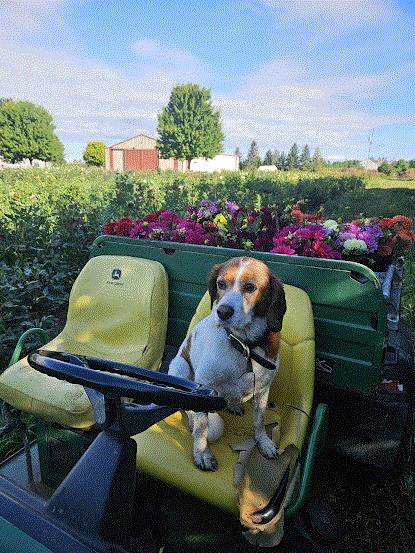
The gator is one of her favorite spots during dahlia harvests. We have an acre in production this year!
Did you remember to start your cool flowers for next spring? It’s on our to do-list this week. It’s odd thinking about poppies, pansies and campanula when we have an acre of dahlias flowering and sunflowers in the field. But I look forward to the change in crop plan!
We experimented with Christmas flowers last season and are growing even more this season. Thankfully, I remembered to set aside anemone and ranunculus corms from last fall’s shipment to make sure we can start them on time to hit the winter holidays. It’s fun seeing the anemone and ranunculus again.
Speaking of anemone and ranunculus, we are champing at the bit to receive our 2025 corms ... although the final cost of the corm with tariffs might sour my mood a little bit. We placed this order last March and a lot has changed since then. Some of those changes took place within thirty days of our ship date, and per the supplier we can no longer adjust the order. I’ll spare you my feelings on that but spoiler alert—they aren’t positive ones! Tater and I hope we can pass the cost to our customers. It’s not ideal, but there isn’t a choice.
Lately, it’s a balance between steaming soil for planting and harvesting dahlias and sunflowers. Steaming this time of year is tricky because Tater and I have to do it at night to prevent damage to the plants that are already in the greenhouse. One day we will have enough greenhouses that we can have one house fully steamed and won’t have to worry about this. All in due time, I suppose.
I look forward to seeing our winter and spring season flowers again. If you are growing Christmas flowers, Tater and I would love to hear some tips and tricks. DROP US A LINE.
In this edition of Bloom Beat we are talking about InFlora cut flower trials at Raker, new Sustainabloom survey results and more. With all that being said, let’s talk shop!

InFlora Cut Flower Trials at Raker-Roberta's
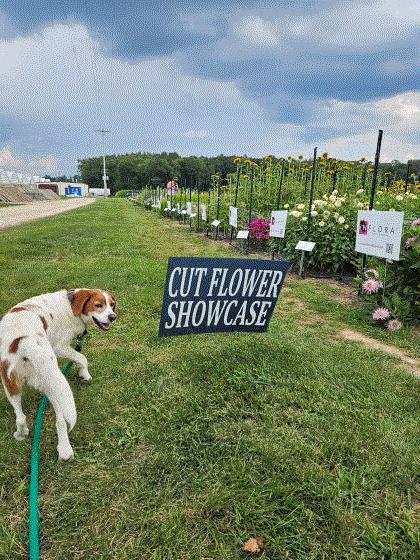
Tater enjoyed her private tour. She may or may not have scored some cookies from her friends at InFlora.
Tater and I are lucky that our farm is so close to Raker-Roberta’s Young Plants in Litchfield, Michigan. We were able to sneak away for the afternoon for a private tour of the trial. Below are Tater’s favorite finds! The trial had a diverse assortment of field-grown cuts, ranging from your standard sunflowers, zinnias and celosias to some real oddities (more on this later).
Dahlia Deco Orange Swirl
I am particularly excited about the new Dahlia Dezign series from InFlora. Tater and I trialed these last season and were excited to see new potential introductions at the Raker trial this season. Some are too new to talk about. But I was excited that Deco Orange Swirl that we trialed last year made an appearance at the Raker trial. All the dahlias in the Dezign series were selected for vase life. Dahlias in this series have a vase life of ten days or more, which is very impressive for a dahlia! ‘Orange Deco Swirl’ can be as wide as 5 in. across, so she’s bodacious and the plants are chock full of blooms. Her sister Pink Swirl is equally impressive.
Cephalophora aromatica Pineapples
Cephalophora Pineapples gets the award for most novel and unique entry in the trial. As the name implies, it smells just like pineapple! The spray of sweet-smelling, yellow ball-shaped flowers speak to me. Then again, I am biased—I love a good scratch-and-sniff plant. The only drawback is that this plant looks tedious to harvest. However, for folks looking for a special aromatic touch to their bouquets, this would fit the bill. Tater and I are likely going to sow a few trays of this next season—even if it’s just for some aromatherapy.
Rudbeckia Maya
Photo: Benary
Tater and I have new Rudbeckia affliction this season. There were a handful of varieties in the trial this year but I enjoyed Maya by Benary the most. Im a sucker for anything that is frilly with high petal fill. I especially enjoyed the 3 in. blooms that are very user friendly for bouquets. Plants were very floriferous and uniform. Plus, it's an upgrade from the standard gold petal rudbeckia on the market.
Zinnia Ballerina
Photo: Johnny's Selected Seeds
Finally a true pastel pink zinnia! I recommend this variety 10/10! Tater and I grew Ballerina by Johnny's Selected Seeds at our farm this year, and it was also in the Raker trial. Our designers clamor for this beauty every week. I wish I grew more of them. It’s also a relief that Johnny’s tests their seed stock for Xanthomonas. This can be challenge when you buy zinnia seeds from backyard breeders because more than likely they aren’t screening for this.
For more info, check out this
ARTICLE by
Grower Talks.

Tater explores the lisianthus
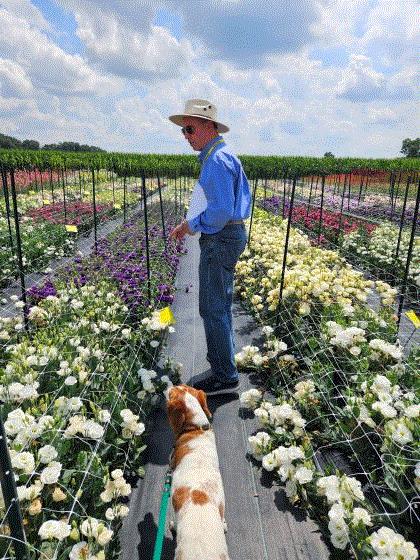
Tater and I enjoyed walking the lisianthus portion of the trial with Bob Croft from Sakata.
Tater and I enjoyed seeing the lisianthus trial the most! There were more than sixty varieties in the trial, and Sakata’s tech specialist Bob Croft took Tater and I around to see all the beauty. I’ve never grown lisianthus outdoors, we always put them in a tunnel. But there were some exceptional varieties that were over 3 ft. tall—without shadecloth! Below are the strongest performing varieties, with the highest bloom count and stem length. These beauties did incredibly well in the outdoor trial:
Rosita 3 Green
Sakata's Rosita 3 Green gets the award for longest stems and best all-around presentation. If you are looking to experiment with outdoor lisianthus production, add this beauty to your list.
ABC Blue
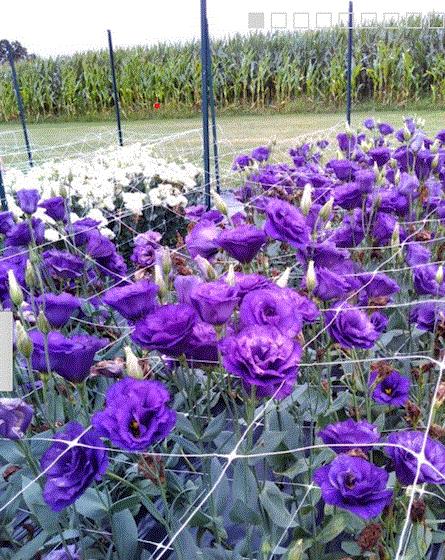
All the colors within PanAmerican Seed's ABC series were strong performers in the trial. In my opinion, ABC 2 Blue was the longest-stem purple variety in the trial. It’s not the flashiest variety but it’s a workhorse. There were minimal blemishes on the petals, which is surprising for such a dark color.
Corelli 3 Light Pink
Corelli 3 Light Pink from Johnny's Selected Seeds was the strongest pink variety in the trial. I always grow this one indoors but she touted stems over 24 in. long and had high bloom count. Was also true to color, with few blemishes to the petals compared to other light pinks in the trial.
Voyage 3 Champagne
Voyage lisianthus from Sakata will always have my heart. I'm a sucker for frilly pastel blooms. Voyage 3 Champagne was my favorite variety in the trial. Stems were just shy of 24 in. long but the soft apricot color and compact sprays make this one a winner in my book. It’s a touch shorter than some of the other varieties in the trial but still passable as a field-grown lisianthus. The color is unmatched and it’s one of favorite varieties on our farm this year.
I appreciate InFlora investing in a cut flower field trial here in Michigan. Cuts grow differently in the Midwest than they do on the west and east coasts. Tater and I were able to see first-hand how some of these new and exciting blooms behave in our climate before committing to these new varieties next spring. Plus, it’s always a treat to hang out with the Raker-Roberta clan and the folks at InFlora. Shout out to Sabrina Vanderwal and Scott Rusch for the private tour of trial—and for Tater’s cookies! We look forward to doing it all again next year.

DWF Merges with Bill Doran Company
Earlier this month, Bill Doran Company (BDC) purchased Denver Wholesale Florist (DWF). DWF is one of the oldest wholesale florists, started in 1909 as a coalition of Colorado flower growers to distribute their flowers more efficiently. In the early days, DWF primarily sold Colorado-grown carnations. By 1945 they were selling 6 million stems of carnations per year and by 1970 that number had reached more than 100 million stems. Over time, however, domestic carnation production started to fade and in 1980 DWF shifted to selling internationally sourced flowers. As of 2021, DWF had 14 locations across the United States.
Bill LaFever, president of Bill Doran Company, stated, “Through early conversations, it became clear that our two organizations share closely aligned philosophies and company cultures focused on integrity, employee empowerment and strong customer relationships. Combining our geographic reach, technology expertise, strong vendor relationships and private label marketing programs, we are better positioned to deliver exceptional value across the floral community.”
DWF President David Legge is optimistic about the merger. He calls BDC a trusted organization in our industry. “This is an exciting time for our employees and customers as join in a team that has set the standard of excellence and brings the resources and opportunities for a bright future ahead.”
I have fond memories of our Toledo DWF location. It was the first wholesale account we sold grower-bunch sunflowers to. Tater and I learned a lot about floral distribution just by walking into their display cooler and seeing flowers from all over the world in one place. Our customers are curious and a little uncertain about how the merger will help their sourcing challenges. Only time will tell.
Acquisitions and consolidations like this one are becoming more common. As local flower farmers, it’s important to be aware of the ever-changing floral landscape. Not that we compete directly with companies like BDC, but a little knowledge goes a long way. Since Tater and I are wholesale-only flower farmers, it’s critical to be aware of what other floral sourcing options our customers have.
Society of American Florist past-president Oscar Fernandez commented, “None of us should be surprised. Consolidation in the flower industry has been happening for years, and this is probably one of the bigger ones any of us have experienced. The flower industry looks a lot different today than it did yesterday.”
For more information, you can read the full press release
HERE.

2024 Floriculture Sustainability Survey Results
American Floral Endowment's Sustainabloom partnered with North Carolina State University to survey business owners from all floral industry sectors.
Dr. Melinda Knuth is the lead on this project. Dr. Knuth and her marketing lab distributed an online survey to members of the American Floral Endowment, Society of American Florists, Association of Specialty Cut Flower Growers and attendees of Cultivate'24.
The goal of the survey was to gain understanding of what sustainability practices the industry is implementing, what sustainability practices folks looking to implement in the future, and what the challenges are to implementing more? And more importantly, is the industry communicating its sustainability practices to customers?
More than 100 floral businesses from across the industry responded, including growers, retailers, wholesalers and floral suppliers. Below are the key takeaways from growers that participated in the survey:
- 18% of growers have a sustainability plan for their farm, but 71% of growers with a sustainability plan were less than an acre in size.
- 24% of grower respondents are looking for alternatives to peat substrate.
- 34% of grower respondents state that the primary barrier to implement sustainability practices the cost of implementation.
- 58% of grower respondents recycle on their farm.
- Growers in the Midwest and West are more likely to implement alternative packaging for their floral products.
- On-farm water conservation sustainability practices are more likely to be practiced in the Midwest and West compared to other areas surveyed.
- Small and large farms implemented sustainability practices the same way. The size of farm did not play a role.
According to NCSU doctoral student Amanda Solliday, “Our study is another line of evidence that many floriculture businesses are practicing sustainability, and many more are ready to make changes that benefit the environment and their bottom line—they just need the right tools and support.”
You can read the full report
HERE.
Shout out to my dear friend Dr. Knuth and her team for tackling these important projects. Tater and I appreciate all your effort to propel the industry forward and educate folks on environmental responsibility. Research like this will empower our businesses to make informed choices on what steps we can take to make our farms more sustainable.
The best part is, our customers actually care about this stuff! According to a recent study from the
Floral Marketing Fund, 60% of consumers are more likely to buy from environmentally friendly floral providers, and many are willing to pay more for sustainably grown and packaged blooms. Seventy nine percent of the florist surveyed in the 2024 Sustainability survey stated that sustainability practices are “very important” to their businesses.
Bottom line, according to Dr. Knuth is, “Across all floral industry sectors, we’re seeing strong interest in sustainability. And by communicating their efforts and tapping into consumer values, floral businesses can turn sustainability to competitive advantage.”
We are spending money to make eco-conscious choices; we might as well showcase our efforts and educate clients on why our products might cost more. What are your thoughts on this? Tater and I would love to hear from you. Drop us a line
HERE.

We're Cheering For You!
Lindsay Daschner (and Tater)
Editor-at-Large—Bloom Beat
Owner—Forget-Me-Not Farms
This email was received by 6,254 of your fellow fresh-cut flower growers!
If you're interested in advertising in Bloom Beat, contact Kim Brown and she will hook you up!