EAB expands its range
Happy New Year, everyone.
Can you believe it? We’ve been talking about emerald ash borer (EAB) for almost 20 years! Since its first detection in Ohio in 2002, EAB hasn't slowed down its quest to conquer the U.S. The borer was found in my home state of South Carolina in 2017, and in Maine, South Dakota and Vermont in 2018. Mississippi and Florida are now the two lone states in the South that haven't reported EAB infestation.
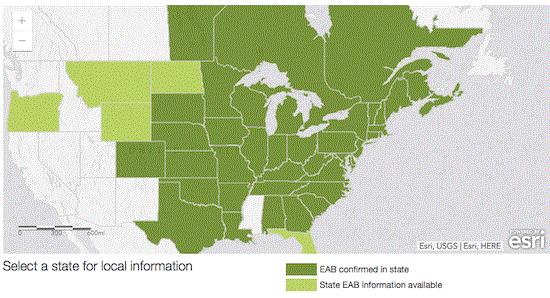
Current state-level distribution of the emerald ash borer. (Figure credit: Emerald Ash Borer Information Network)
Although no new states were put on the “infested” list in 2019, USDA-APHIS tallied 104 new county level detections. We closed 2019 by seeing new counties placed on the “infested” list or under EAB quarantine in December.
Kansans have already been dealing with EAB since 2012, with its first detection in Wyandotte County (west of Kansas City). Afterward, EAB was found in Johnson (2013), Leavenworth (2014), Douglas (2015), Jefferson (2015), Atchison (2016), Doniphan (2017) and Shawnee counties (2017), all of which are near Kansas City. Miami County (south of Kansas City) and Jackson County (north of Topeka) were reported as EAB-positive in 2019. Quarantine plans for Jackson and Miami counties are currently being drawn up.
EAB was first confirmed in Tennessee in 2010. EAB quarantines currently exist for 63 counties there, all of which are in central or eastern Tennessee. Lewis County (southwest of Nashville) is the newest addition to the quarantine list.
Visit the Emerald Ash Borer Information Network for more information. A very useful document is the third edition of Insecticide Options for Protecting Ash Trees, a bulletin developed to answer questions and offer management options to tree care specialists, arborists and homeowners.
Citrus greening in two takes
I don't know how many of you remember that I used to work in South Florida. One of the projects I worked on was a survey of Asian citrus psyllid on landscape ornamental plants. The Asian citrus psyllid is a vector of the dreaded citrus disease Huanglongbing, or citrus greening. Boy, was I glad citrus greening was not found in Florida until I was transitioning from Florida to South Carolina; otherwise my career would’ve taken a very different trajectory. The disease has devastated the Florida citrus industry. Many former citrus orchards are now “growing” houses and cattle.
Do you know who is very nervous about citrus greening? Everyone who produces citrus fruits and nursery stock, of course. Florida produces about 35% of all citrus fruits in the U.S. The rest are produced by California (60%), Texas and Arizona (a combined 5%).
No wonder folks in California weren’t happy when citrus greening was detected in the Golden State. The first detection was in 2012 on a pummelo tree (smuggled from China where the disease is rampant), which was promptly disposed of. The next infestation wasn’t found until 2015. With greater surveying efforts and better diagnostic tools, more and more diseased trees have been found since 2015. The state of California established quarantine areas, with additional area in San Bernardino County added in December 2019. Currently the quarantine area covers 1,224 sq. miles in Los Angeles, Orange, Riverside and San Bernardino counties.
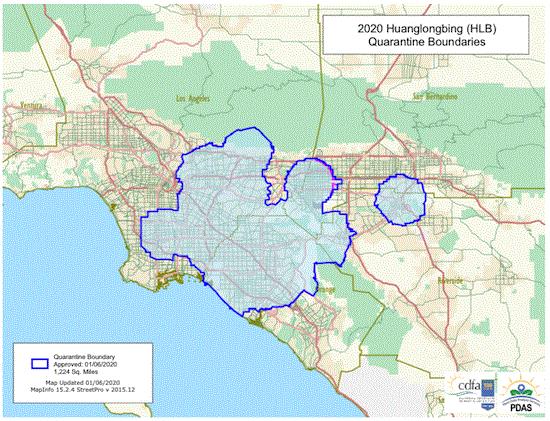
A map showing the quarantine areas for citrus greening (within the blue lines) in California. (Figure credit: California Department of Agriculture)
There is also regulatory movement regarding citrus greening at the federal level. USDA-APHIS published its citrus nursery stock protocol in 2013. This protocol was updated and published in November 2019. Okay, APHIS is a federal agency, so its official document name is in no way simply “Citrus Nursery Stock Protocol.” Check out the officially entitled “Interstate Movement of Citrus Nursery Stock from Areas Quarantined for Citrus Canker, Citrus Greening and/or Asian Citrus Psyllid” by clicking here.

Bacterial leaf spot diagnosis and management
I was visiting a Florida nursery just before Christmas, and saw quite a bit of bacterial leaf spot and blight on hibiscus. Bacterial leaf spots and blights on hibiscus are usually caused by Acidovorax, Pseudomonas or Xanthomonas bacteria. I didn't run a diagnostic test, but if I’m to guess, I’ll put my money on Pseudomonas. Don't follow my bets unless you are okay with a good chance of going bust. Sure, Xanthomonas typically loves warm weather and Pseudomonas loves cool weather, but remember—this is Florida, where “cool” is relative and people wear parkas at 70F. Host ranges of bacterial pathogens are also variable. What I’m trying to say is to do a proper diagnosis so you know what you are actually dealing with.
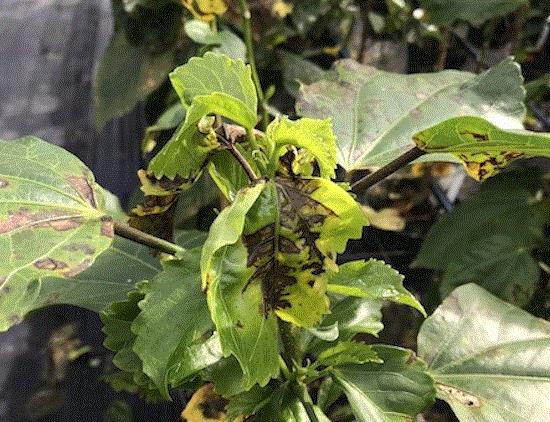
Most bacterial leaf spots resemble water-soaked, rotting, brown or black masses or patches. Often, they show up between leaf veins. But, field diagnosis can only take you so far. You still need to send the infected tissues in for proper diagnosis to know if indeed it’s a bacterial pathogen, not a fungal one. The management approach for a bacterial leaf spot is obviously different from a fungal leaf spot.
One management strategy that works great against bacterial leaf spot is also the most difficult—eliminate overhead irrigation and exposure to rainfall. This particular operation I visited had seen great improvement after switching over to drip irrigation, but still suffered significant loss of plants grown outdoors and rained on. When overhead irrigation cannot be avoided, then you should irrigate when the leaves will dry quickly. Avoid overhead irrigation for highly susceptible plants at any cost. Proper plant spacing and increasing air circulation can help shorten drying time. When a plant cannot be saved, it’s cheaper to just throw it in the dump. As plant lovers, we need to learn how to say goodbye.
Chemical and biological bactericides are available but there are only a handful of modes of action. Bacteria grow and can develop pesticide resistance very rapidly; therefore, it’s important not to overuse bactericides and rotate among different FRAC groups. Some examples of bactericides include Camelot O, Cease, CuPro, Ecoswing, Kalmor, KleenGrow, Kocide, Phyton, Regalia, Stargus, Triathlon, and ZeroTol. You may notice that almost half of these products (Camelot O, CuPro, Kalmor, Kocide and Phyton) are copper-based (FRAC Group M01). As Ann Chase declared in her recent GrowerTalks article, “All coppers are not created equal!” Know what you are using, and use them well.

Continuing education opportunities
Looking for opportunities in January to further your knowledge base in production and pest management? Here are two opportunities.
University of Massachusetts’ Center for Agriculture, Food and the Environment is hosting its 2020 Greenhouse Production Winter Education Program in Westford, Massachusetts, on January 14. Several specialists from UMass, UNH, Cornell and IPM Labs will talk about optimal light, temperature, humidity and fertilizer; botrytis, insects and mites; and using guardian plants for pest management. Pesticide re-certification credits valid for all New England states will be awarded at the end of the program. Click here for information and registration.
The Ohio State University will hold its Greenhouse Management Workshop at its OARDC campus in Wooster, Ohio, on January 16 and 17. This is a two-day workshop that tackles topics such as management of temperature, lighting, pests, diseases, nutrients, water quality and hydroponics. Attendees will tour Green Circle Growers in Oberlin, Ohio, on the second day. Continuing education credits are available for Ohio, Michigan, Indiana and Pennsylvania. Click here for information and registration.


See y'all next time!

JC Chong
Professor of Entomology at Clemson University
This e-mail received by 22,731 subscribers like you!
If you're interested in advertising on PestTalks contact Kim Brown ASAP!