Nursery Irrigation Guide
The first free resource comes from the University of Tennessee. The Nursery Irrigation: A Guide for Reducing Risk and Improving Production is (in my opinion) the best written nursery-centric irrigation publication out there. But it’s also got a lot of useful info that could cross over to the landscape contracting folks, too.
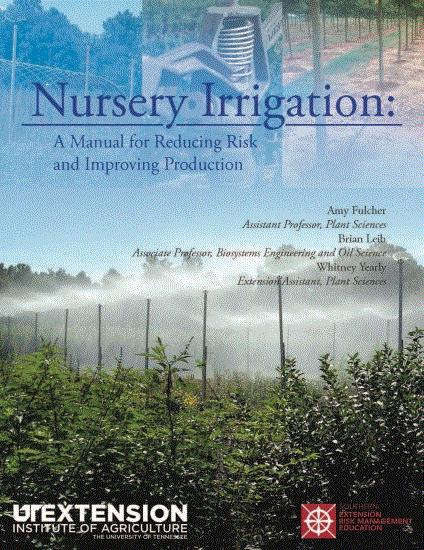
It’s a university publication that’s easy to read—what an amazing concept! It also has a logical flow to topic areas, which include determining water sources, water-testing procedures and interpretation, cultural practices to reduce water use, irrigation scheduling, irrigation system efficiency, reclaiming (recycling) water, drought preparedness, and, most importantly, helpful calculations (because not many horticulturists are mathematicians).
Journal of Environmental Horticulture
The Horticulture Research Institute, which is AmericanHort’s research arm, has for years published an academic journal called the Journal of Environmental Horticulture. Now don’t worry about that whole "academic" part because this has always been an applied journal, written so industry could understand results of trials and experiments. And if you don’t completely understand, just Google the authors and call them for further explanation!
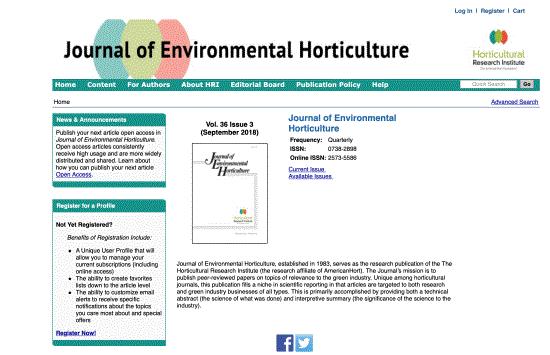
Here comes the cool part … this publication is now "open access," which means anyone can read it (until recently you had to subscribe to it and pay a fee to read it). All you need to do is head over to the website, type in a search parameter in the top-right search box and voilà—you get a list of research articles that include those keywords.
And there's A LOT of available articles, since this has been a quarterly publication for going on 37 years! And it’s applicable to landscape contractors, greenhouse producers and nursery producers alike. You’d be amazed at the amount of information at your fingertips via the Journal of Environmental Horticulture.

HortTechnology
Speaking of open-access (free-to-read) academic journals, I wanted to throw in another one that recently opened its doors to everyone. HortTechnology is a publication of the American Society for Horticultural Science. It’s definitely more technical than the Journal of Environmental Horticulture, but still written so that people with some experience can understand what’s going on. And again … if you don’t understand, just Google the authors and give them a call.
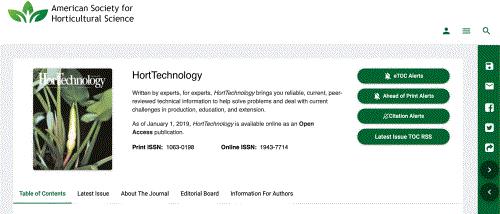
This journal is also searchable via clicking on the search icon (looks like a magnifying glass) on the top right of the page. You can search by taxa (e.g. Taxus), a procedure (e.g. dormant pruning), your favorite author (e.g. Raulston) or a chemistry (e.g. glyphosate).
Let me tell you, these open-access journals will expose a wormhole of horticultural nerdiness that's hard to escape, so proceed with caution.
The IPM Books Collection
Chalk this one up as shameless self-promotion if you wish, but I'm convinced it represents the most comprehensive collection of production strategies and landscape applications for 20 genera (10 trees and 10 shrubs) of woody ornamentals common in Zones 6 south. I do want you to know that I am but a small cog (shameless "Umbrella Academy" reference—see Netflix for details) in the wheel that has created these three grower/landscape contractor-targeted textbooks.
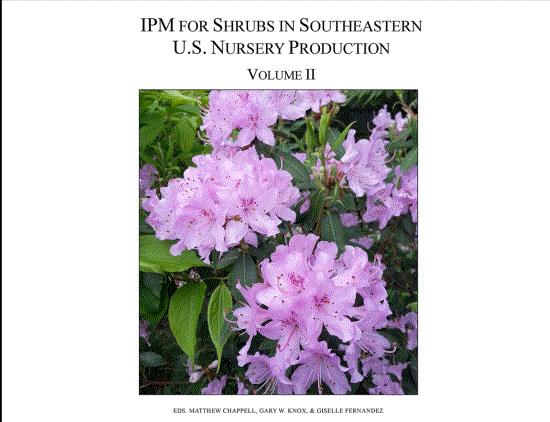
All books include genera/species-specific chapters broken into sections, including production guidelines (for species/cultivar traits), abiotic (environmental) stress factors and biotic (insects, disease, viral and nematode) stressors.
The first text is "IPM for Select Deciduous Trees in Southeastern U.S. Nursery Production" that covers Betula spp., Prunus spp., Lagerstroemia spp., Cornus spp., Ulmus parviflora, Magnolia spp., Acer spp., Quercus spp. and Cercis spp. The second text is "IPM for Shrubs in Southeastern U.S. Nursery Production: Vol I" that covers Abelia spp., Camellia spp., Rosa spp., Vaccinium spp. and Viburnum spp. The third text is "IPM for Shrubs in Southeastern U.S. Nursery Production: Vol II" that covers Hydrangea spp., Loropetalum chinense, Ilex spp., Rhododendron spp. and Rhaphiolepis spp.

BugWood Network
I still find it amazing that so few growers and landscape contractors have heard of the Bugwood Network (it’s been around nearly 20 years). In short, it's a USDA-funded project to assist landscape contractors and specialty crop growers (floriculture, nursery, fruit/vegetable and turfgrass) in identifying pests and pathogens. They have tens of thousands of images that you can access to help you figure out the problem!
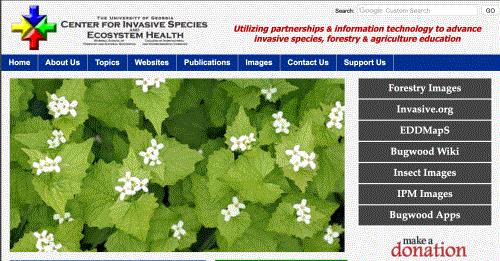
They also have search criteria that can help you identify the pest/pathogen/environmental stress causing damage. The coolest part of this site is that almost every Land Grant University contributes, so you can easily diagnose issues no matter where you're located. And if you’re in Europe or Canada, no problem—many European and Canadian universities contribute, too.
Safe Procurement and Production Manual
There's no doubt that in nursery production, a systems approach for the production of healthy nursery stock is critical to the long-term success of the business. A systems-based approach isn’t a new concept; in fact, growers have for generations been practicing this concept. So what's a systems-based approach? In short, it’s a common-sense approach to producing plants.
It brings together concepts such as grouping plants via irrigation requirements and use of IPM strategies to combat pest pressure. In fact, nurseries are now being certified by the National Plant Board in this area, so it may be a good time to read up on the subject.
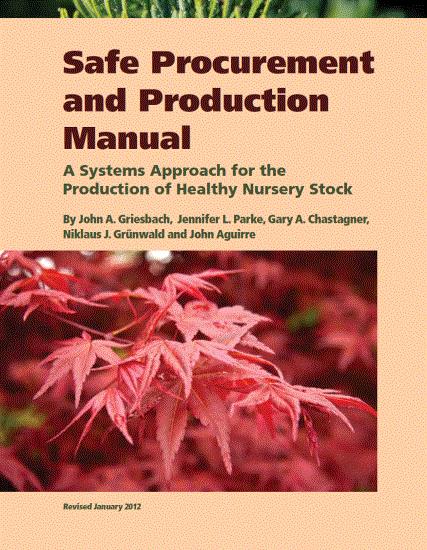
It just so happens that Oregon State University has produced an excellent guide that describes the steps necessary to achieve this certification, titled Safe Procurement and Production Manual: A Systems Approach for the Production of Healthy Nursery Stock.
Prairie Flame Shining Sumac
Did you think I could go a whole newsletter without mentioning a cool plant? No way! Which brings me to Rhus copallina var. latifolia Morton. Now you can tease me about my love of Rhus all you want, but this is one tough native species (from Quebec and Ontario south to the Gulf of Mexico). Now that's a BIG native range, from Zone 4 to 9, in fact.
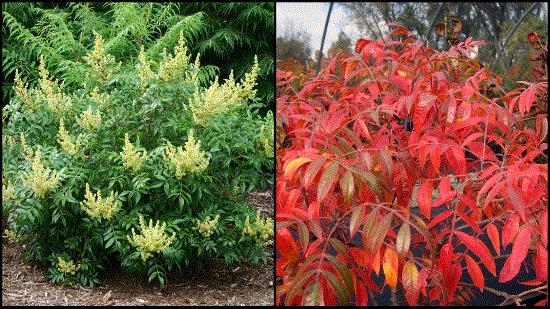
A mature flowering specimen (left) and fall color (right). Gotta love multi-season interest!
Morton was selected from a collection of seedlings grown out at … drumroll … Morton Arboretum. Not very creative, but still an excellent plant. Thankfully, it was trademarked as Prairie Flame. It’s a male cultivar that exhibits denser, compact growth (6- to 7-ft. tall), while retaining vibrant orange to red fall color. If the cultivar had one flaw, it's that it suckers as heavily as the species does. I don’t see this as a problem, as long as you realize this and site it properly. Just give it room to spread its wings.

Our Wacky Wonderful World—Notes from the Edge of Sanity
I've heard over and over again from middle-aged people that “young people today just don’t care about what’s happening to our government (fill in blank with continued rant).” I’ve never prescribed to that theory, only to the theory that no one becomes politically active until they understand that their voice matters.
Yesterday, I had the opportunity to take nine University of Georgia Students to the Georgia State Capitol, where they (along with industry leaders) shook hands of representatives. They also got to sit down with the Commissioner of Agriculture and the Governor to convey the value of horticulture to the economy and environment. I couldn’t be prouder of these kiddos. But, more importantly, they now have that energy to continue the dialog and bring others into the process.
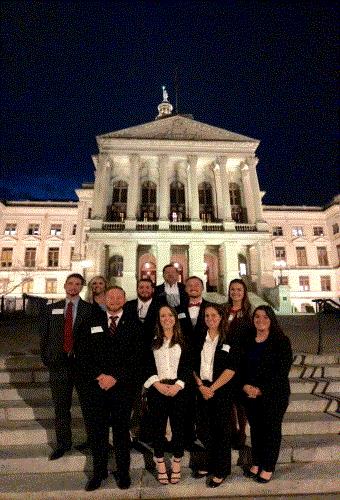
When college students get up at 4:00 a.m., it's tough to question their dedication to our industry. We need that energy moving forward to help accomplish national, state and local initiatives.
Moral of the story: you old folks need to do everything you can to get youngsters involved because they have marvelous ideas that will change the world. All they need is a little shove in order to be empowered, and then get out of the way and watch the magic happen!

Live authentic,

Matthew Chappell
Editor-at-Large
Nursery & Landscape Insider
This has been received by 30,816 of the hardest-working horticulturists in show business!
If you're interested in reaching 30,816 (and growing) clients who eagerly await every Nursery & Landscape Insider and surely read every word, contact Kim Brown ASAP and she'll hook you up. And thanks for helping us reach a community of 30,000+ fellow horticulturists! Keep spreading the word.